China’s groundbreaking reusable rocket has reportedly reached a significant development milestone, bringing its inaugural flight considerably closer.
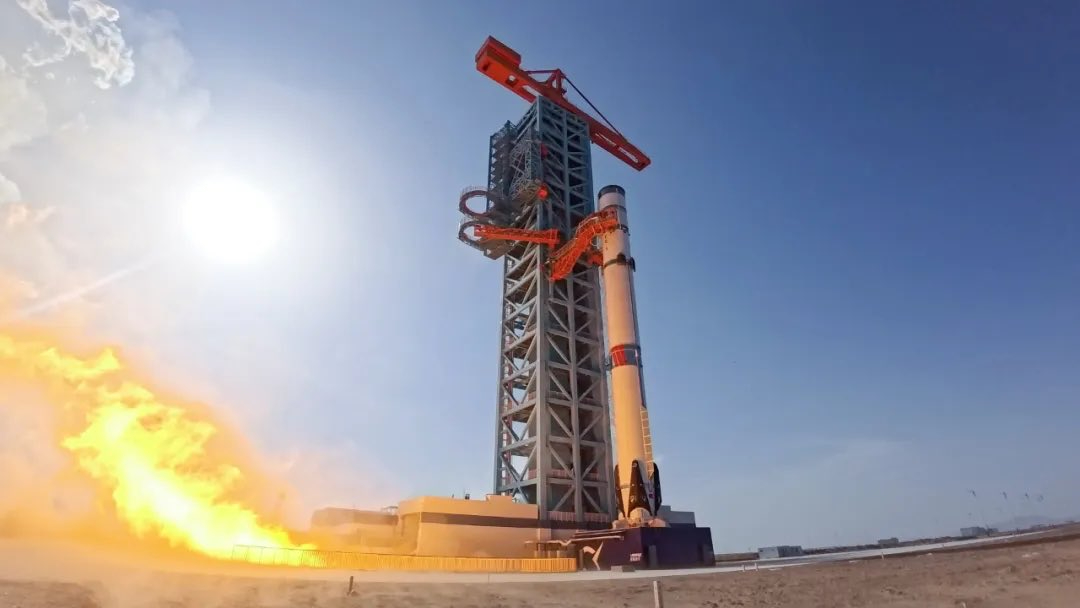
Chinese aerospace company LandSpace successfully completed a static-fire test of its stainless steel Zhuque-3 launcher on Monday, October 20. This significant ground operation confirms the rocket remains on schedule for its highly anticipated inaugural flight, expected before the end of the year.
LandSpace has announced the successful completion of a static fire test for its Zhuque-3 rocket, concluding the initial three-day phase of the vehicle’s maiden flight campaign. This standard pre-launch procedure involves igniting the rocket’s engines while it remains securely anchored to the launch pad.
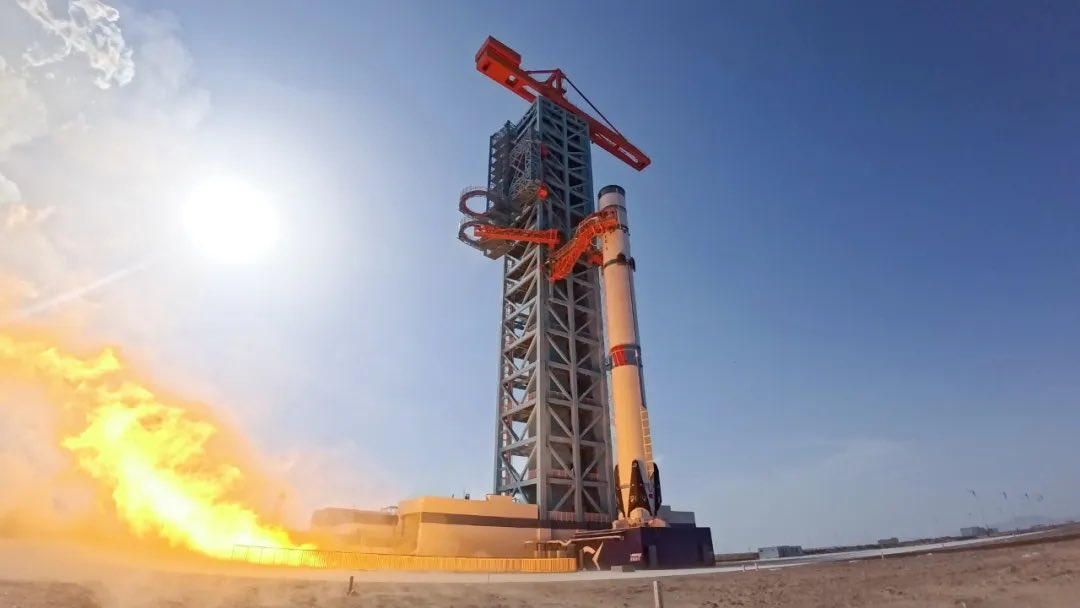
The development phase also featured a vital fueling test, an operation that, like the earlier static fire assessment, was conducted at the Dongfeng Commercial Space Innovation Pilot Zone in northwestern China.
Private Chinese aerospace company LandSpace announced Monday on X the next phase of preparations for its launch vehicle. The rocket is slated to undergo a vertical integration rehearsal, a crucial step before it returns to a technical zone for comprehensive inspection and maintenance. These procedures are vital readiness measures ahead of its impending orbital launch and the planned recovery of its first stage.
The Zhuque-3 rocket, developed by LandSpace, bears a striking design resemblance to SpaceX’s established Falcon 9, specifically adopting a reusable first stage complemented by an expendable upper section. Mirroring the Falcon 9’s configuration, the Zhuque-3’s booster is powered by a cluster of nine engines. These are LandSpace’s proprietary Tianque-12A engines, engineered and produced entirely in-house.

The Tianque-12A rocket distinguishes itself by utilizing a propulsion system fueled by liquid methane and liquid oxygen (LOX). This choice represents a key divergence from the propellant mix found in the Falcon 9, which powers its Merlin engines with LOX and traditional rocket-grade kerosene. Interestingly, the Tianque-12A’s methane-LOX combination mirrors the advanced fuel system of SpaceX’s next-generation Raptor engines, engineered to propel the Starship megarocket.
Standing 217 feet (66 meters) tall, the Zhuque-3 rocket is designed to transport approximately 40,350 pounds (18,300 kilograms) to low Earth orbit (LEO). This places its payload capacity in a similar range to SpaceX’s Falcon 9, which is capable of lifting 50,265 pounds (22,800 kg) to the same orbital destination.
The Zhuque-3 reusable rocket achieved a significant development milestone with a successful static fire test conducted on Monday. This crucial engine firing is the latest in a rapid succession of key trials for the vehicle. Prior to this week’s event, LandSpace, the company behind the Zhuque-3, successfully executed low-altitude launch and landing demonstrations last year, and the rocket also underwent another static fire test this past June.
Beijing-based LandSpace, founded in 2015, operates the expendable Zhuque-2 rocket. The Zhuque-2 achieved a significant milestone in July 2023, making history as the first liquid oxygen-methane propelled vehicle to successfully reach Earth orbit. This inaugural triumph initiated an impressive streak of four consecutive successful missions for the rocket. However, that run was interrupted during its most recent launch attempt this past August, which unfortunately ended in failure.