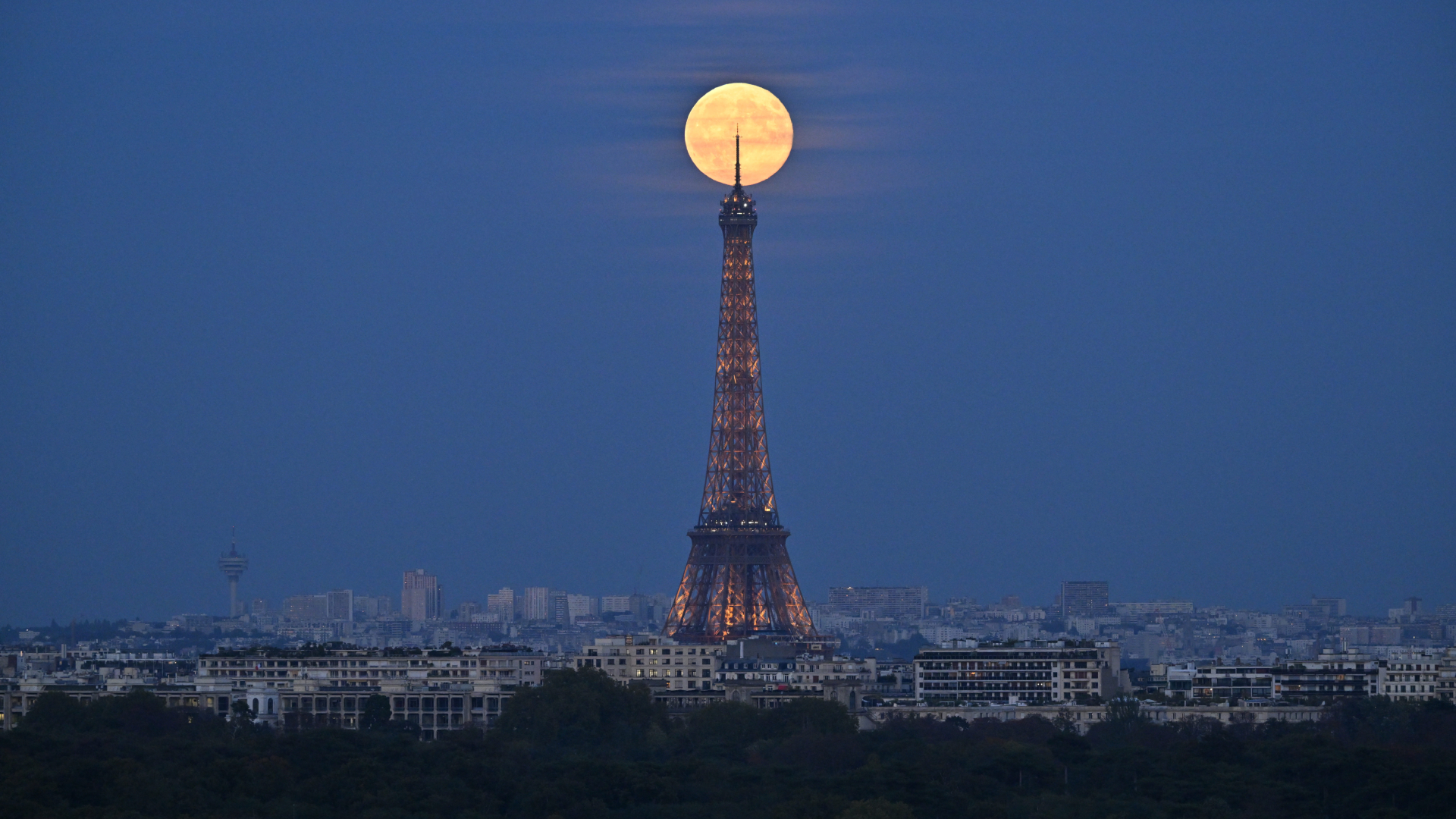
Get ready for a celestial spectacle: the most prominent full moon of 2025, colloquially known as a ‘supermoon,’ is set to grace the night sky on Wednesday, November 5. Skygazers can anticipate a breathtaking display as its exceptionally bright illumination dramatically lights up the darkness.
Skygazers are in for a celestial treat as the moon prepares for a significant astronomical event. At 5:30 p.m. EST (2230 GMT), our lunar companion will reach its closest point to Earth for the year, a phenomenon known as perigee, at an impressive distance of 221,726 miles (356,833 kilometers).
This exceptional proximity follows closely on the heels of the moon officially turning full, a precise astronomical moment occurring nine hours and 11 minutes prior to perigee. This fortunate alignment means the moon will appear exceptionally large and luminous, making it the biggest full moon of the year.
While a full moon is, in astronomical terms, a momentary phase, this exact instant of 100% illumination is virtually imperceptible to the unaided eye. For roughly a day before and after this precise moment, observers will perceive the moon as “full.” This visual constancy occurs because the shaded line separating light from dark, known as the terminator, is incredibly narrow and shifts so gradually that it’s challenging for the naked eye to discern its presence or exact position.
This Wednesday night, as the moon illuminates the sky, it’s important to note an astronomical distinction. While it may appear fully round to the casual observer, the moon will not technically be “full.” Instead, what viewers will witness is a waning gibbous moon, having already passed its precise moment of peak illumination many hours earlier.

News organizations frequently frame what they label a “Supermoon” as an extraordinary or even unprecedented celestial spectacle. This enthusiastic portrayal often drives the public to seek out a glimpse, leading many to believe they are witnessing an event on par with a truly rare cosmic alignment. Such a collective sentiment, however, brings to mind Hans Christian Andersen’s 1837 satirical tale, “The Emperor’s New Clothes.”
While the upcoming lunar event is indeed set to be the “Biggest Full Moon of 2025,” the subtle variation in the moon’s distance is typically not apparent to most observers viewing it directly.
The moon regularly reaches its closest orbital point to Earth, known as perigee, once or occasionally twice a month, with these distances varying by approximately three percent. However, this particular full moon will mark its absolute closest approach of the entire year.
In contrast, looking ahead to May 31 next year, the full moon will align with its apogee – the farthest point in its orbit from Earth. This phenomenon, often referred to as a “micro-moon,” will result in the lunar disk appearing roughly 14 percent smaller than usual.
While a common statistic frequently claims the moon shines 30% brighter than normal, this widely cited figure translates to a minuscule 0.2 or 0.3 magnitude difference in brightness. Such a subtle variation is, in fact, largely imperceptible to the unaided human eye.
A revealing phone call to New York’s Hayden Planetarium once highlighted a common public misconception surrounding celestial events like the “supermoon.” A caller expressed profound disappointment, noting that the much-hyped lunar display “didn’t look at all brighter than normal.”
When asked about her expectations, the woman clarified that she had anticipated a dramatic increase in luminosity, likening it to the noticeable jump experienced when switching a three-way light bulb from 100 to 150 watts. To her dismay, she concluded, the supermoon “really wasn’t at all” noticeably brighter, failing to meet her heightened visual anticipation.
Human perception is a curious thing: once an individual is informed that the moon is uncommonly close to Earth and thus appears larger, they often readily confirm the visual shift. This effect becomes particularly pronounced when the moon is viewed near the horizon, a setting where the well-documented — yet still mysterious — “moon illusion” inevitably comes into play, significantly amplifying its apparent size. The upcoming Wednesday’s genuinely closer lunar approach is poised to further heighten this captivating optical phenomenon.
The upcoming full moon, nearly coinciding with perigee – its closest orbital point to Earth – is poised to generate unusually extreme high and low ocean tides. Should a coastal storm develop during this period, its impact on shorelines could be dramatically amplified. Communities might face significantly worse coastal flooding if a storm hits at high tide. Conversely, powerful offshore winds accompanying a storm could lead to exceptionally low water levels during low tide, potentially exposing vast stretches of seabed.
This remarkable celestial phenomenon, characterized by exceptionally high and low tides, is scientifically termed a **perigean spring tide**. The “spring” in this designation is not a nod to the season, but rather an etymological nod to the German word “springen,” meaning “to spring up” or “to leap,” vividly describing the surge in water levels.
Spring tides occur exclusively when the moon is either in its full or new phase. During these precise moments, the gravitational forces of both the moon and the sun align directly with Earth. This straight-line configuration allows their individual tidal effects to combine, creating a powerful cumulative pull on our planet’s oceans. It’s important to note that while the sun contributes significantly to this effect, its tidal force is slightly less than half that exerted by the moon.
Conversely, **neap tides** present a stark contrast. These weaker tides manifest when the moon is in its first or last quarter phase. At these times, the moon and sun are positioned at right angles to Earth, causing their gravitational influences to work against each other. This counteracting force results in a diminished tidal range, producing noticeably weaker tides.
The intensity of tidal forces is profoundly influenced by an object’s distance, rapidly diminishing according to an inverse cube law. This month’s full moon provides a compelling illustration: at its perigee (the closest point in its orbit to Earth), it is positioned 12.2 percent nearer than an apogee full moon (its farthest point), such as the one anticipated next May. This notable proximity directly translates into a 46 percent increase in the tidal force exerted by the moon.
While the perigee moon brings an amplified gravitational pull, the actual peak tidal events will not coincide precisely with this celestial alignment. Instead, the highest tides are expected to lag by one to two days, with the exact timing influenced by each specific coastal location.
For example, Cape Fear, North Carolina, is projected to reach its highest tide of 6.88 feet at 7:20 a.m. EST on Thursday. Similarly, New York City’s Battery will experience its high water mark of 6.34 feet at 7:59 a.m. EST, also on Thursday. Further north, Boston Harbor anticipates a formidable peak tide of 12.22 feet later, at 11:54 a.m. EST on Friday — nearly two full days following the perigee, underscoring the variability of this lag.
The designation “super” for certain full moons may be a misnomer, particularly if the primary criterion hinges solely on the moon reaching its closest point in orbit relative to Earth. This celestial alignment, known as perigee, is not an infrequent event; it occurs monthly, and occasionally even twice within a single lunar cycle.
The definition of a “supermoon” is expanding beyond just the full moon that perfectly aligns with perigee, the Moon’s closest point to Earth. Now, full moons occurring immediately before and after this perigee full moon are also being granted the supermoon designation.
This year provides a prime example: the “Harvest Moon” on October 6 was classified as a supermoon, and the upcoming full moon on December 4 is set to receive the same title. The frequency of these celestial events varies considerably from year to year. While some years, such as 2028 and 2034, are projected to feature four supermoons, others—like the continuous period from 2029 through 2033—could see as many as five.
While the term “supermoon” primarily captivates audiences when coinciding with a full moon, the celestial phenomenon of the Moon nearing its closest point to Earth—known as perigee—is not exclusive to this phase. For example, on February 24, 2026, the first quarter moon will approach perigee within a mere eleven hours. However, such instances, often dubbed a “super” half-moon, seldom generate the public excitement or widespread attention typically associated with their fully illuminated counterparts.
It appears the quote or statement by Dr. Neil deGrasse Tyson that you wish to have paraphrased is missing from the provided text. Please provide the full quote or the content you would like me to rewrite to fulfill your request.
The question arises whether a relatively minor increase in the Moon’s apparent diameter truly holds substantial significance. Skeptics often frame the discussion with a relatable, if slightly facetious, analogy: if a 14-inch pizza were to expand marginally to 15 inches, would that subtle growth genuinely warrant the dramatic moniker of a “Super-pizza”?
Despite initial assumptions, it seems the true impact of our natural satellite isn’t dictated by its physical scale.
Joe Rao is a distinguished figure in the field of astronomy, recognized for his dual roles as an educator and a writer. He shares his extensive knowledge as an instructor and guest lecturer at New York’s renowned Hayden Planetarium. Furthermore, Rao is a prolific contributor to numerous publications, penning insightful articles on celestial phenomena for outlets such as Natural History magazine and Sky & Telescope, among others.