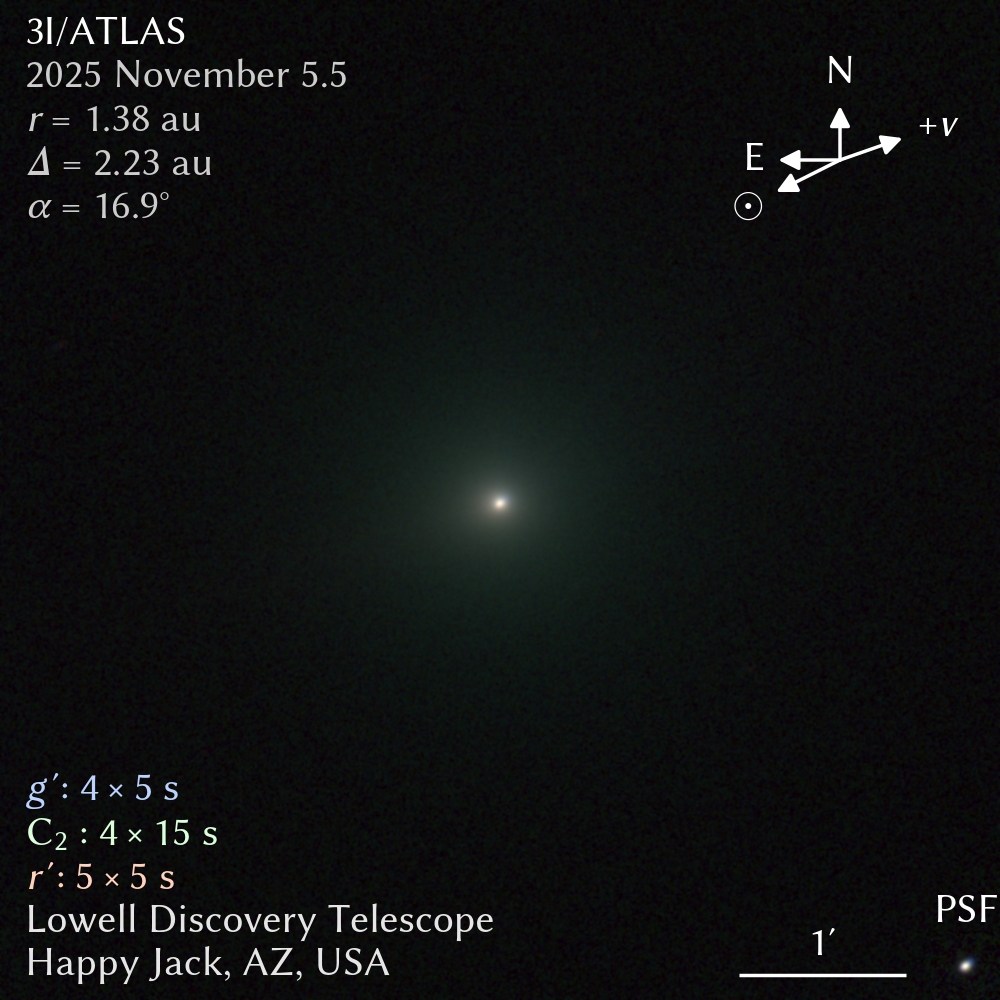
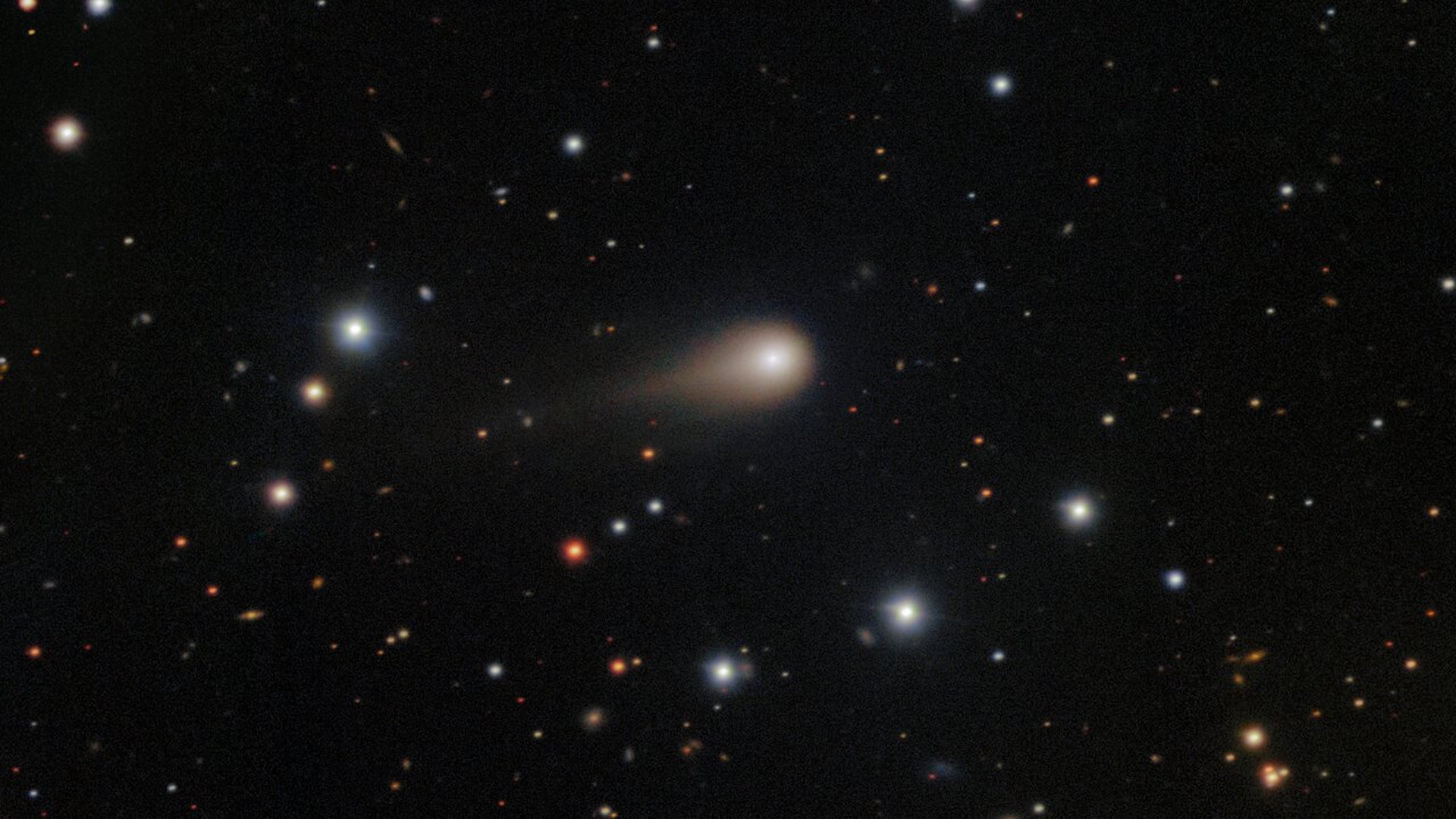
Newly released imagery of comet 3I/ATLAS showcases the interstellar visitor emitting a vibrant green luminescence, with its characteristic tail conspicuously absent. Despite this distinctive presentation, astronomers emphasize there is absolutely nothing amiss with the celestial body.
Astronomer Qicheng Zhang, based at Arizona’s Lowell Observatory, recently made new observations of a comet. Utilizing the institution’s formidable Discovery Telescope, Zhang tracked the icy visitor on Wednesday, November 5, as it sped away from the sun. The comet had only recently become visible again after completing its passage around the far side of our star.
As comets journey closer to the sun, they undergo a remarkable transformation, developing a distinctive gaseous envelope known as a coma. This ethereal atmosphere, a cloud of gas and dust, forms when the sun’s increasing heat causes the comet’s frozen components to sublimate—turning directly from solid ice into observable gases. As this process intensifies, the coma expands significantly in both size and luminosity, becoming a prime target for astronomical study. Notably, the emitted gases from this particular comet’s coma display their greatest brilliance when viewed through a green filter, a phenomenon commonly observed among comets that venture close to our star.
Employing a specialized filter, astronomer Zhang successfully identified diatomic carbon (C2) particles, distinguished by their characteristic green luminescence. His observations also revealed the comet’s abundant content of large hydrocarbons—molecules rich in both carbon and hydrogen. As the celestial body draws nearer to the Sun, intense ultraviolet (UV) radiation is responsible for breaking down these complex molecules.
Speaking with Live Science, Zhang elucidated the underlying mechanism, likening it to the process of a sunburn. He explained that just as prolonged, unprotected exposure to the sun causes ultraviolet (UV) rays to destroy DNA within skin cells, a similar form of molecular degradation occurs. Zhang further clarified that DNA is a large, carbon-containing molecule, underscoring its susceptibility to such damage.
During periods of cometary activity, a key observable element released is diatomic carbon, a molecule consisting of two bonded carbon atoms. These distinct molecular fragments are notably straightforward for astronomers to detect.
Despite an initial impression that the comet’s dust tail is absent in the image, closer inspection confirms its presence. Astronomer Zhang points out a subtle visual cue: a faint but discernible brightness on the left side of the comet, marginally exceeding that on the right.
This slight asymmetric glow arises from our unique vantage point. Viewers are observing the tail almost head-on, trailing directly behind the comet and curving gently towards the left. Consequently, the comet’s seemingly “missing” tail is merely an optical effect, offering no cause for unusual astronomical excitement or concern.
Since its discovery in July, Comet 3I/ATLAS has emerged as a cosmic sensation, capturing widespread public imagination. Much of its notoriety stems from fervent speculation suggesting the celestial body could be an alien spacecraft. However, the overwhelming scientific consensus among astronomers firmly identifies this interstellar visitor as a natural comet, believed to originate from a distant, unknown star system within the Milky Way galaxy.
To categorize comet 3I/ATLAS merely as an ordinary celestial body would profoundly undervalue its extraordinary significance. This rare cosmic interloper holds the distinction of being only the third interstellar visitor ever recorded. Even more remarkably, it is a candidate for the oldest comet ever observed, with a prominent study suggesting it predates our solar system by an astounding 3 billion years.
Comet 3I/ATLAS has recently reappeared in Earth’s skies after a brief period hidden behind the sun. Its closest approach to our star, known as perihelion, occurred on October 29. This post-perihelion phase is now offering astronomers a crucial window to investigate the comet’s gaseous emissions and overall composition, as comets typically exhibit their highest levels of activity when nearest to the sun.
Preliminary research indicates that comet 3I/ATLAS has developed a thick, radiation-baked crust, a consequence of prolonged exposure to the harsh environment of deep space. This outer shell, significantly altered from its original composition, no longer offers clues to its birthplace. Should these initial observations be confirmed, scientists would face a considerable challenge in deciphering the comet’s origins, as any vented material would be irradiated rather than pristine samples from its home star system.
Astronomer Zhang made the first Earth-based optical observation of comet 3I/ATLAS following its closest approach to the Sun (perihelion) on October 31, Halloween, utilizing the Lowell Discovery Telescope. His most recent sighting, mirroring the initial detection, also occurred during morning twilight.
From our vantage point, the comet is currently progressing northward, gradually moving away from the northeastern horizon. This trajectory presents a prime opportunity for early morning observers to spot the comet as it ascends above the horizon in the pre-dawn sky.
Astronomer Zhang captured the comet using an array of filters, yielding multiple distinct images. Among these, a diatomic carbon image—first unveiled on his Cometary blog Wednesday—offers a compelling approximation of how the celestial body might appear to the unaided human eye.
New research posted October 28 by Zhang and a colleague on the preprint server arXiv offers fresh insights into comet 3I/ATLAS. Their study revealed that the comet underwent a period of rapid brightening leading up to its perihelion — its closest approach to the sun — and displayed a distinctive blue hue compared to our star.
Interestingly, the appearance of green in a subsequent image does not necessarily mean the comet’s color changed after perihelion. Instead, the scientists propose that any such spectral shift could have occurred earlier, prior to that critical orbital phase.
New observations paint a vivid picture of the comet’s luminosity, revealing a distinctly “bluer” signature. In astronomical terms, this “bluer” classification signifies a predominance of shorter light wavelengths, contrasting with “redder” celestial bodies characterized by longer wavelengths.
A striking aspect of this discovery is the comet’s significantly enhanced brightness when viewed through filters optimized for bluer light. Its appearance through these shorter-wavelength filters is markedly more luminous than when observed using redder light filters. Researchers, however, noted a crucial detail: these so-called “bluer” filters are actually a composite of green and blue light, possessing only limited sensitivity to pure blue.
Zhang stated that peak brightness is achieved when utilizing their bluest filter.
Initially, the Lowell Discovery Telescope was likely one of the few large observatories uniquely positioned to capture comet 3I/ATLAS immediately after its perihelion, according to astronomer Zhang. Its capability to point exceptionally close to the horizon offered a critical early viewing advantage.
However, the comet has since ascended higher in the sky, significantly broadening its accessibility. Now, numerous large professional telescopes can observe it, and notably, even amateur astronomers can spot the celestial body using personal telescopes equipped with a 6-inch (15-centimeter) lens.
Over the next few months, scientists anticipate a significant outpouring of compelling new data and revelations regarding the comet.