Astronomers have pinpointed a dramatic cosmic event: a pair of stars locked in an accelerating, terminal orbital decay. This celestial “dance of doom” is providing unprecedented insights into the fundamental workings of gravity.
Astronomers have achieved an unprecedentedly clear view of the celestial system ZTF J2130, which resides approximately 4,000 light-years from Earth. While the system’s existence has been known to researchers for some time, this marks the inaugural instance it has been observed with such remarkable clarity.
A unique binary star system, hurtling towards an imminent merger, is proving to be a critical cosmic laboratory for advancing our understanding of gravity.
Researchers have observed the system’s inward spiral, noting its remarkable consistency with theoretical predictions. This precise alignment means that forthcoming, highly refined observations of these celestial bodies will offer an unparalleled opportunity to meticulously test and potentially refine fundamental theories of gravity.
The groundbreaking findings were presented by the research team in a study submitted for publication in October to the journal *Astronomy & Astrophysics*.
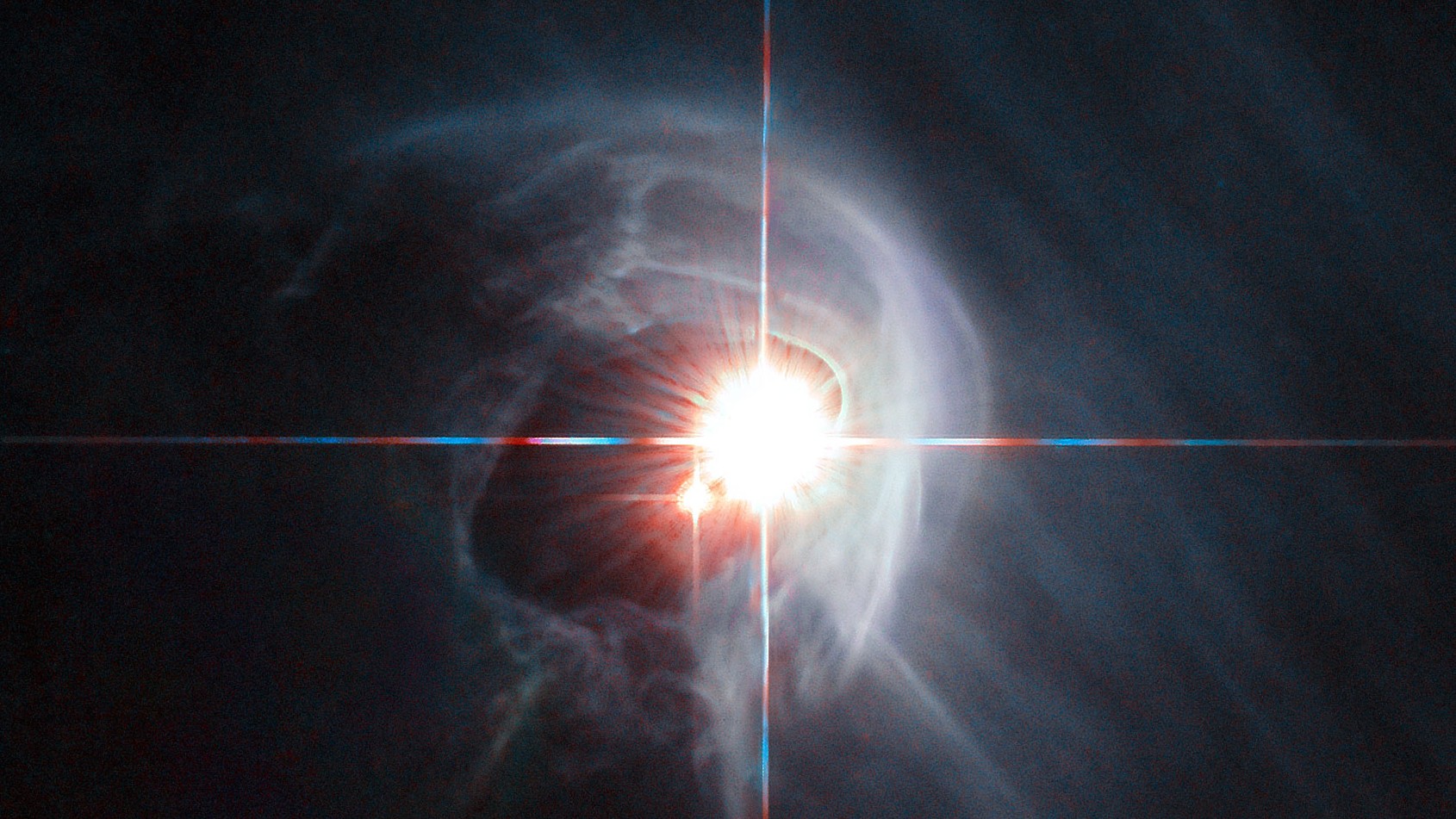
This ancient and extraordinary stellar system hosts a dramatic cosmic ballet between two dying stars. One is a white dwarf, the super-dense, white-hot core left behind by a star once akin to our own sun. Its companion is a diminutive subdwarf, a small star now nearing the twilight of its life cycle.
Locked in an incredibly tight gravitational embrace, these two celestial bodies complete an entire orbit in a breathtakingly brief span of just under 40 minutes. Their immense mutual gravity has pulled them into such close proximity that they are visibly stretched and distorted. The subdwarf’s outer material is actively being siphoned off, flowing steadily onto its white dwarf partner in a continuous, cosmic transfer.
The immense mass and rapid motion of celestial bodies generate gravitational waves—ripples in the very fabric of space-time, a phenomenon first theorized by Albert Einstein and definitively confirmed in 2015. This continuous emission of gravitational waves steadily saps energy from the stellar system, consequently causing the two stars to gradually spiral closer together with each passing year.
Astronomers, leveraging extensive data from the Oskar Luhning telescope at Germany’s Hamburg Observatory and the CAHA Observatory in Spain, undertook a meticulous campaign to precisely measure an orbital period. Their rigorous analysis revealed a subtle but persistent decay in this orbit. Specifically, researchers determined that with every passing second, the orbital period shrinks by an astonishing two-trillionths of a second.
These findings align with calculations derived from our prevailing theoretical understanding of gravity. Yet, despite this consistency, the scientific community has, for over a century, been eager to advance beyond Einstein’s theory of general relativity. Consequently, any opportunity to scrutinize or challenge this foundational theory invariably garners immediate and widespread interest.
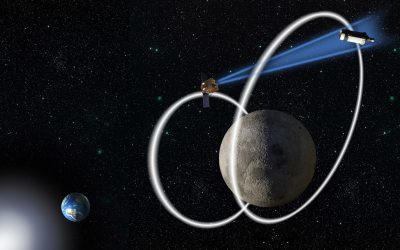
Astronomers have made a significant discovery, revealing that the upcoming Laser Interferometer Space Antenna (LISA), a pioneering gravitational-wave observatory, is uniquely positioned to directly measure gravitational waves from a specific celestial system.
The European Space Agency (ESA) plans to launch LISA, which will detect ripples in spacetime, in the 2030s. Crucially, this stellar pair is projected to remain an active source of gravitational waves well into the next decade, ensuring it will be a prime target for observation once LISA becomes operational.
When two celestial bodies finally coalesce, astronomers predict a spectacular, supernova-level explosion will erupt, potentially radiating enough light to be visible from Earth with the unaided eye. However, before that anticipated cosmic spectacle unfolds, researchers remain focused on the intricate gravitational forces currently shaping the interaction between these stellar giants.