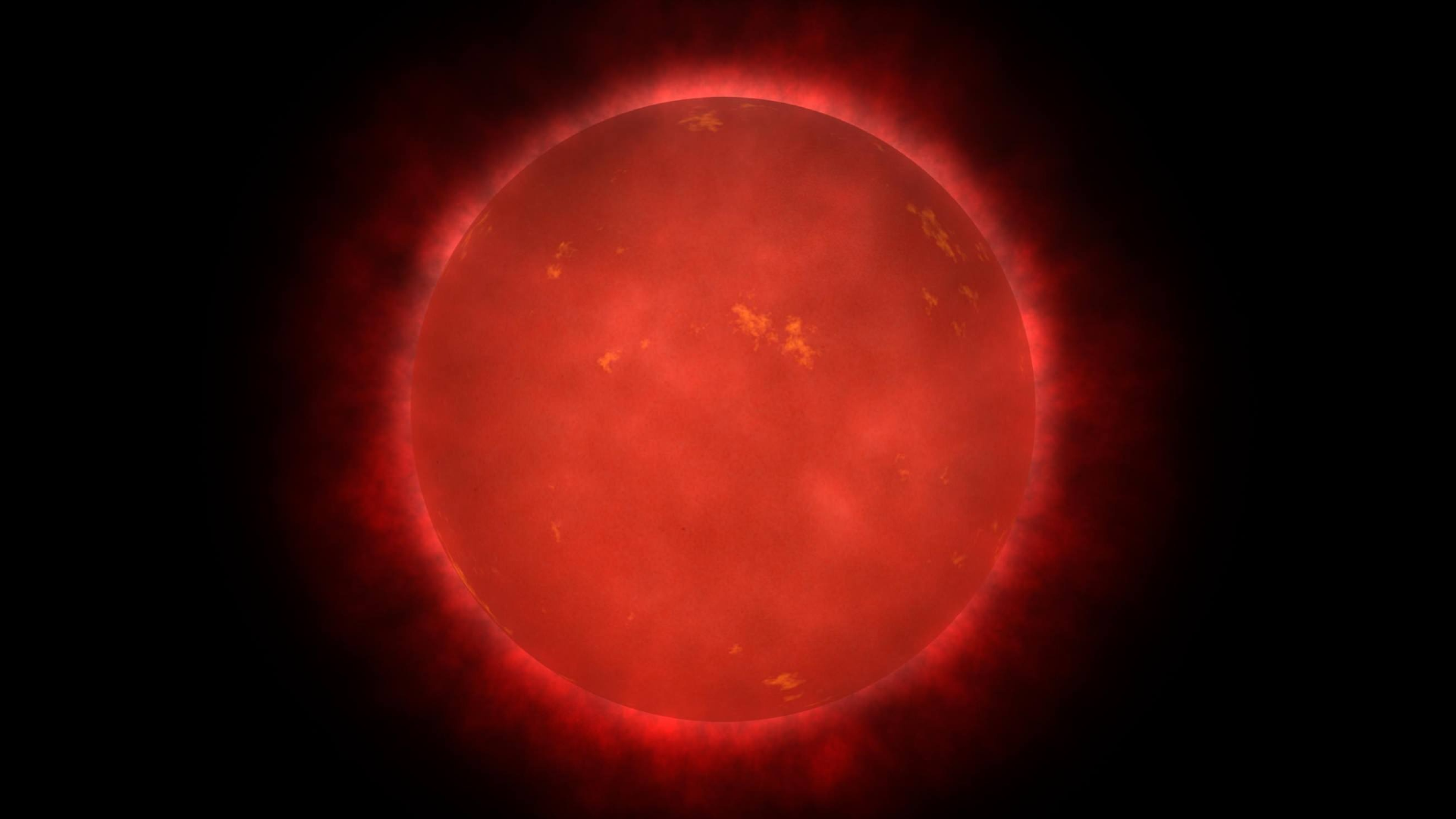
A perplexing cosmic anomaly has astronomers captivated: the red giant star Kepler-56 exhibits a remarkably misaligned spin. Scientists are now theorizing that this unusual rotation could be the direct consequence of the star having devoured one of its own orbiting planets.
New research suggests the star Kepler-56, known to host two exoplanets, may have once harbored a third, long-lost planetary companion. This hypothesis comes from Takato Tokuno, a doctoral student in the Department of Astronomy at the University of Tokyo, who identified the potential former planet after analyzing Kepler-56’s peculiar characteristics.
The red giant star Kepler-56 presents an astrophysical anomaly, characterized by two profoundly unusual rotational properties. Most notably, its outer envelope whirls at an extraordinary velocity, spinning approximately ten times faster than is typically observed in red giant stars.
Compounding this peculiarity, the star’s internal core is strikingly misaligned with its rapidly rotating outer shell; their axes of rotation, in fact, point in entirely different directions. To offer a terrestrial comparison, this cosmic phenomenon would be akin to Earth’s crust rotating considerably faster and in a divergent direction from its underlying mantle.
The inexplicable nature of this event has sparked an urgent inquiry into its origins.
The most straightforward explanation attributes these phenomena to the influence of exoplanets. Much like Jupiter causes a subtle wobble in our Sun, massive planets can exert significant gravitational tugs on their parent stars. Additionally, these orbiting bodies generate tidal forces on the stellar surface, even if minor.
The key lies in the cumulative effect: these repeated, gentle gravitational pulls and tidal interactions, sustained over millions of years, are sufficient to accelerate the spin of a star’s outer atmosphere. Furthermore, if the planets’ orbital planes are not aligned with the star’s axis of rotation, these continuous gravitational exchanges can also lead to substantial stellar misalignments.
However, physicist Tokuno ultimately deemed this hypothetical scenario unrealistic. His analysis revealed it would demand an exceptionally efficient mechanism for planets to generate substantial tides and subsequently siphon their rotational energy into the central star—a capability orders of magnitude beyond anything observed in stellar systems studied to date.
One intriguing theory suggests a dramatic cosmic event: perhaps the star initiated an intense period of accretion, effectively “devouring” surrounding stellar material.
When a star engulfs a planet, the dramatic celestial event significantly alters the star’s rotational dynamics. This process is akin to Earth absorbing the energy from a glancing meteor strike, which would cause our planet to speed up. Similarly, a star absorbs the kinetic energy of an ingested planet, thereby influencing its spin rate.
Should a planet collide with a star at an unusual or oblique angle, it can also induce a notable misalignment between the star’s core and its outer atmospheric layers, a phenomenon potentially observed in stellar systems like Kepler-56.
In new research published October 29 on the arXiv preprint server, astronomer Tokuno has outlined the precise conditions necessary for a planet’s destruction in a specific scenario. Tokuno’s calculations indicate that the ill-fated world would need to possess a mass between half and twice that of Jupiter. Crucially, just before its ultimate impact, the planet’s orbital period would have to be remarkably short, ranging from one to six days.
These calculated parameters align strikingly with the characteristics of typical “hot Jupiter” exoplanets, a class of celestial bodies widely believed to be spiraling towards a similarly destructive fate.
A competing theory, advanced by Tokuno in a paper that has yet to undergo peer review, proposes that the star may have simply been born with an exceptionally rapid spin. However, this explanation falls short of clarifying the puzzling misalignment between the star’s core and its atmosphere. Moreover, it raises a subsequent crucial question: What initiated such an extraordinary rotational speed at the star’s very genesis? One compelling hypothesis suggests the star may have absorbed a planet early in its existence, rather than closer to the end of its lifespan.
Astronomers are just beginning to unravel the intricate, and often brutal, dynamics that govern the relationship between planets and their parent stars. Each new discovery, no matter how violent or catastrophic, serves to deepen our understanding of a world’s complete life cycle.