On April 10, 2024, the cosmos provided a fleeting, yet profound, spectacle. The Asteroid Terrestrial-impact Last Alert System (ATLAS) detected the initial burst of light from the explosive death of a colossal star, estimated to be between 12 and 15 times the sun’s mass.
In an extraordinary display of rapid astronomical response, astronomers acted swiftly. A mere 26 hours later, the powerful Very Large Telescope (VLT) in Chile was precisely aimed at the nascent supernova. This crucial, early observational window offered an unparalleled opportunity to scrutinize the very first moments of a star’s cataclysmic demise, yielding invaluable data on the initial phases of stellar death.
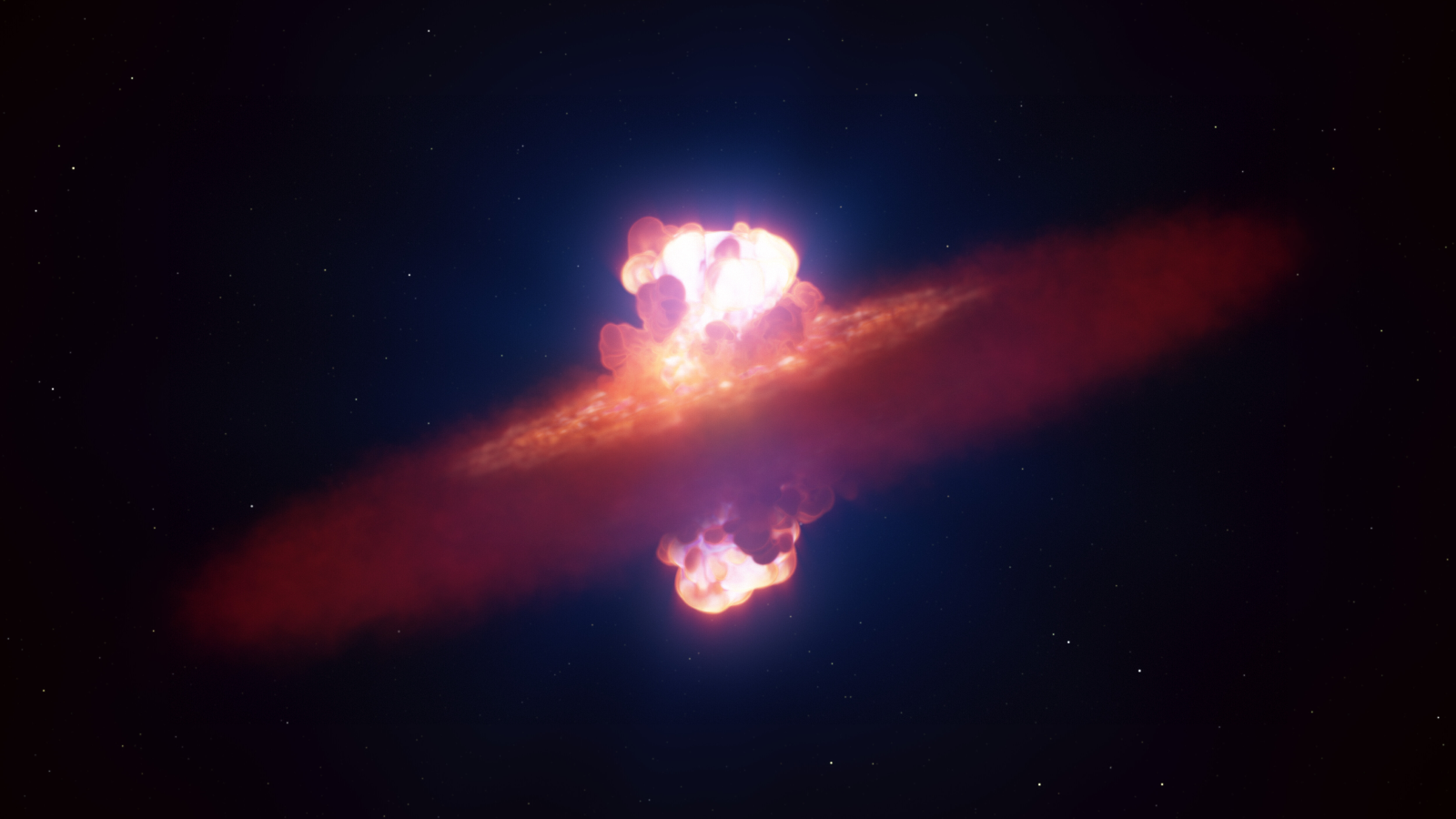
A remarkable artist’s interpretation, informed by data from the Very Large Telescope (VLT), dramatically illustrates a supernova’s explosive spectacle. Thanks to incredibly prompt observations, astronomers were able to pinpoint the event’s crucial initial shape—a fleeting phase that would have become undetectable just one day later.
A powerful supernova, officially cataloged as SN 2024ggi, has been observed erupting within the galaxy NGC 3621. This immense stellar explosion, situated approximately 22 million light-years away in the constellation Hydra, was visually confirmed by an image captured by the Very Large Telescope (VLT) on April 11, 2024, which clearly pinpoints its location inside the distant galaxy.
The remarkable, near-perfect spherical form of a massive star is a testament to a finely tuned cosmic equilibrium. This stability is maintained by a constant struggle: the immense inward pull of the star’s own gravity perpetually contends with the powerful outward pressure generated by intense nuclear fusion reactions deep within its core.
However, this delicate balance is not eternal. When this intricate equilibrium eventually falters, the star faces its ultimate demise. Gravity, finally overwhelming the internal pressure that once supported the stellar core, causes it to catastrophically collapse under its own colossal weight.
The drama of a supernova begins with an unstoppable inward collapse, drawing the star’s outer layers inexorably towards its core. This intense compression is swiftly met with a violent rebound, unleashing a powerful shockwave that subsequently rips the star asunder. The moment this colossal shockwave breaches the stellar surface, it expels an immense burst of energy, dramatically escalating the supernova’s observed brilliance. Yet, despite these profound effects, the precise mechanisms governing the formation and outward propagation of this destructive shock have long remained a fundamental and hotly debated mystery within astrophysics.
Astronomers have successfully captured the initial “breakout” shape of a cosmic explosion, a fleeting phenomenon observable only in the critical moments after detonation and before it begins interacting with its surrounding environment. This groundbreaking achievement was made possible by scientists at the Very Large Telescope (VLT) who employed spectropolarimetry. This advanced technique sorts light by its wavelengths and reveals the precise direction in which light waves vibrate, allowing researchers to discern the explosion’s nascent form for the very first time.
In a surprising revelation about the universe’s most dramatic stellar events, new data from the Very Large Telescope (VLT) indicates that exploding stars don’t burst forth symmetrically. Observations from the VLT’s FORS2 instrument—the only facility in the Southern Hemisphere capable of making such precise measurements—have shown that the initial light from these cosmic detonations was not emitted equally in all directions.
Instead, the powerful inaugural shockwave was found to be stretched along a single axis, described as resembling an olive. This distinct elongation provides compelling evidence that the explosion itself was not a perfectly spherical event.
As the supernova’s blast expanded with blinding light, it began to illuminate the dynamic interaction between the stellar explosion and the gas enveloping the star. A critical discovery emerged around day 10: the star’s hydrogen-rich outer layers became visible, revealing a precise alignment with the axis of the initial shockwave observed on the supernova’s very first day. This remarkable congruence suggests that the core explosion maintained a stable, directional shape from its earliest moments. Such an enduring orientation points to a powerful, underlying mechanism driving this consistent celestial phenomenon.
A recent study, leveraging unprecedented observations, has delivered crucial insights, leading to the rejection of some prevailing supernova models and the confirmation of others. Crucially, it also unearths fresh details about the violent, terminal explosions of massive stars.
The comprehensive study officially debuted on November 12, appearing in the prestigious journal *Science Advances*.
Explore an expanded collection of magnificent cosmic photography by delving into the unparalleled visuals available in our Space Photo of the Week archives.