
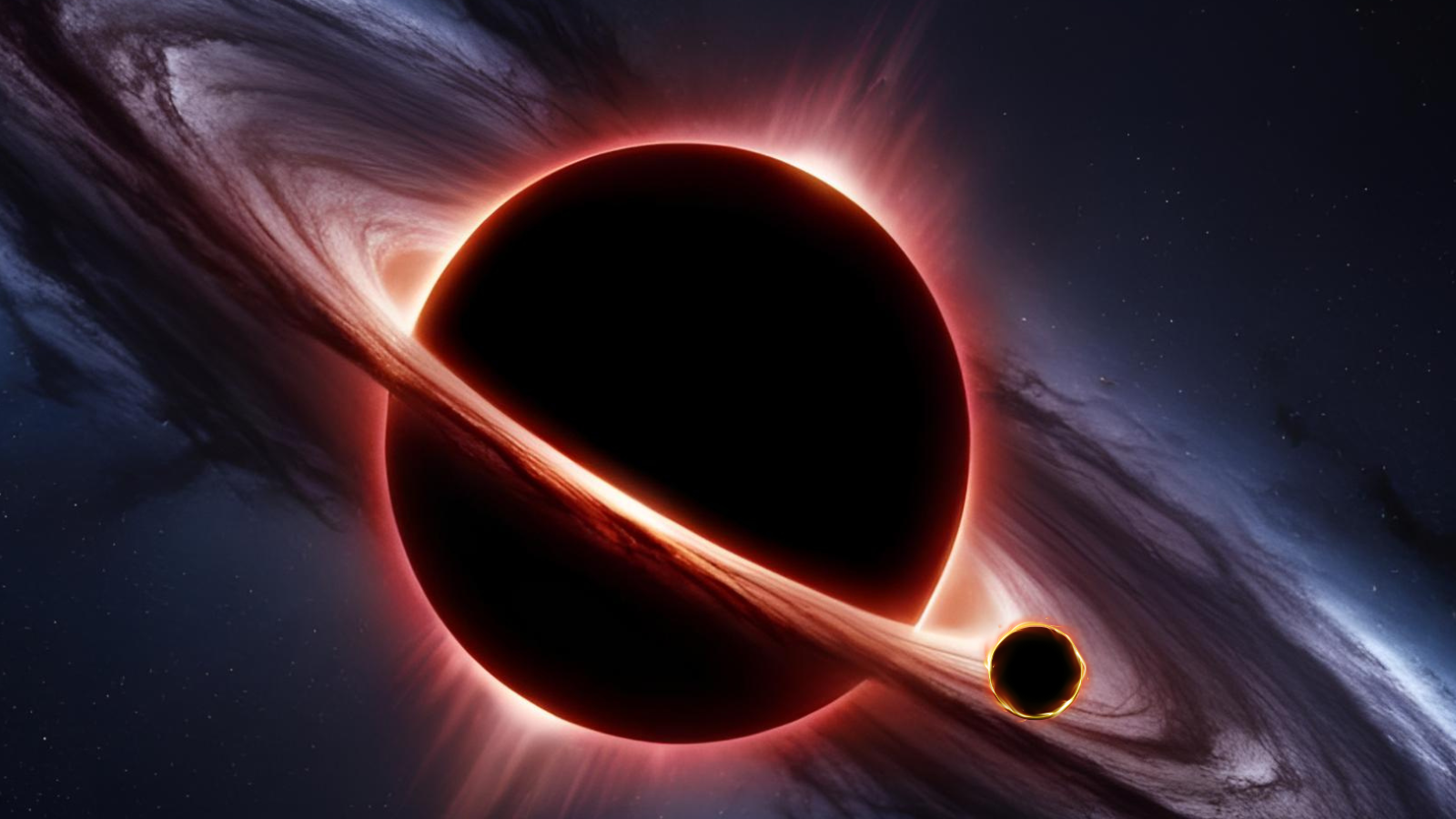
Scientists are reporting tantalizing, early evidence suggesting the existence of primordial black holes, theoretical cosmic objects believed to have formed during the universe’s infancy. This potential groundbreaking discovery stems from the detection of gravitational waves — minute ripples in spacetime — by the sophisticated Earth-based detectors of the Laser Interferometer Gravitational-wave Observatory (LIGO) and the Virgo collaboration.
These elusive black holes, hypothesized to be relics from the Big Bang, could be remarkably tiny, potentially spanning a vast size range from the diameter of a coin down to mere fractions of an atom.
For over a decade, the LIGO-Virgo collaboration has routinely captured gravitational waves – cosmic ripples born from extreme astrophysical events like merging black holes and colliding neutron stars. However, on November 12, the expanded LIGO-Virgo-KAGRA collaboration issued an automated alert that signaled a black hole merger of truly extraordinary nature, marking a significant departure from their usual detections.
A recent gravitational wave observation, designated S251112cm, has potentially unveiled a celestial object that defies conventional astrophysical understanding. The detected signal indicates that one of the interacting bodies possessed a mass significantly smaller than that of either a stellar-mass black hole or a neutron star. These well-understood stellar remnants, which form from the collapsing cores of dying massive stars, invariably have masses greater than our Sun.
Theoretical physicist Djuna Croon of Durham University, who was not involved in the gravitational wave observation, emphasized the profound implications of such a discovery. Speaking to Science, Croon stated, “If this turns out to be real, then it’s enormous. This is not an event we can explain by conventional astrophysical processes.” However, the scientific community underscores that the authenticity and full interpretation of this extraordinary signal remain subject to rigorous verification.

A new gravitational wave candidate, designated *S251112cm*, is generating significant interest within the astronomical community. Christopher Berry, a gravitational wave astronomer and member of the LIGO team, highlighted the alert from the LIGO-Virgo collaboration, noting the intriguing possibility that the signal originates from a “subsolar” mass source. This suggests the detection of an astronomical phenomenon potentially unlike anything observed before.
However, the authenticity of the signal remains under significant scrutiny. A researcher from the University of Glasgow has cautioned that there is a considerable likelihood of it being a false alarm, generated by ambient noise within the highly sensitive detectors. False positives of this nature are statistically estimated to occur roughly once every four years. While this error rate presents a relatively small margin for the frequent observations of “ordinary” black hole and neutron star mergers, its impact on a uniquely rare signal such as S251112cm is profound, introducing substantial doubt about its true nature.
Primordial black holes have long been a subject of intense theoretical speculation, yet these enigmatic cosmic objects have consistently eluded detection. This enduring mystery ensures that even the slightest possibility of their discovery ignites significant excitement within the scientific community.
When the term “black hole” is commonly used, it most often refers to a stellar-mass black hole. These cosmic powerhouses possess masses ranging from 5 to 100 times that of our sun. Their dramatic birth occurs following the catastrophic collapse of the core of a truly massive star—one weighing at least 10 solar masses. This violent implosion triggers a spectacular supernova, a cosmic explosion powerful enough to blast away the star’s outer layers, leaving behind the ultra-dense remnant.
Beyond the more common understanding, the term “black hole” frequently refers to the supermassive entities that anchor the cores of virtually all large galaxies. These cosmic leviathans boast masses millions to billions of times that of our sun, a scale far too immense for them to have formed from a single collapsing star. Scientists therefore theorize that these galactic behemoths achieve their staggering size through a relentless process of successive mergers, coalescing with increasingly larger black holes over cosmic time.
Primordial black holes are theorized to have taken shape in the universe’s infancy, eons before the first stars ever flickered to life. Their genesis is attributed to the direct collapse of exceptionally dense pockets within the superheated, primordial plasma that permeated the cosmos just moments after the Big Bang.
Primordial black holes represent a distinct class of cosmic phenomena, uniquely independent of the stellar origins that define their astrophysical counterparts. Often dubbed “non-astrophysical black holes,” their formation is not reliant on the collapse of massive stars. This unique genesis allows for an exceptionally broad theoretical mass spectrum, ranging from objects as infinitesimally light as 1/100,000th the mass of a paperclip to colossal entities weighing 100,000 times that of our sun. This vast potential range notably encompasses what scientists refer to as “sub-stellar masses.”
Should primordial black holes indeed exist, their implications for cosmic understanding could be profound. These hypothetical entities might not only have played a significant role in shaping the universe’s evolution over billions of years, but they could also offer a crucial explanation for one of modern cosmology’s most enduring mysteries: the true nature of dark matter.
Dark matter stands as one of the universe’s most perplexing enigmas. Despite accounting for an astonishing 85% of all matter in the cosmos, it remains entirely invisible to us because it does not interact with electromagnetic radiation – the fundamental force responsible for light, radio waves, and X-rays.
Given this complete lack of interaction with light, scientists can only infer dark matter’s presence indirectly through its powerful gravitational influence. This unseen force warps spacetime, subsequently affecting the distribution and movement of visible, ordinary matter and light across the universe.
The profound mystery surrounding dark matter’s inability to directly engage with light has spurred researchers to explore theoretical candidates for its composition far beyond the established framework of the Standard Model of particle physics.
Primordial black holes (PBHs) represent an especially compelling candidate in the ongoing quest to identify dark matter. Their significant theoretical appeal stems from their inherent compatibility with existing cosmological models, requiring no revolutionary physics beyond the well-established Standard Model. Yet, despite this elegant theoretical fit, all rigorous attempts to detect these hypothesized cosmic relics have thus far consistently failed. This persistent absence of observational evidence has led to a leading hypothesis: should primordial black holes exist, they may no longer be a prevalent feature, or even present at all, in the modern universe.
Defying the conventional image of eternal cosmic devourers, Stephen Hawking famously theorized that black holes aren’t perfectly stable. Instead, they subtly emit heat into the cosmos through what he termed “Hawking Radiation.”
This phenomenon leads to a gradual process of evaporation, which eventually culminates in a final, explosive burst. Crucially, the rate of this evaporation slows significantly as a black hole’s mass increases.
Consequently, supermassive black holes are predicted to possess lifespans that vastly exceed the universe’s projected age. Conversely, the theory suggests that exceptionally light primordial black holes could have vanished mere seconds after their formation, while larger primordial examples might still be actively evaporating across the cosmos today.
A puzzling new gravitational wave signal has left researchers stumped, as its potential origin cannot be explained by the collision of any currently understood astrophysical bodies, should it prove to be more than a false alarm.
The alert, issued by the LIGO-Virgo collaboration, has galvanized astronomers into an urgent search for a corresponding cosmic explosion. However, this pursuit faces an enormous hurdle: the gravitational wave detectors could only narrow down the signal’s source to an expansive region of the sky, an area approximately 6,000 times the apparent width of the moon. This vast uncertainty makes locating an accompanying electromagnetic signal a formidable challenge, akin to finding a solitary needle in a colossal cosmic haystack.
Researchers currently possess just one key to understanding this cosmic merger: its gravitational wave signal. However, this seemingly singular data point offers a surprising wealth of information. Gravitational wave scientists can meticulously analyze the distinctive “hum” of these waves, emitted during the objects’ final inspiral before collision, to precisely determine the identities of the two celestial bodies involved.
The true nature of this intriguing signal, and whether it genuinely originates from a primordial black hole, remains a profound mystery. A conclusive determination would hinge entirely on the detection of further, similar signals – a scenario scientists largely view as a slim possibility.
Here are a few options, maintaining a clear, journalistic tone:
**Option 1 (Concise):**
“Ultimately, Croon conceded that definitive clarity on the alert’s authenticity is unlikely to emerge.”
**Option 2 (Slightly more formal):**
“Croon concluded that ascertaining with certainty whether the alert was legitimate will likely remain an unresolved question.”
**Option 3 (Emphasizing the lasting ambiguity):**
“The true nature of the alert may never be definitively known, Croon remarked in a final assessment.”
**Option 4 (Direct and clear):**
“It is highly improbable that we will ever gain certain knowledge of the alert’s veracity, Croon stated in conclusion.”





