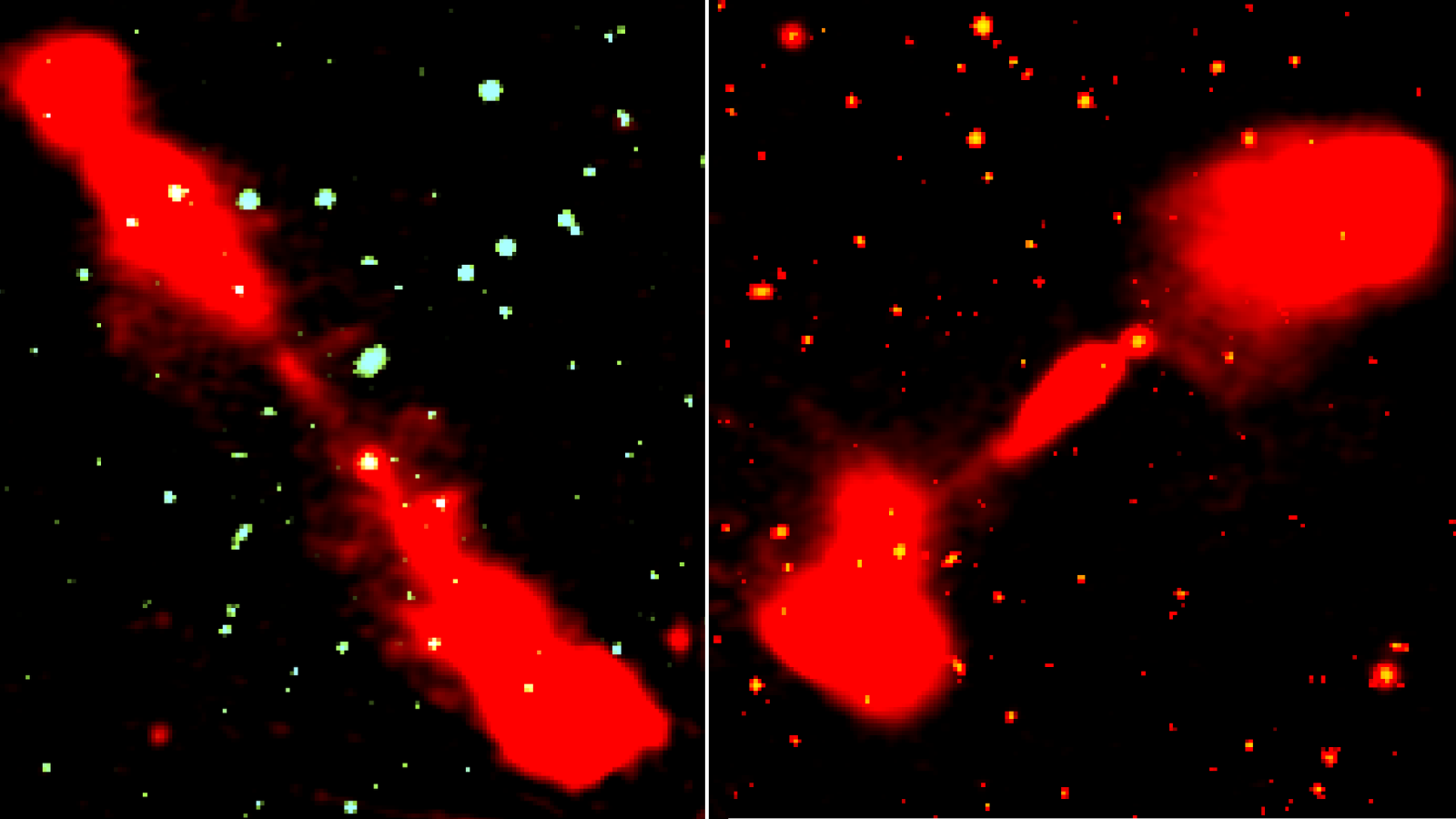
A recent astronomical survey has led to the identification of 53 new quasars, incredibly powerful celestial objects each driven by a supermassive black hole at its core. These cosmic engines are known to propel immense jets of matter at speeds nearing that of light. Some of these colossal outflows extend up to an astounding 7.2 million light-years across space — a distance equivalent to roughly 50 times the entire diameter of the Milky Way galaxy.
Indian astronomers have announced the discovery of 369 new radio quasars, including colossal cosmic entities now identified as Giant Radio Quasars. This significant finding emerged from data collected by the Giant Meterwave Radio Telescope (GMRT), a formidable array of 30 parabolic dishes situated near Pune, India, as part of the TIFR GMRT Sky Survey (TGSS).
The TGSS project meticulously mapped approximately 90% of the celestial sphere visible from Earth. The GMRT’s unique combination of extensive sky coverage and exceptional sensitivity proved instrumental, making it the ideal instrument for detecting such distant and gigantic radio-emitting structures as these newly observed Giant Radio Quasars.
The monumental scale of newly observed radio jets dwarfs even our galaxy, defying conventional astronomical comparisons. Souvik Manik, a researcher from Midnapore City College, underscored their astonishing size, explaining that these colossal structures are not merely larger than our solar system but extend an incredible 20 to 50 times the diameter of the entire Milky Way galaxy when measured end-to-end.

Supermassive black holes, cosmic titans weighing millions to billions of times the mass of our sun, are widely believed to anchor the core of every large galaxy. Yet, despite their ubiquitous presence, not all of these colossal gravitational wells actively power the brilliant central regions known as Active Galactic Nuclei (AGN). Consequently, only a fraction of them ignite into the extraordinarily powerful galactic cores we identify as quasars.
To power a quasar’s intense luminosity, a supermassive black hole must draw sustenance from a vast cosmic reservoir of gas and dust. This abundant material doesn’t fall directly into the black hole but instead spirals inward, coalescing into immense, flattened structures known as accretion disks. Within these dynamic disks, the black hole’s overwhelming gravitational influence generates incredible tidal forces. This powerful stress and friction superheat the material to extraordinary temperatures, compelling it to brilliantly emit radiation across the entire electromagnetic spectrum.
Despite their reputation as cosmic vacuum cleaners, black holes are notably inefficient eaters, with a substantial amount of material in their accretion disks escaping consumption. Instead, powerful magnetic fields capture highly ionized gas, or plasma, channeling it towards the supermassive black hole’s poles. There, this plasma is accelerated to near-light speeds before being violently ejected in opposing directions, forming powerful twin jets.
Over time, these formidable jets can extend many light-years from their origin, eventually fanning out into expansive plumes, often referred to as “lobes.” These vast structures stretch dramatically both above and below the plane of the galaxy from which they emanate, broadcasting strong radio wave emissions across the cosmos.
Quasars equipped with immense radio jets are proving to be crucial tools for scientists aiming to decipher the advanced stages of their evolution and the vast, tenuous intergalactic medium that restricts their radio lobes, extending millions of light-years from the central black hole. This assessment comes from Sabyasachi Pal, an astronomer at Midnapore City College and the research team’s leader.
However, pinpointing these colossal astronomical structures is no simple task. Pal elaborated that the challenge arises because the faint “bridge” of emissions typically linking the two lobes frequently dips below observable limits. This phenomenon causes the quasar’s full structure to appear broken or incomplete to researchers.
Low-frequency radio surveys are particularly adept at pinpointing these astronomical systems, Pal explained. This effectiveness stems from the aged synchrotron plasma located within their lobes, which radiates far more intensely at lower radio frequencies than at higher ones.
Researchers have identified a compelling environmental trend concerning Giant Radio Quasars. A substantial portion—at least 14%—of these colossal cosmic engines are found nestled within dense galaxy groupings, clusters, and in close proximity to cosmic filaments. These vast, thread-like structures, composed of gas, dust, and dark matter, are recognized as crucial hubs where galaxies assemble and flourish across the universe.
The cosmic environment profoundly influences the evolution of radio jets, according to Netai Bhukta, a team member from Sidho Kanho Birsha University in Lagda, India. Bhukta explained that dense regions of surrounding gas can impede, distort, or even fragment these jets, while in sparser areas, they are able to expand freely across the intergalactic medium.
While quasars are known for their powerful twin jets of ejected particles, scientists have observed that these jets often exhibit notable disparities in length or brightness. This phenomenon, termed “radio jet asymmetry,” provides a critical window into the cosmic environments surrounding these active galactic nuclei.
“This asymmetry tells us that these jets are battling against an uneven cosmic environment,” explained Sushanta K. Mondal, a team member from Sidho Kanho Birsha University. He elaborated that one jet might be struggling to penetrate denser clouds of intergalactic gas, consequently slowing its expansion, while its counterpart enjoys a less restrictive path, expanding more freely through a thinner, less resistant medium.
**Distant Quasars’ Skewed Jets Hint at Tumultuous Early Cosmos**
A compelling new observation reveals that giant quasars located further away from Earth display a notably greater degree of asymmetry in their energetic jets than those situated closer to the Milky Way. This phenomenon is interpreted as a direct window into the universe’s infancy.
Researchers suggest that because observing distant quasars is akin to looking back billions of years in time, the increased jet distortion reflects the conditions of the early cosmos. That nascent epoch was far more chaotic and densely packed with gas, environments that would have significantly interfered with and twisted the trajectories of these powerful plasma outflows, leading to the pronounced asymmetry witnessed across cosmic distances today.
The team’s research was officially unveiled on November 13, appearing in The Astrophysical Journal Supplement Series, a publication of the American Astronomical Society.