
Norway maintains a commanding position in the global seafood industry, renowned as the world’s foremost producer of farmed Atlantic salmon and a premier exporter of marine products. This substantial output predominantly meets international demand, with the United States notably serving as the largest global importer of these goods, as reported by the Food and Agriculture Organization. Reflecting this dynamic, two students from the Massachusetts Institute of Technology (MIT) recently traveled to Trondheim, Norway, to investigate the cutting-edge technologies being developed and deployed in the nation’s burgeoning offshore aquaculture sector.
Two promising student researchers, Beckett Devoe, a senior specializing in artificial intelligence and decision-making, and Tony Tang, a junior in mechanical engineering, began their collaboration with MIT Sea Grant through the Undergraduate Research Opportunities Program (UROP). Their initial contributions were instrumental in projects ranging from innovative wave generator design to pioneering machine learning applications for assessing the health of oyster larvae in aquaculture hatcheries.
This research takes on particular significance given the current landscape of aquaculture. While near-shore operations are a well-established industry across both Massachusetts and the broader United States, open-ocean farming remains a nascent field domestically, presenting a distinct array of complex challenges that require novel solutions.
MIT Sea Grant has launched “AquaCulture Shock,” a collaborative initiative designed to enhance understanding of the rapidly growing aquaculture industry. Funded by an Aquaculture Technologies and Education Travel Grant from the National Sea Grant College Program, the program partnered with MIT-Scandinavia MISTI (MIT International Science and Technology Initiatives). This collaboration successfully placed students Devoe and Tang in aquaculture-focused summer internships at SINTEF Ocean, one of Europe’s most prominent research institutes.
Madeline Smith, managing director for MIT-Scandinavia, articulated the core mission of the MIT International Science and Technology Initiatives (MISTI) program. She emphasized that MISTI allows students to engage in practical aquaculture projects under the guidance of a globally recognized research institution, situated in a region celebrated for its advancements in marine technology.
According to Smith, the program offers more than just valuable field-specific experience; it also fosters crucial cultural understanding and equips students with essential skills for future global leadership roles. As an example, the students involved in this particular initiative conducted their work within SINTEF Ocean’s Aquaculture Robotics and Autonomous Systems Laboratory (ACE-Robotic Lab), a specialized facility dedicated to developing and evaluating innovative aquaculture technologies.
Norway’s distinctive geography, characterized by an abundance of fjords, creates naturally sheltered waters ideal for extensive sea-based aquaculture. Sveinung Ohrem, research manager for the Aquaculture Robotics and Automation Group at SINTEF Ocean, estimates that roughly a thousand fish farms now operate along the nation’s coast, leveraging these prime conditions.
The industry employs a suite of advanced technologies to manage its operations efficiently. This includes sophisticated decision-making systems designed to gather and visualize critical data for farmers and operators, alongside robots for essential inspection and cleaning tasks. Environmental sensors continuously monitor vital parameters such as oxygen levels, temperature, and ocean currents. Echosounders utilize acoustic signals to precisely track fish locations, while cameras aid in estimating biomass and fine-tuning feeding strategies.
Ohrem highlights feeding as a paramount concern within the sector. “Feed is the largest cost, by far,” he states, emphasizing that “optimizing feeding leads to a very significant decrease in your cost.” This focus on precision feeding is crucial for enhancing economic efficiency and sustainability in Norway’s thriving aquaculture industry.
During his internship, Devoe spearheaded an innovative project that leverages artificial intelligence to optimize fish feeding. He explained that the system analyzes various farm metrics, including fish size and water temperature, to determine the most effective feeding amounts. This strategic approach aims to achieve superior outcomes for fish growth and health while simultaneously reducing feed costs. Devoe emphasized the significant practical experience gained, particularly in refining his machine learning techniques on a real-world application.
In the same research facility, Tang’s work centered on simulating an advanced underwater robotic system, complete with a manipulator arm, designed to patrol aquaculture farms and execute crucial repairs on damaged cage nets.
The widespread adoption of such technology is evident in Norway, where Ohrem estimates “thousands” of aquaculture robots are currently operational. Emphasizing the immense scale, Ohrem notes, “You can’t have 8,000 people controlling 8,000 robots — that’s not economically or practically feasible.” This reality, he concludes, underscores the critical need for a significant increase in the autonomy levels of these robotic units.
A significant research collaboration between the Massachusetts Institute of Technology (MIT) and SINTEF Ocean commenced in 2023. This partnership began when MIT Sea Grant hosted Eleni Kelasidi, a visiting research scientist from SINTEF’s ACE-Robotic Lab.
During her tenure, Kelasidi worked closely with MIT Sea Grant director Michael Triantafyllou and Professor Themistoklis Sapsis of Mechanical Engineering. Their joint efforts focused on advancing the development of sophisticated controllers, innovative models, and specialized underwater vehicles for aquaculture applications. A critical component of their study also involved investigating the intricate interactions between fish populations and robotic machinery.
MIT Sea Grant maintains an enduring and productive partnership with the Norwegian University of Science and Technology (NTNU) and SINTEF, a collaboration that is currently extending to vital initiatives like the aquaculture project led by Dr. Kelasidi, according to Triantafyllou. Citing Norway’s pioneering role in offshore aquaculture and MIT Sea Grant’s strategic investment in the sector, Triantafyllou voiced strong optimism, anticipating significant advancements and breakthroughs from the joint endeavor.
Professor Kelasidi, a distinguished academic at NTNU, spearheads the Field Robotics Lab. Her team’s primary mission is to engineer highly resilient robotic systems designed for operation in the most intricate and demanding environments.
Kelasidi pinpoints aquaculture as a uniquely formidable domain for deploying autonomous solutions. “Everything is moving,” she explains, highlighting the inherent challenge posed by constantly shifting elements. She further emphasizes aquaculture’s deeply interdisciplinary nature, stressing the urgent need for students possessing expertise in both biological sciences and technology.
“We cannot develop technologies that are applied for industries where we don’t have biological components,” Kelasidi clarifies, “and then apply them somewhere where we have a live fish or other live organisms.” This underscores her belief that technological advancements in aquaculture must be intrinsically linked with a deep understanding of living biological systems.
The rapid expansion of the aquaculture industry places fish welfare at the forefront of operational concerns for both researchers and commercial enterprises, a key point emphasized by Ohrem. The central challenge, he notes, lies in effectively guaranteeing this well-being as the sector continues its growth.
To tackle this critical inquiry, SINTEF Ocean operates its four research licenses for fish farming in collaboration with SalMar, recognized as the world’s second-largest salmon producer. Students recently gained firsthand insight into these advanced operations during a visit to Singsholmen, an industrial-scale farm situated on the island of Hitra.
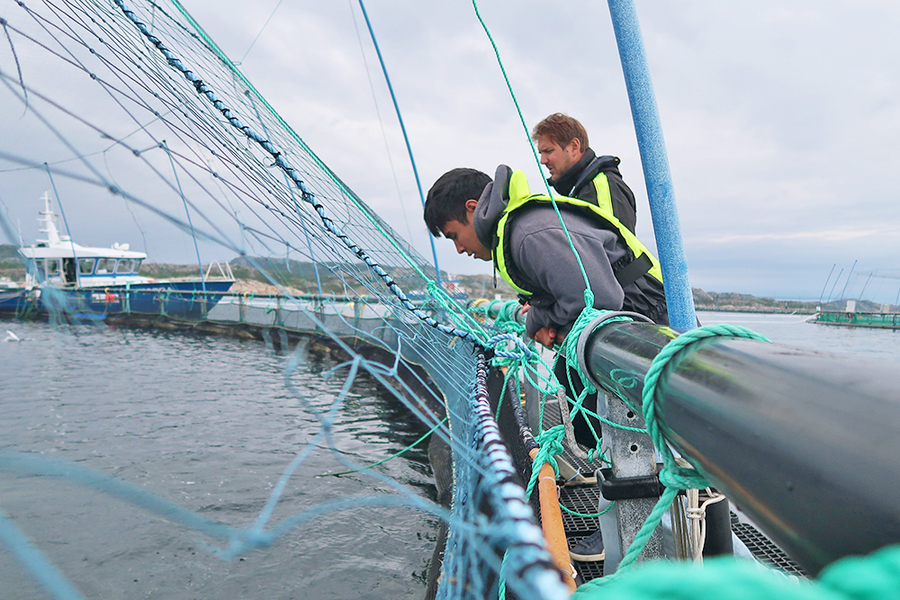
Singsholmen’s impressive infrastructure includes ten expansive, circular net pens, each spanning approximately 50 meters in diameter and extending deep beneath the ocean surface. These immense structures are capable of housing up to 200,000 salmon apiece. During the tour, student Tang recounted a tangible experience, observing the nets up close and recognizing the potential for robotic arms to conduct repairs, underscoring the blend of large-scale farming with innovative maintenance solutions.
Kelasidi strongly advocates for the unparalleled insights gained from direct fieldwork, asserting that such crucial information is simply unattainable within traditional office or laboratory environments. She explained that this on-the-ground experience is vital for grasping the true scale of both the operational challenges and the existing facilities. To advance this critical research area and foster the development of more resilient robotic systems, Kelasidi further underscored the imperative of robust international and institutional collaboration. She concluded by issuing a clear call for a united effort, advocating for a collaborative approach to address and resolve these issues effectively.
**Cambridge, MA** – MIT Sea Grant and the MIT-Scandinavia MISTI program are jointly recruiting a new cohort of four MIT students for summer internships in Norway, focusing on advancements in offshore farming technologies.
This unique opportunity invites students to contribute to cutting-edge research at pioneering Norwegian institutions, including NTNU’s Field Robotics Lab in Trondheim. Participants will gain invaluable hands-on experience in critical areas of modern aquaculture.
Ideal candidates will possess a keen interest in fields such as autonomous systems, deep learning, simulation modeling, and underwater robotic systems, as well as broader aquaculture-related disciplines.
MIT students eager to seize this opportunity should contact Lily Keyes at MIT Sea Grant for more information.





