
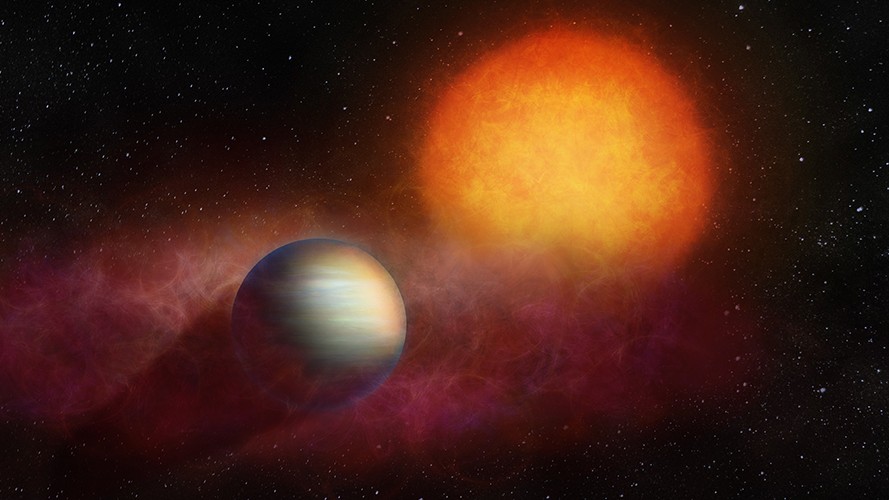
New astronomical observations have revealed a “super-puff” exoplanet is actively expelling a significant amount of helium into space. This phenomenon could signify the distant world is undergoing a dramatic and potentially rapid loss of its entire atmosphere.
New research, leveraging observations from the James Webb Space Telescope (JWST), has confirmed the detection of a substantial plume of helium gas actively evaporating from the colossal exoplanet WASP-107b. This significant atmospheric escape was detailed in findings derived from the powerful space observatory’s data.
A new study, detailed Monday (Dec. 1) in the journal Nature Astronomy, reports the observation of an immense gas cloud — nearly five times the planet’s diameter — visibly streaking far ahead of WASP-107b along its orbital path.
In a significant scientific first, the James Webb Space Telescope (JWST) has successfully observed helium escaping from a planet. This landmark detection marks a crucial achievement, as explained by lead author Vigneshwaran Krishnamurthy, a postdoctoral researcher at McGill University’s Trottier Space Institute in Montreal, in a recent statement.
Scientists say this new discovery offers crucial insights into the behavior of exoplanet atmospheres, particularly those found in extreme stellar environments such as the WASP-107 system, which hosts the planet WASP-107b.
Discovered in 2017, the exoplanet WASP-107b resides approximately 210 light-years from Earth, a significant stretch compared to the mere 4 light-years separating us from the nearest known planets. Despite being nearly Jupiter’s size, at 94% of the gas giant’s diameter, WASP-107b holds only 12% of its mass. This striking discrepancy between its large volume and exceptionally low mass places it in the distinct category of “super-puff” exoplanets.
Beyond its remarkably low density, the exoplanet WASP-107b occupies a strikingly anomalous position within its system. It orbits its host star at an astonishingly close proximity, situated seven times nearer than Mercury is to our Sun. This arrangement starkly contrasts with the architecture of our own solar system, where smaller, rocky planets reside closer to the Sun, while massive gas giants like Jupiter are typically found in more distant orbits. This significant deviation from established planetary models presents a compelling challenge for scientists, necessitating new theoretical frameworks to explain such unique formation and orbital dynamics.
Scientists hypothesize that the exoplanet WASP-107b initially coalesced at a considerable distance from its star, much like Jupiter and Saturn did in our own solar system. However, the prevailing theory suggests that gravitational interactions — possibly with an as-yet-unidentified companion planet — subsequently coerced WASP-107b to migrate closer to its host star over immense periods.
WASP-107c, orbiting significantly farther from its star than WASP-107b, may have been instrumental in the system’s planetary migration, according to study co-author Caroline Piaulet-Ghorayeb. Piaulet-Ghorayeb, an exoplanet researcher who completed her Ph.D. at the University of Montreal in 2024 and is now affiliated with the University of Chicago, offered this insight.
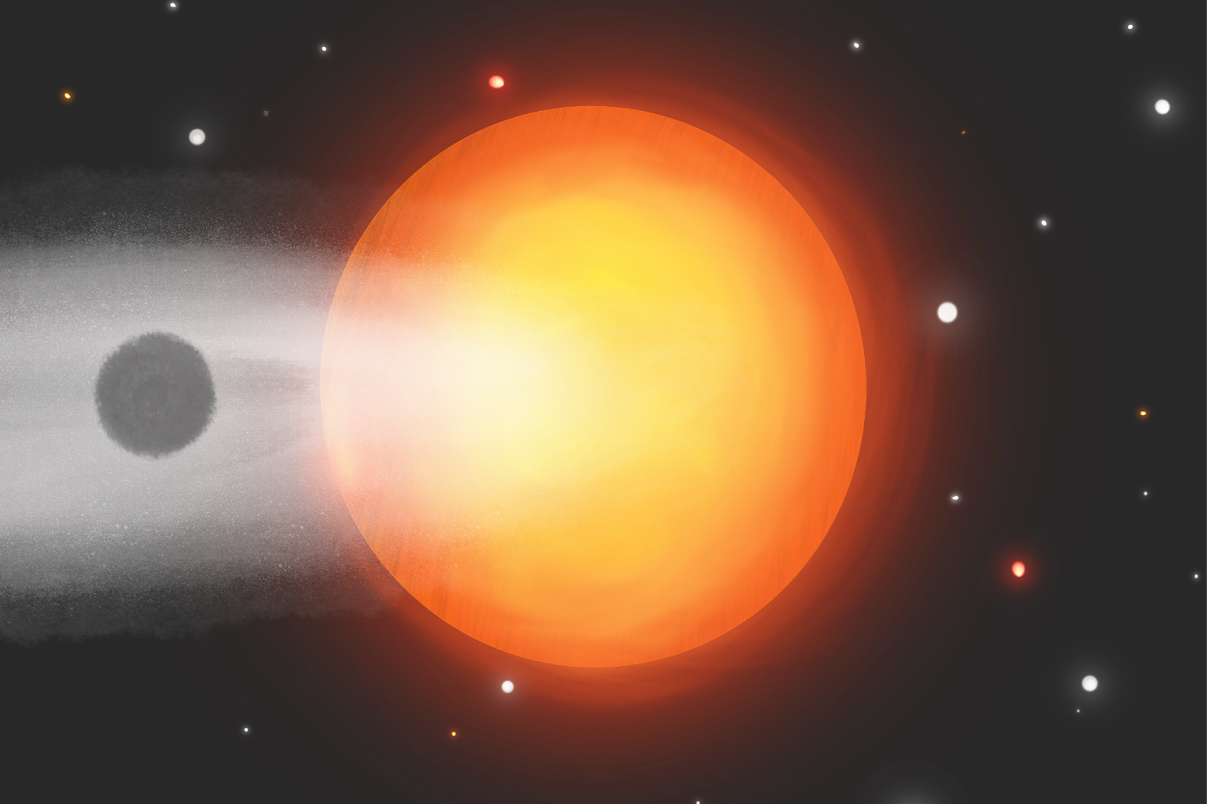
Exoplanet WASP-107b is experiencing severe atmospheric stripping due to its searingly close proximity to its host star, scientists have confirmed. The extreme heat generated by its tightened orbit is actively eroding the exoplanet’s vast gaseous atmosphere, researchers explained.
Crucially, new observations from the James Webb Space Telescope (JWST) have provided direct evidence of this dramatic process. The powerful observatory detected a substantial helium cloud, a telltale remnant of the exoplanet’s disintegrating atmosphere, as it transited the system’s parent star. This cloud was distinctly spotted approximately 90 minutes before WASP-107b itself passed into view.
Researchers investigating exoplanet WASP-107b have pinpointed specific atmospheric elements, offering crucial insights into the gas giant’s complex evolutionary path. A significant discovery is the presence of oxygen at concentrations far exceeding what would be anticipated if the planet had formed close to its host star. This unexpected abundance of oxygen provides compelling new evidence, strengthening the hypothesis that WASP-107b’s inward migration from a more distant orbit was a relatively recent astronomical event.
The James Webb Space Telescope’s latest atmospheric analysis not only affirmed the presence of water – a finding initially observed by the Hubble Space Telescope – but also precisely identified spectral signatures of carbon monoxide, carbon dioxide, and ammonia. Intriguingly, however, methane, a gas widely anticipated based on the planet’s chemical models, was conspicuously absent from the detections.
The James Webb Space Telescope’s extraordinary sensitivity, capable of remotely detecting methane, has unveiled unexpected atmospheric dynamics. Researchers, including Piaulet-Ghorayeb, now propose that intense stellar heating is driving “vigorous vertical mixing” deep within the planet’s atmosphere. This powerful churning, she explains, is likely pulling up gases significantly depleted in methane from these lower layers, rather than the methane-rich compounds one might expect.
While planets like Earth experience a relatively modest degree of atmospheric thinning, the extreme gas loss observed on worlds like WASP-107b offers scientists a crucial window into planetary evolution.
According to a statement from the University of Geneva, the research team believes studying these super-hot exoplanets can illuminate the mechanisms behind atmospheric escape on other celestial bodies. This understanding is particularly vital for planets like Venus, which over eons, saw its significant water reserves dissipate into space due to similar atmospheric stripping processes.