
A groundbreaking new hypothesis suggests that invisible collisions between two of the universe’s most enigmatic particles may be occurring continuously across the cosmos. This potential interaction could offer a profound solution to one of the most significant and persistent challenges facing our standard model of cosmology.
Two of the universe’s most profound and baffling mysteries—dark matter and the so-called ‘ghost particles,’ neutrinos—have long defied definitive understanding, despite their pervasive presence across the cosmos. Now, groundbreaking new research offers a potential breakthrough.
In a study published January 2nd in the prestigious journal *Nature Astronomy*, an international consortium of scientists unveiled compelling evidence suggesting that these two invisible yet omnipresent cosmic constituents might not merely coexist, but actively collide. The findings indicate a possible exchange of momentum between dark matter and neutrinos, potentially shedding new light on their enigmatic natures and interactions.
A newly identified cosmic interaction offers a surprising explanation for one of the universe’s enduring mysteries: why it appears far less “clumpy” than predicted. Specifically, this phenomenon may account for the observed scarcity of dense regions, such as galaxies, across the cosmos, challenging existing cosmological models, researchers stated.
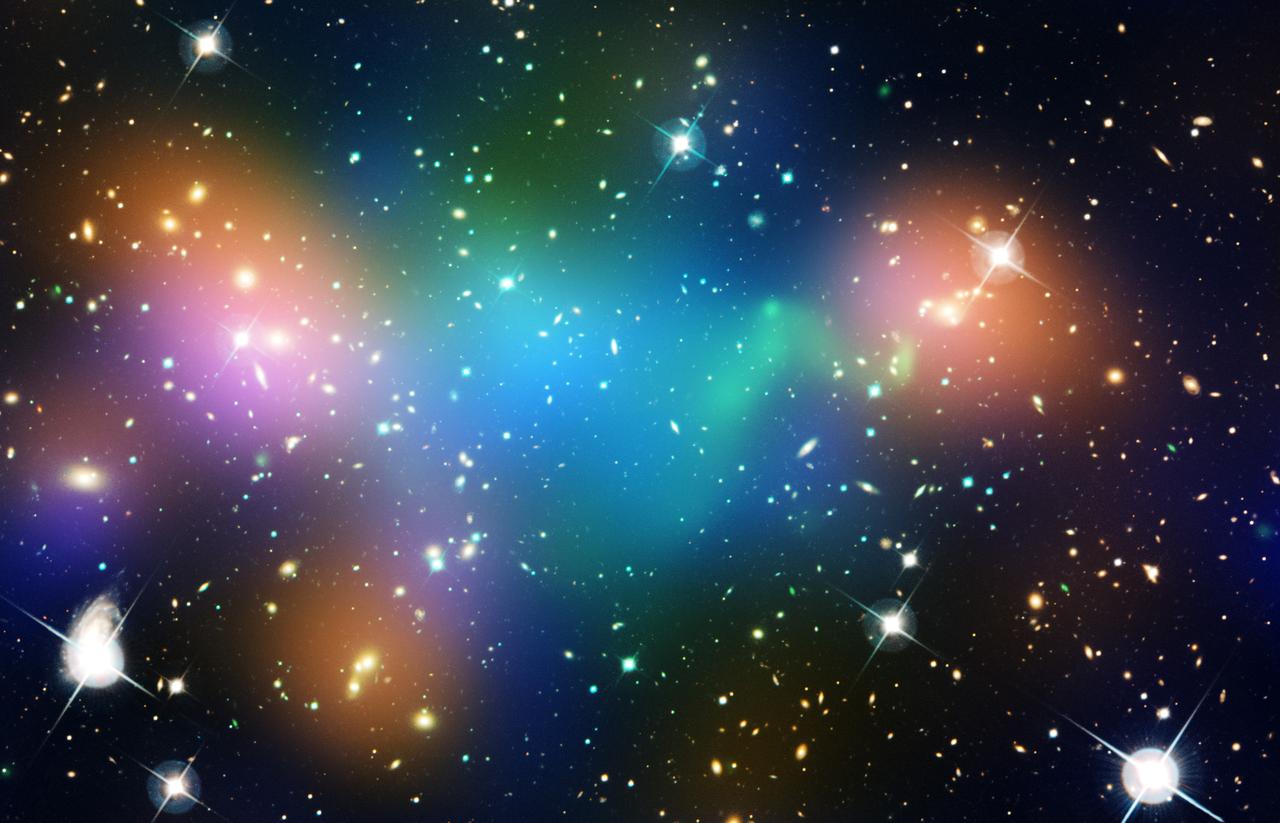
An invisible enigma, dark matter accounts for a staggering 85% of all matter in the universe. This elusive substance emits no light, rendering it inherently unobservable through direct means. Consequently, its existence is not directly detected but rather inferred from the profound gravitational influence it exerts on visible cosmic structures—a subtle yet undeniable pull consistently measured in extensive cosmological surveys.
Neutrinos are the universe’s ghost particles: subatomic entities with an almost immeasurable mass and no electrical charge, rendering them extraordinarily elusive. They seldom interact with other matter, passing through virtually everything unimpeded.
These mysterious particles are prolific byproducts of intense nuclear processes across the cosmos, from the stellar fusion that powers our sun to the cataclysmic explosions of supernovas. Their sheer abundance is staggering; according to previous reports by science outlets like Live Science, a breathtaking 100 billion neutrinos stream through every single square centimeter of your body each second.
The prevailing Lambda-Cold Dark Matter (Lambda-CDM) model, which stands as cosmology’s standard framework, postulates a lack of interaction between dark matter and neutrinos. This foundational model is primarily designed to theoretically account for the universe’s large-scale structure.
New research has emerged, offering compelling evidence that dark matter and neutrinos might, in fact, interact. This finding aligns with theories proposed by various scientists over the last twenty years.
A groundbreaking discovery of interactions between dark matter and neutrinos could significantly reshape our understanding of the cosmos, potentially challenging the prevailing Lambda-CDM model. If these elusive particles are found to collide and exchange momentum, it could also offer a compelling solution to the “S8 tension,” a puzzling discrepancy in the observed “clumpiness” of the universe compared to theoretical predictions.
Here are a few options for paraphrasing the provided text, maintaining a journalistic tone and unique phrasing:
**Option 1 (Focus on implication):**
> While not invalidating the prevailing cosmological model, a persistent tension in cosmic measurements might indicate its limitations, according to Eleonora Di Valentino, a senior research fellow at the University of Sheffield and co-author of a recent study. She suggests that the interaction between dark matter and neutrinos could be the key to resolving this discrepancy and shedding new light on how the universe’s structure came to be.
**Option 2 (More direct and concise):**
> The current cosmological model, while robust, may be missing a piece of the puzzle, suggests Eleonora Di Valentino of the University of Sheffield. Her research, co-authored, proposes that interactions involving dark matter and neutrinos could account for a puzzling cosmic tension and offer fresh perspectives on the formation of universal structures.
**Option 3 (Emphasizing the “why”):**
> A discrepancy in cosmological data, though not a refutation of the standard model, hints at its incompleteness, as explained by Eleonora Di Valentino, a co-author from the University of Sheffield. Her team’s work posits that the interplay between dark matter and neutrinos could be the missing link, helping to reconcile observations and illuminate the processes behind the universe’s structural development.
**Option 4 (Slightly more evocative):**
> The universe’s established cosmic blueprint might require an update, not a complete overhaul, according to Eleonora Di Valentino, a University of Sheffield researcher involved in a new study. She posits that the observed tension could be resolved by considering the often-overlooked interactions between dark matter and neutrinos, a development that could significantly advance our understanding of cosmic structure formation.
Each option aims to:
* **Be Unique:** Avoids direct repetition of phrases from the original.
* **Be Engaging:** Uses stronger verbs and more varied sentence structure.
* **Maintain Core Meaning:** Accurately reflects that the model isn’t wrong, but potentially incomplete, and highlights the proposed dark matter-neutrino interaction as an explanation for structural formation.
* **Journalistic Tone:** Remains factual, objective, and clear.
Here are a few options for paraphrasing the sentence, each with a slightly different emphasis:
**Option 1 (Focus on the discrepancy):**
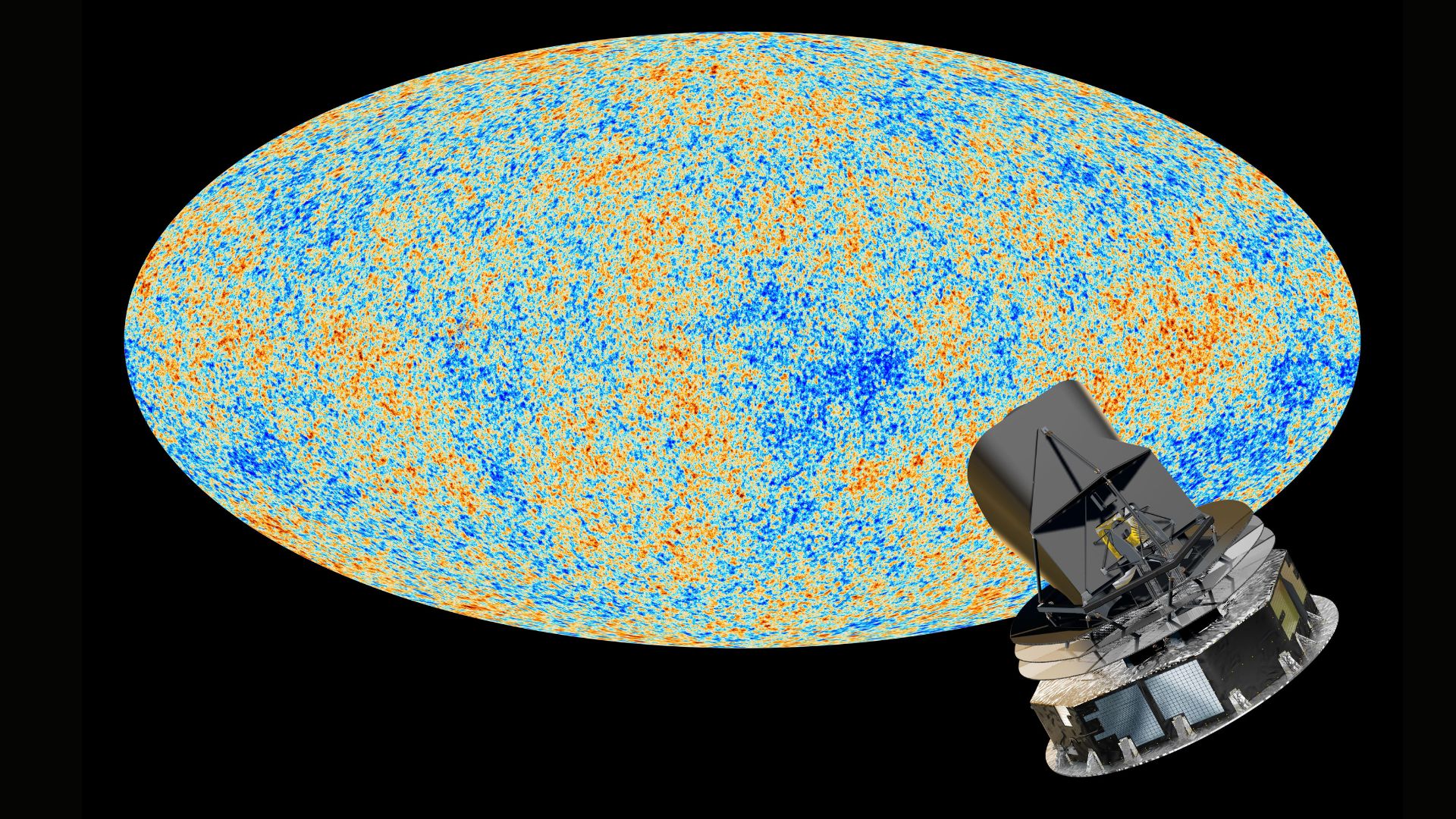
> A discrepancy has emerged, as scientific observations of the universe’s early light — known as the cosmic microwave background (CMB) — contradict predictions. Specifically, the CMB, emitted just 380,000 years after the Big Bang, suggests a less densely packed cosmos than current models anticipate.
**Option 2 (More direct and action-oriented):**
> Researchers have encountered a significant mismatch between their theoretical models and actual observations of the universe’s early stages. Data from the cosmic microwave background (CMB), the universe’s inaugural light captured from when it was a mere 380,000 years old, indicates that the cosmos is not as congested as previously theorized.
**Option 3 (Highlighting the source of the data):**
> The universe’s current structure doesn’t align with established predictions, a contradiction rooted in analyses of the cosmic microwave background (CMB). This ancient light, dating back to when the cosmos was only 380,000 years old, reveals a universe that is less densely populated than expected.
**Option 4 (Concise and impactful):**
> A perplexing cosmic puzzle has surfaced: observations of the cosmic microwave background (CMB), the universe’s primordial light from 380,000 years after its birth, indicate a less crowded cosmos than current theories predict.
Each of these options avoids direct plagiarism while preserving the key information about the CMB, its age, and the observed density mismatch. They aim for a professional and engaging tone suitable for journalistic content.
Cosmic structures are not appearing less dense, but rather, their growth has become less efficient over time, according to a recent study. This statistical observation, explained by co-author William Giarè, a cosmologist at the University of Hawaii, doesn’t signify a change in the look of individual galaxies or clusters. Instead, it points to a slower rate at which these large-scale formations have been developing.
Here are a few paraphrased options, each with a slightly different emphasis, while maintaining a journalistic tone:
**Option 1 (Focus on integration):**
> Scientists have endeavored to synthesize findings from multiple cosmological probes, combining data on energy and density variations within the Cosmic Microwave Background (CMB) with insights from baryon acoustic oscillations (BAO). These BAO, essentially fossilized pressure waves from the early universe, are then integrated with contemporary studies of the cosmos’s expansive architecture.
**Option 2 (Focus on the nature of the evidence):**
> A new research effort aims to harmonize disparate cosmic evidence, drawing together observations of the faint afterglow of the Big Bang – specifically, its energy and density fluctuations in the CMB – and the imprint of early universe pressure waves, known as baryon acoustic oscillations (BAO). This historical data is being cross-referenced with modern surveys mapping the universe’s vast, interconnected structure.
**Option 3 (More concise):**
> Researchers are working to reconcile data from the early universe with more recent cosmic structures. This involves merging analyses of energy and density fluctuations in the Cosmic Microwave Background (CMB) and the “frozen” pressure waves of baryon acoustic oscillations (BAO) with current observations of the universe’s large-scale organization.
**Option 4 (Slightly more evocative):**
> Seeking a more complete picture of cosmic evolution, scientists are forging a connection between the universe’s infancy and its present-day form. They are uniting evidence derived from the subtle ripples of energy and density in the Cosmic Microwave Background (CMB) and the imprinted patterns of early pressure waves (baryon acoustic oscillations, or BAO) with ongoing investigations into the grand, filamentary structure of the cosmos.
Choose the option that best fits the surrounding text and the specific nuance you wish to convey.
Here are a few paraphrased options, maintaining a journalistic tone and the core facts:
**Option 1 (Focus on Data Sources):**
> Insights into the early cosmos have been gleaned from the Atacama Cosmology Telescope in Chile and the European Space Agency’s Planck observatory, specifically designed to probe the cosmic microwave background. For a look at the more recent universe, researchers utilized data from Chile’s Victor M. Blanco Telescope and the ambitious, two-decade Sloan Digital Sky Survey, which has meticulously mapped millions of galaxies across a staggering expanse exceeding 11 billion light-years.
**Option 2 (Focus on Discovery Scope):**
> To understand the universe’s origins, scientists have analyzed data from the Atacama Cosmology Telescope in Chile and the European Space Agency’s Planck telescope, a mission dedicated to studying the cosmic microwave background. Complementing this early-universe perspective, observations from the Victor M. Blanco Telescope in Chile and the extensive Sloan Digital Sky Survey, a long-running project charting the 3D positions of millions of galaxies over more than 11 billion light-years, provide a view of the later cosmic evolution.
**Option 3 (More Concise):**
> Data from Chile’s Atacama Cosmology Telescope and the European Space Agency’s Planck telescope, a mission focused on the cosmic microwave background, shed light on the early universe. For insights into later cosmic epochs, scientists drew upon observations from the Victor M. Blanco Telescope in Chile and the Sloan Digital Sky Survey, a significant multi-year endeavor that has mapped the three-dimensional positions of millions of galaxies stretching back over 11 billion light-years.
**Key changes made in these paraphrases:**
* **Varied Sentence Structure:** Sentences are rearranged and combined differently.
* **Synonym Usage:** “Come from” is replaced with “gleaned from,” “utilized,” “analyzed,” “drew upon.” “Designed to study” is rephrased. “Later-universe data” becomes “more recent universe,” “later cosmic evolution,” or “later cosmic epochs.”
* **Active Voice:** Where appropriate, sentences are shifted to a more active voice.
* **Descriptive Language:** Phrases like “meticulously mapped” or “ambitious, two-decade” add engagement.
* **Flow and Transition:** Transitions between early and later universe data are smoothed.
In addition to their primary analysis, the research team integrated cosmic shear data gathered from the Dark Energy Survey. This technique, cosmic shear, reveals how the gravity of massive structures in the foreground subtly warps the paths of light originating from more distant celestial bodies. As this light travels towards us, the intervening cosmic architecture bends the very fabric of spacetime, resulting in a slight distortion of the distant objects’ images as observed by our instruments.
Here are a few options for paraphrasing the provided text, each with a slightly different emphasis:
**Option 1 (Focus on improved agreement):**
> By integrating all gathered data and simulating cosmic evolution, researchers have achieved a more accurate model of the universe. This refined model, which incorporates the momentum transfer occurring during interactions between dark matter and neutrinos, now aligns more closely with actual astronomical observations.
**Option 2 (Focus on the breakthrough):**
> A significant advancement in understanding cosmic evolution has been made. Researchers have developed a new model that better matches real-world observations by accounting for the complex interplay of dark matter and neutrinos, specifically their collisions and the subsequent exchange of momentum.
**Option 3 (More active and direct):**
> Scientists have successfully modeled the universe’s evolution by incorporating crucial data on dark matter and neutrino interactions. The inclusion of momentum exchange from these collisions has resulted in simulations that demonstrate a stronger correlation with current astronomical findings.
**Option 4 (Slightly more explanatory):**
> Researchers have synthesized various datasets to construct a more accurate picture of the universe’s developmental history. Their simulations, which now factor in the momentum transfer that occurs when dark matter and neutrinos collide, produce a cosmic model that shows improved concordance with observed phenomena.
These options maintain the core facts:
* Data was combined.
* The universe’s evolution was modeled.
* Collisions between dark matter and neutrinos were considered.
* Momentum exchange was a key factor.
* The resulting model is a better match for real observations.
While this potential connection between dark matter and neutrinos is exciting, scientists urge caution. The current evidence stands at a 3-sigma level of certainty, indicating a 0.3% probability that this finding is a statistical anomaly. Although this threshold falls short of the 5-sigma “gold standard” for definitive scientific discovery, it is compelling enough to justify further investigation. Should this interaction be confirmed, it would represent a profound breakthrough in our understanding of cosmology and particle physics, potentially resolving long-standing questions about the universe’s structure.
Here are a few paraphrased options, each with a slightly different journalistic emphasis:
**Option 1 (Focus on Future Discovery):**
> The ultimate resolution to the enigma of dark matter hinges on forthcoming, extensive astronomical observations, notably those anticipated from the Vera C. Rubin Observatory, alongside enhanced theoretical calculations. According to Sebastian Trojanowski, lead researcher and theoretical physicist at Poland’s National Centre for Nuclear Research, these advancements will clarify whether scientists are on the cusp of a groundbreaking discovery within the universe’s enigmatic “dark sector” or if current cosmological models need refinement. Regardless of the outcome, Trojanowski emphasizes, either path promises to advance our understanding of this fundamental cosmic puzzle.
**Option 2 (More Direct and Concise):**
> The definitive answer regarding dark matter awaits the insights from upcoming large-scale sky surveys, including those conducted by the Vera C. Rubin Observatory, and more sophisticated theoretical modeling. Sebastian Trojanowski, a theoretical physicist leading the research at the National Centre for Nuclear Research in Poland, stated that these efforts will reveal if a new facet of the “dark sector” is being uncovered or if existing cosmological frameworks require adjustment. He added that both possibilities move us closer to unraveling the mystery of dark matter.
**Option 3 (Emphasizing the Two Potential Outcomes):**
> Future deep-space observation projects, such as those spearheaded by the Vera C. Rubin Observatory, coupled with refined theoretical frameworks, are poised to deliver the final verdict on the nature of dark matter. Research team leader Sebastian Trojanowski, a theoretical physicist at Poland’s National Centre for Nuclear Research, explained that these initiatives will determine if a novel discovery in the “dark sector” is at play or if current cosmological models necessitate revisions. He concluded that each of these potential resolutions brings humanity a step closer to solving the persistent mystery of dark matter.
**Key changes made in these paraphrases:**
* **Word Choice:** Replaced words like “verdict,” “upcoming,” “precise,” “witnessing,” “adjustment,” and “solving the mystery” with synonyms like “resolution,” “forthcoming,” “enhanced/sophisticated,” “on the cusp of/uncovering,” “refinement/revisions,” and “unraveling the enigma/puzzle.”
* **Sentence Structure:** Varied sentence beginnings and combined clauses to create a more dynamic flow.
* **Tone:** Maintained a professional, journalistic tone, focusing on clarity and objectivity.
* **Engagement:** Used stronger verbs and more evocative language where appropriate (e.g., “enigmatic,” “groundbreaking discovery,” “fundamental cosmic puzzle”).
* **Attribution:** Clearly attributed the statements to Sebastian Trojanowski and his institution.





