**Astronomers Detect Signs of a Gargantuan Moon Orbiting Distant Gas Giant**
An extraordinary celestial discovery may be on the horizon, as astronomers have observed a gas giant planet, located far beyond our solar system, exhibiting an unusual wobble. This subtle, yet significant, movement suggests the presence of an orbiting moon, a finding that, if confirmed, promises to rewrite our understanding of planetary companions.
The potential moon in question is not just any satellite; preliminary observations indicate it would possess a staggering mass, rivaling roughly half that of Jupiter itself. This would dwarf any moon currently known within our own solar system by a factor of thousands, prompting a serious re-evaluation of what defines a moon in the vast expanse of the cosmos. The sheer scale of this hypothetical celestial body could redefine the boundaries of planetary science.
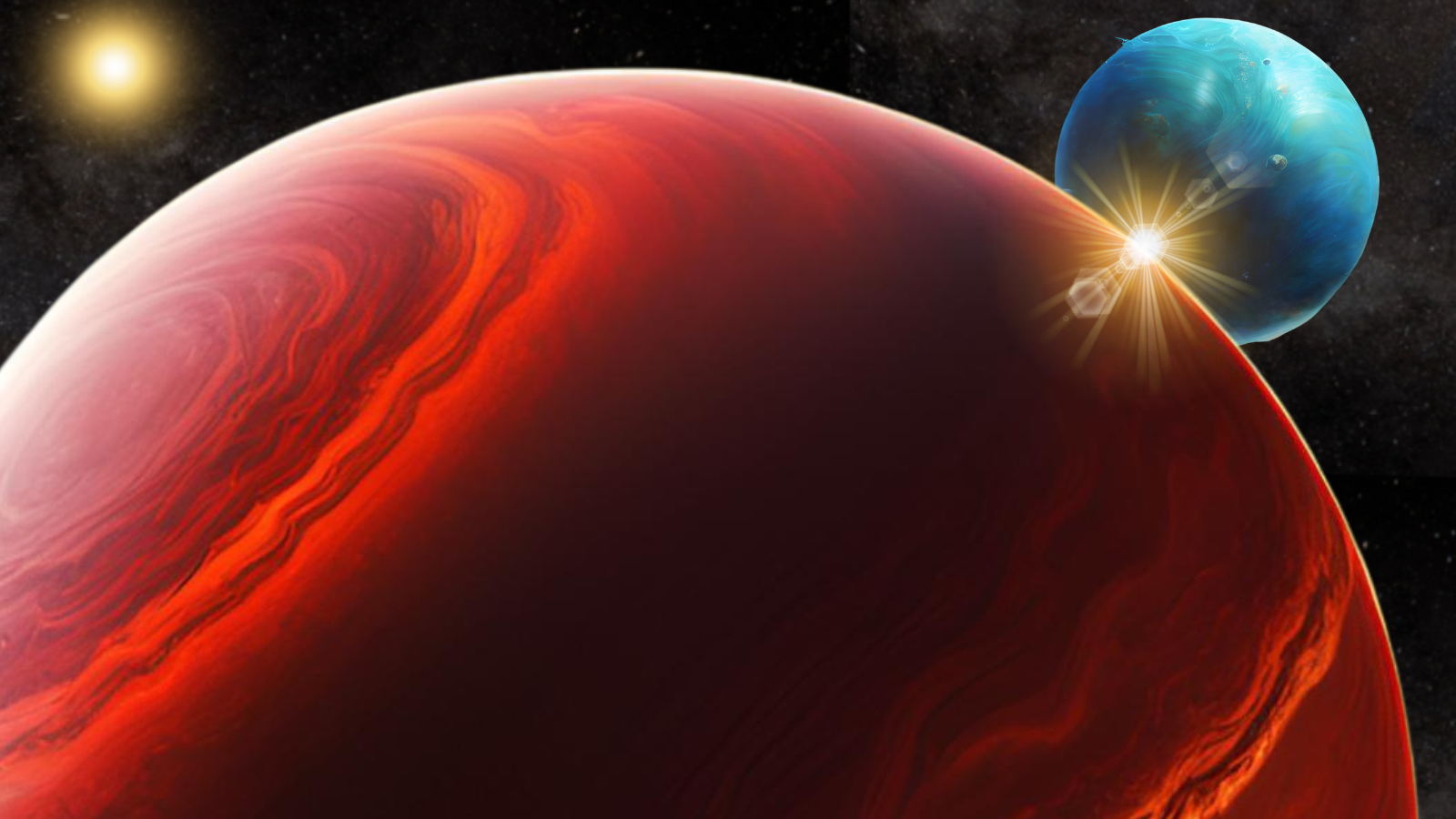
Astronomers have pinpointed a colossal gas giant, designated HD 206893 B, as the likely host of a remarkable exomoon. This gas giant, boasting a mass 28 times that of Jupiter, orbits a youthful star approximately 133 light-years away. The discovery was made by a research team utilizing the sophisticated GRAVITY instrument at the Very Large Telescope (VLT) in Chile’s Atacama desert, who observed unusual signals during their study of HD 206893 B.
Astronomers have identified an “intriguing candidate” in the quest for exomoons, after discovering that the object HD 206893 B exhibits a distinct, nine-month “wobble” in its orbit.
This small but measurable back-and-forth motion, with a size comparable to the Earth-moon distance, deviates from a smooth orbital path, according to team leader and University of Cambridge astronomer Quentin Kral. Speaking to Space.com, Kral explained that such a signal is precisely what one would expect if the object were under the gravitational influence of an unseen companion, such as a large moon, making HD 206893 B a prime target for exomoon research.

Leveraging the advanced capabilities of the GRAVITY instrument, researchers employed a sophisticated technique known as astrometry. This method precisely maps the evolving positions of stars and other celestial objects over time. Such exacting measurements empower astronomers to detect even the most subtle deviations in their movement, which serve as telltale indicators of a gravitational pull from an otherwise unseen cosmic body.
A breakthrough in astronomical observation has revealed a subtle, back-and-forth ‘wobble’ in the orbit of exoplanet HD 206893 B. This discovery stems from researchers dramatically refining a technique historically used to chart the vast, unhurried paths of massive exoplanets and brown dwarfs, which typically involved observations spaced years apart.
“In our study, we pushed this approach much further by monitoring the object over much shorter timescales, from days to months,” explained astronomer Kral. This intensified scrutiny unveiled that HD 206893 B’s journey around its parent star isn’t merely a predictable, smooth ellipse. “What we found is that HD 206893 B doesn’t just follow a smooth orbit around its star. On top of that motion, it shows a small but measurable back-and-forth ‘wobble,'” Kral concluded, highlighting a new layer of complexity in the exoplanet’s celestial dance.
A recent investigation has yielded compelling evidence for a celestial companion – a potential exomoon – orbiting the gas giant HD 206893 B. This inferred body completes an orbit approximately every nine months, maintaining a distance roughly one-fifth that of Earth from the sun.
Intriguingly, the orbit of this potential exomoon is dramatically tilted at about 60 degrees relative to its parent planet’s orbital plane. Such a significant inclination offers a potent clue, suggesting that some form of dynamic interaction or gravitational disturbance has perturbed this system at a pivotal point in its past.
Should its existence be confirmed, this distant exomoon stands to redefine our understanding of celestial bodies. Its estimated mass is truly colossal, weighing in at approximately 40% of Jupiter’s immense bulk—a staggering nine times that of the ice giant Neptune. Such extraordinary proportions, astronomers suggest, might compel a fundamental reevaluation of what qualifies as a “moon.”
Our solar system’s largest moon, Ganymede, is still dwarfed by the proposed exomoon candidate currently under inference. As astronomer Kral noted, Ganymede itself is thousands of times less massive than even a planet like Neptune. This stark comparison highlights an immense and unprecedented gap in mass between the largest known natural satellites and this potential new celestial body. If confirmed, the exomoon would exist in an entirely different class than any moon discovered to date.
Here are a few options for paraphrasing the provided text, each with a slightly different journalistic emphasis:
**Option 1 (Focus on the definitional challenge):**
> The question naturally arises: can an object of this mass truly be classified as a moon? At such low masses, the line between a substantial moon and a less significant planetary companion blurs considerably. While a universally accepted definition for exomoons remains elusive, the current practice among astronomers is to label any celestial body orbiting a planet or a substellar object as a moon.
**Option 2 (More direct and concise):**
> This discovery prompts a debate: is such a body accurately termed a moon? The significant overlap in mass between a large moon and a low-mass companion makes a clear distinction difficult. Currently, there is no official definition for exomoons. In practice, however, astronomers tend to categorize any object orbiting a planet or substellar companion as a moon.
**Option 3 (Highlighting the practical approach):**
> This observation naturally leads to a discussion about nomenclature. When an object reaches certain masses, the difference between a sizable moon and a less massive companion becomes indistinct. Although no official definition for exomoons currently exists, the prevailing approach among astronomers is to identify any orbiting body around a planet or substellar object as a moon.
**Key changes made in these paraphrases:**
* **”Naturally raises the question”** replaced with phrases like “prompts a debate,” “leads to a discussion,” or “naturally arises.”
* **”Such an object should even be called a moon”** rephrased to “can an object of this mass truly be classified as a moon?” or “is such a body accurately termed a moon?”
* **”At these masses, the distinction…becomes blurred”** reworded for variety, such as “the line between…blurs considerably” or “the significant overlap…makes a clear distinction difficult.”
* **”However, there is currently no official definition of an exomoon”** made more active, like “a universally accepted definition for exomoons remains elusive” or “no official definition for exomoons currently exists.”
* **”and in practice, astronomers generally refer to any object orbiting a planet or substellar companion as a moon”** varied to “the current practice among astronomers is to label,” “astronomers tend to categorize,” or “the prevailing approach among astronomers is to identify.”
* **Journalistic tone:** Used more active voice and straightforward sentence structures.
* **Engagement:** Introduced phrases that suggest a point of discussion or debate.
* **Uniqueness:** Employed different vocabulary and sentence construction.
Astronomers have previously identified potential exomoons, but these discoveries remain unconfirmed due to ongoing debate. A team is now working to provide definitive proof for the exomoon orbiting HD 206893 B, hoping it will be the first to be officially verified.
Here are a few paraphrased options, maintaining a journalistic tone and the core meaning:
**Option 1 (Focus on the challenge):**
> Detecting exomoons presents a significant astronomical challenge, as their signals are dwarfed by those of planets and are highly susceptible to the specific observation methods and the celestial alignment of the system, according to Kral.
**Option 2 (More active voice):**
> Kral highlighted the considerable difficulty in identifying exomoons, noting that their signals are minuscule in comparison to planets and are heavily influenced by the chosen observational techniques and the precise geometric arrangement of the system.
**Option 3 (Emphasizing sensitivity):**
> According to Kral, exomoons are notoriously elusive because their faint signals are vastly overshadowed by planetary emissions, with detection success hinging critically on both the employed observing strategies and the specific geometry of the exomoon system.
**Option 4 (Concise and direct):**
> “The minuscule signals exomoons emit, which are also highly dependent on observation methods and system geometry, make them incredibly hard to find,” Kral stated.
Each option rephrases the original sentence while retaining the key elements: the difficulty of exomoon detection, the small signal size relative to planets, and the dependence on observing technique and system geometry.
Astronomers have found the greatest number of planets outside our solar system by observing the subtle dimming of starlight. This technique, known as the transit method, works by detecting the slight decrease in brightness that occurs when an exoplanet passes directly in front of its host star from our perspective.
While this approach has proven effective in other astronomical pursuits, its application to discovering exomoons has yielded far less impressive results.
Here are a few options for paraphrasing the provided text, each with a slightly different emphasis while maintaining a journalistic tone:
**Option 1 (Focus on limitations):**
> While the transit method has proven exceptionally effective in discovering exoplanets, its ability to detect exomoons is significantly constrained. According to Kral, the technique, though theoretically capable of identifying moons as large as Jupiter’s biggest, is primarily sensitive to planets situated very near their stars. Furthermore, theoretical research indicates that these close-orbiting planets are unlikely to hold onto substantial moons for extended cosmic timescales.
**Option 2 (More direct and concise):**
> The transit method, the leading technique for exoplanet detection, faces limitations when it comes to finding moons. Kral explains that while the method could, in theory, spot moons similar in size to Jupiter’s largest, its sensitivity is highest for planets orbiting extremely close to their stars. However, scientific models suggest that such inner planets are improbable to keep large moons over vast stretches of time.
**Option 3 (Emphasizing the “why”):**
> The highly successful transit method for exoplanet discovery has a crucial caveat when it comes to finding exomoons, as explained by Kral. Although the technique could, in principle, identify moons comparable in size to Jupiter’s largest satellites, its efficacy is strongest for planets in very close proximity to their host stars. This presents a challenge because, according to theoretical studies, these tightly orbiting planets are unlikely to sustain large moons for geological epochs.
**Option 4 (Slightly more active voice):**
> Exoplanet hunters largely rely on the transit method, the most successful technique to date. However, Kral notes that this method’s capability to find exomoons is restricted. While it can, in principle, detect moons as sizable as Jupiter’s largest, the method excels at finding planets extremely close to their stars. Theoretical research, however, posits that such close-in planets would struggle to retain large moons over extended periods.
Each of these options aims to:
* **Be Unique:** They use different sentence structures and word choices.
* **Be Engaging:** They aim for clarity and directness that keeps the reader interested.
* **Be Original:** They rephrase the original statement without directly copying phrases.
* **Maintain Core Meaning:** All essential facts about the transit method’s capability and limitations regarding exomoons are preserved.
* **Use a Clear, Journalistic Tone:** The language is informative, objective, and professional.
Here are a few paraphrased options, each with a slightly different emphasis, maintaining a journalistic tone:
**Option 1 (Focus on Astrometry’s Capability):**
> Astrometry, a precise observational method, excels at identifying longer-period moons that orbit planets or substellar objects located at significant distances from their host stars. This capability makes the technique especially valuable for discovering exomoons in their expected stable orbits, particularly for the most massive lunar bodies, which are anticipated to be the initial targets of detection.
**Option 2 (Focus on the Promise for Exomoon Detection):**
> The astrometry technique offers a promising avenue for exomoon discovery, especially for those with extended orbital periods around planets or substellar companions situated far from their stars. This method is particularly well-suited for finding exomoons within regions where they are theorized to remain stable, with the most massive moons expected to be the first to be identified.
**Option 3 (More Concise and Direct):**
> Our astrometry technique is adept at spotting moons with long orbital periods around distant planets or substellar companions. This makes it a prime candidate for detecting exomoons in stable orbital zones, with the heaviest exomoons likely to be found first.
**Option 4 (Emphasizing the “Why it’s Promising”):**
> The sensitivity of astrometry to longer-period moons orbiting planets or substellar companions at a distance from their stars positions it as a particularly promising tool for exomoon detection. This is especially true in areas where exomoons are anticipated to be stable, with the most massive examples anticipated to be the first ones we can successfully locate.
Each of these options rephrases the original text using different sentence structures and vocabulary while preserving the core message about astrometry’s strengths in finding massive, distant exomoons in stable orbits.
Beyond the potential confirmation of an exomoon, the research conducted by Kral and his team, along with the innovative method they employed, is poised to serve as a foundational guide for future exomoon detection across the cosmos.
**Journalist’s Paraphrase:**
Kral emphasized that current discoveries likely represent only a fraction of what exists, likening it to the early days of exoplanet research. “Just as the earliest exoplanets found were the largest ones that happened to be in close proximity to their stars – due to their ease of detection – we anticipate that the first exomoons we pinpoint will be the most substantial and unusual specimens,” he stated. This suggests that as our detection capabilities improve, we will uncover a wider variety of exomoons, including smaller and less extreme examples.
Here are a few paraphrased options, maintaining a journalistic tone and core meaning:
**Option 1 (Focus on evolution):**
> With advancements in observational technology, our very definitions and comprehension of what qualifies as a moon are poised for significant evolution.
**Option 2 (Focus on certainty and change):**
> Enhanced observational capabilities are practically guaranteed to reshape our understanding and the criteria we use to define a moon.
**Option 3 (More direct and active):**
> As our ability to observe the cosmos sharpens, expect our definitions of what a moon is to inevitably change and deepen.
**Option 4 (Slightly more formal):**
> The ongoing improvement of observational techniques will almost certainly lead to a refinement of our definitions and understanding of moons.
**Option 5 (Emphasizing the “almost certainly”):**
> It’s a near certainty that as observational methods grow more sophisticated, our established definitions of moons will be updated and expanded.
Researchers have made their latest findings accessible as a pre-peer-reviewed paper on the online repository arXiv. This work has also been accepted for publication in the esteemed journal *Astronomy & Astrophysics*.