
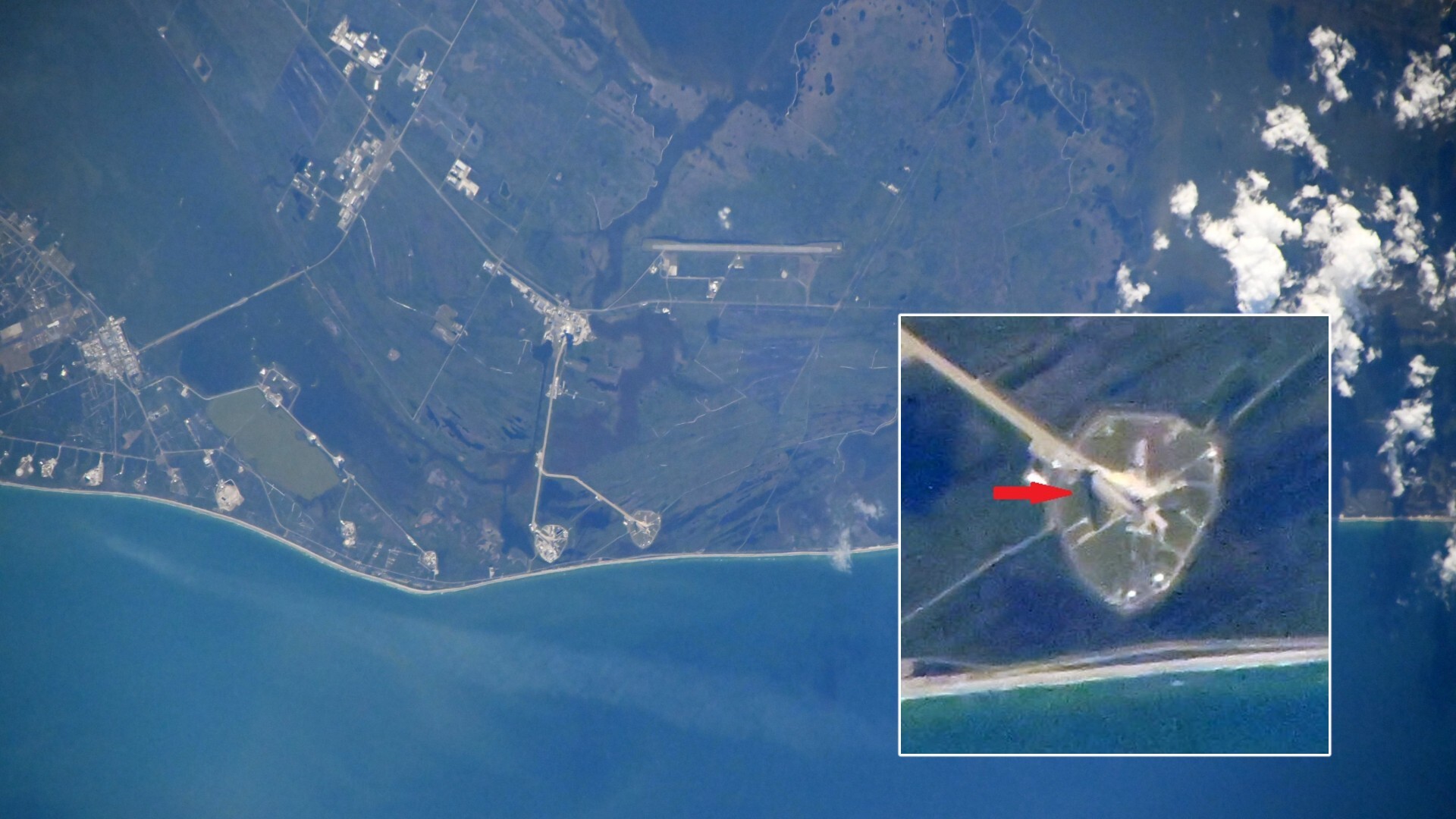
From his unique vantage point in orbit, America’s lone astronaut currently in space has captured an unprecedented image of NASA’s groundbreaking new rocket. This vehicle marks the first time in over half a century that the space agency has designed a rocket specifically for human moon missions.
Anticipation is building for NASA’s Artemis II mission after the colossal Space Launch System (SLS) rocket, designed to propel astronauts to the moon, arrived at its launch pad at Florida’s Kennedy Space Center this past Saturday, January 17. This pivotal mission, which will carry four astronauts around the Moon, could blast off as early as February 6.
The rocket’s presence didn’t go unnoticed, even from orbit. NASA astronaut Chris Williams, currently aboard the International Space Station, provided a unique, high-altitude perspective. From his vantage point, Williams captured an image that revealed the immense scale of the launch vehicle.
In a post on X (formerly Twitter) on Monday, January 19, Williams highlighted a subtle detail: “If you zoom in on the rightmost launch pad, you can see a shadow just to the left of the center of the pad,” he wrote. He then underscored the significance of this fleeting silhouette, confirming it was “from the rocket (and launch tower) that will soon take four of my friends on a trip around the moon.”
The upcoming Artemis II mission is set to make history, marking humanity’s first crewed return to the lunar vicinity since Apollo 17’s moon-landing excursion in 1972. This groundbreaking voyage will carry a four-person crew, each poised to achieve significant milestones in space exploration.
Leading the expedition as Commander will be NASA’s Reid Williams. He will be joined by fellow NASA astronauts Victor Glover, serving as Pilot, and Christina Koch, a Mission Specialist. Rounding out the quartet is Canadian Space Agency astronaut Jeremy Hansen, also a Mission Specialist.
Notably, Victor Glover will become the first person of color to venture beyond low Earth orbit. Christina Koch will make history as the first woman to embark on a lunar mission, while Jeremy Hansen will break new ground as the first non-American to journey around the Moon.

Astronaut Williams, currently the sole U.S. crew member aboard the International Space Station (ISS) following the unprecedented medical evacuation of SpaceX Crew-11 on January 15, recently shared a space photo that, while he critiqued his lens choice, held special significance. Coincidentally, the ISS orbited directly over Florida precisely as the colossal Space Launch System (SLS) rocket completed its journey to Launch Pad 39B.
The SLS arrived at its launch destination on Saturday at 6:42 p.m. EST (2342 GMT), marking the end of a nearly 12-hour, meticulously slow transit across Kennedy Space Center. Its stately progression was made possible by a historic, baseball-infield-sized “crawler-transporter,” a vehicle with a distinguished past, having previously ferried rockets for the Apollo and Space Shuttle missions.
The Artemis II mission is poised for a critical 10-day duration, marking the Orion capsule’s third journey into space. Its four-person crew will undertake rigorous testing of the spacecraft, commencing with an extensive checkout within Earth’s orbit. Should these initial system diagnostics prove successful, the astronauts will execute a powerful trans-lunar injection burn, propelling them on a trajectory around the Moon before their eventual return to Earth.
While Artemis II is poised to make history as the Orion spacecraft’s inaugural crewed mission, the capsule already boasts a substantial flight legacy. Its operational journey began in 2014 with Exploration Flight Test-1 (EFT-1), an uncrewed orbital mission that circled Earth, launched aboard a United Launch Alliance Delta IV rocket. More recently, in 2022, another uncrewed Orion successfully circumnavigated the Moon as part of the Artemis I mission, which also marked the maiden flight of the powerful Space Launch System (SLS) rocket.
**Artemis 2 Mission to Pave Way for Extended Lunar Stays with Groundbreaking Research**
The upcoming Artemis 2 mission is poised to conduct a comprehensive suite of scientific and human health experiments, laying critical groundwork for future, extended lunar expeditions. These investigations are designed to meticulously prepare for longer durations of human presence on the Moon.
**Artemis 3: A Landmark Lunar Landing Set for 2027 or 2028**
Following closely, Artemis 3 is targeted for a historic human landing on the lunar surface in either 2027 or 2028. This ambitious endeavor, however, remains contingent on the operational readiness of the SpaceX Starship lander, which has been designated for this pivotal role.
**Building a Lasting Lunar Foothold**
The Artemis program is envisioned as a multi-mission initiative, with subsequent missions slated to further expand humanity’s reach and capabilities on the Moon. NASA’s ultimate objective is to establish a sustained and permanent human presence on our celestial neighbor.
**Artemis 2 Launch Date Contingent on Rigorous Testing, Including Crucial Fueling Exercise**
The anticipated launch of the Artemis 2 mission faces a flexible timeline, as NASA navigates essential testing of the Space Launch System (SLS) rocket and Orion spacecraft at the launch pad. A critical component of this preparatory phase is the “wet dress rehearsal,” a simulated launch sequence involving the full fueling of the rocket. This specific exercise proved challenging during the Artemis 1 mission, requiring several attempts before certification. The current schedule aims to complete this vital rehearsal no later than February 2nd, with the ultimate launch date subject to the successful outcome of these stringent evaluations.
NASA is targeting a launch window for its Artemis 2 mission in February, March, or April of next year. Agency officials stated on January 16th that safety will be the paramount consideration for the mission’s readiness, emphasizing that they will not be “rushing” the process to meet a specific date. The team at the Kennedy Space Center reiterated their commitment to a secure and thorough launch preparation.





