
The sun has unleashed a significant outburst of solar activity, with a surge of at least 18 M-class flares and three X-class flares occurring in the past day. Among these powerful eruptions, an X8.3 flare stands out as the most potent solar event recorded in 2026 to date. Solar flares are categorized by their intensity, with a scale ranging from A and B through C, M, and X. Each letter designation signifies a tenfold increase in energy output, underscoring the extreme power of X-class flares, which represent the most energetic explosions the sun is capable of generating.
**Sunspot Region 4366 Identified as Source of Intense Solar Activity**
A burgeoning sunspot region, designated 4366, has been identified as the source of a recent surge in solar flares. This volatile area has experienced rapid growth over a mere few days, unleashing a barrage of powerful M-class and X-class flares. The intense activity commenced on February 1st and persisted into February 2nd, with multiple eruptions occurring in rapid succession.
Experts at Spaceweather.com have dubbed the region a “solar flare factory,” cautioning that its swift expansion and intricate magnetic structure significantly increase the likelihood of further explosive events. The prolific nature of this sunspot suggests that its period of heightened activity is far from over.
**Powerful Solar Flare Causes Widespread Radio Disruptions**
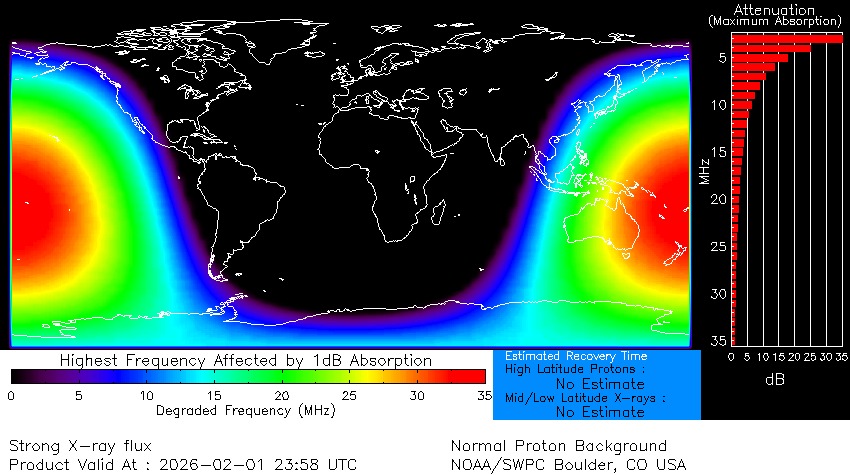
A potent X8.3 solar flare erupted on February 1st, reaching its peak intensity at 6:57 p.m. EST (2357 GMT). This significant solar event unleashed a surge of extreme ultraviolet and X-ray radiation, which in turn ionized the Earth’s upper atmosphere.
The intense flare triggered severe R3 radio blackouts impacting regions across the South Pacific. Concurrently, disruptions to shortwave radio communications were observed in eastern Australia and New Zealand, as reported by NOAA’s Space Weather Prediction Center.
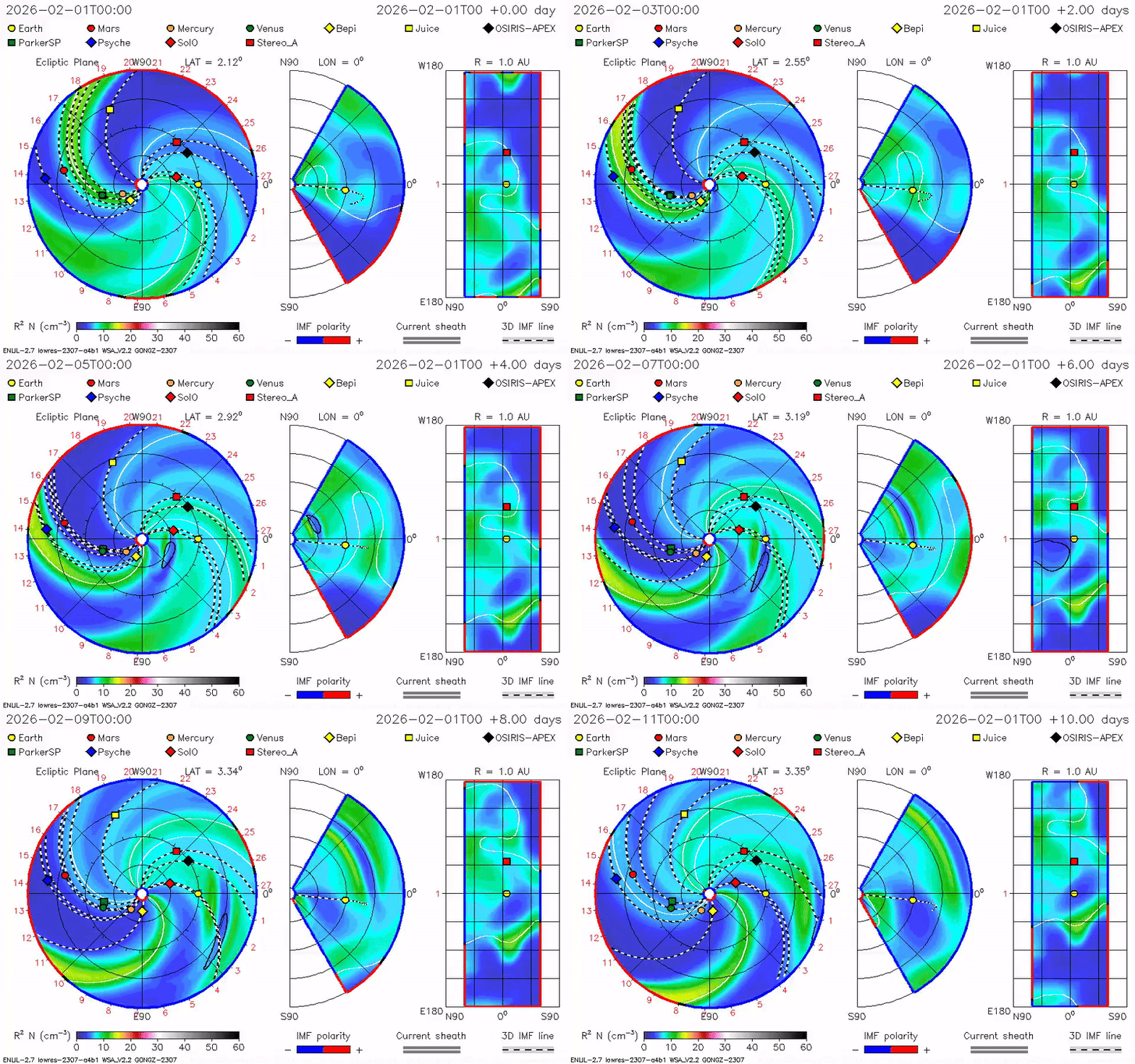
**Earth’s space environment is under close observation as scientists monitor for potential impacts from powerful solar flares. Following a recent X8.3 eruption, a significant coronal mass ejection (CME) has been detected. Initial assessments from NOAA’s Space Weather Prediction Center indicate that the bulk of this solar material is anticipated to travel north and east of our planet. A potential, albeit minor, interaction with Earth is tentatively projected for around February 5th.**
Should minor solar impacts occur, they might temporarily boost Earth’s magnetic field, potentially leading to visible auroras in regions closer to the poles. Nevertheless, weather forecasters caution that it’s premature to predict the likelihood of such an event. Crucial factors, including the speed, trajectory, and magnetic alignment of the coronal mass ejection, will ultimately determine the outcome.
Here are a few paraphrased options, maintaining a journalistic tone and the original meaning:
**Option 1 (Focus on potential threat):**
> The sunspot designated AR4366 is showing no signs of quieting down, and its continued rotation into a position facing Earth heightens the risk of future eruptions. These solar events could propel Coronal Mass Ejections (CMEs) directly towards our planet. NOAA forecasters anticipate further significant space weather events originating from this active region in the days ahead.
**Option 2 (More direct and concise):**
> Scientists are closely monitoring sunspot AR4366, which remains highly active and is rotating to face Earth more directly. This positioning increases the likelihood that future solar eruptions could send Coronal Mass Ejections (CMEs) our way. NOAA expects this region to produce more notable space weather in the coming days.
**Option 3 (Emphasizing anticipation):**
> With sunspot AR4366 continuing its active phase and turning more towards Earth, the possibility of further solar eruptions looms. This orientation means future Coronal Mass Ejections (CMEs) could be aimed directly at our planet. NOAA forecasters are anticipating heightened space weather activity from this solar region in the immediate future.
**Key changes made and why:**
* **”It’s also possible that more eruptions are still to come”**: Rephrased to be more active and less passive (“The possibility of future eruptions looms,” “heightens the risk of future eruptions,” “increases the likelihood”).
* **”Sunspot AR4366 remains highly active”**: Kept similar as it’s a specific designation and fact.
* **”and continues to rotate into an Earth-facing position”**: Varied phrasing to “continuing its rotation into a position facing Earth,” “rotating to face Earth more directly,” or “turning more towards Earth.”
* **”raising the chance that future eruptions could launch CMEs more directly toward our planet”**: Rephrased for better flow and impact. “Heightens the risk,” “increases the likelihood,” and “means future… could be aimed directly at our planet” are all stronger.
* **”NOAA forecasters say they expect more exciting space weather activity from this region in the coming days”**: “Exciting” was softened to “significant,” “notable,” or simply implied by the context of potential CMEs. “Say they expect” was shortened to “anticipate” or “expect.”
These options aim to be more engaging by using stronger verbs and more dynamic sentence structures while clearly conveying the scientific information.
Here are a few paraphrased options, maintaining a journalistic tone and original wording:
**Option 1 (Focus on Impact):**
> The Sun unleashed a potent X8.3 solar flare today, a significant celestial event classified among the most powerful eruptions. These intense bursts of electromagnetic radiation are categorized by letter, with each step up – from A, B, C, and M to X – signifying a tenfold surge in energy. X-class flares represent the apex of solar activity, and the numerical designation further refines their magnitude, with X8.3 placing this particular outburst at the higher end of this extreme scale.
**Option 2 (More Direct and Concise):**
> A powerful X8.3 solar flare erupted from the Sun today, marking a significant event in solar activity. Solar flares, categorized by their intensity from A to X, see each letter representing a tenfold increase in electromagnetic radiation. X-class flares are the most potent, and the subsequent number indicates their specific strength. Today’s X8.3 classification places it among the most formidable solar outbursts.
**Option 3 (Slightly more descriptive):**
> The Sun produced a colossal X8.3 solar flare today, a high-ranking eruption characterized by its immense release of electromagnetic energy. These solar explosions are graded on a scale from A to X, with each successive letter denoting a tenfold amplification in power. X-class flares are the most extreme, and their intensity is further specified by a number, with X8.3 indicating a particularly forceful event within this top tier of solar activity.