
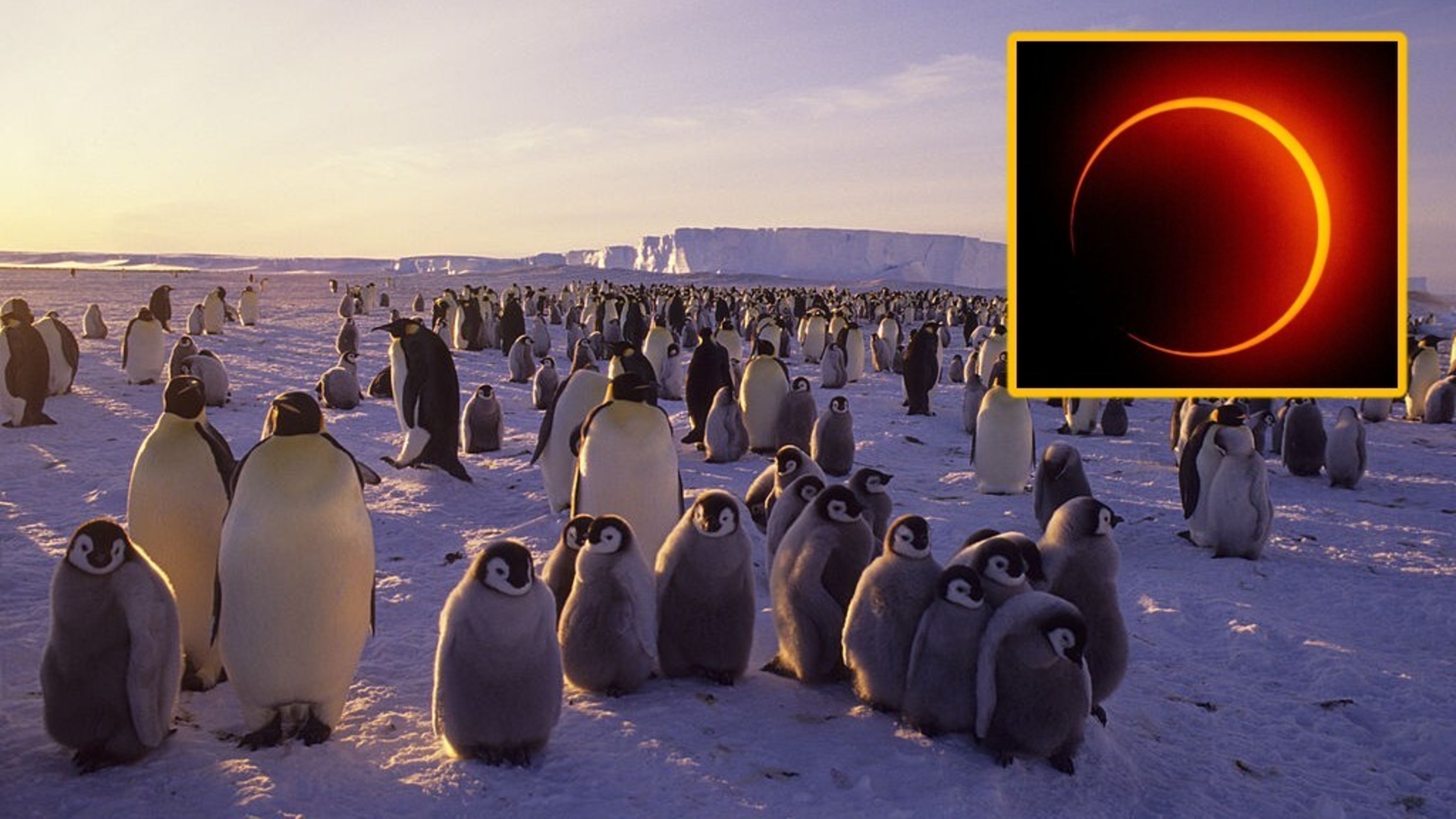
This coming Tuesday, February 17th, the new moon will largely go unnoticed across the globe. However, a select portion of Antarctica will be treated to a more spectacular celestial event: a rare “ring of fire” solar eclipse, also referred to as an annular solar eclipse.
An annular solar eclipse, a captivating celestial event, occurs when the Moon passes directly between the Sun and Earth. However, unlike a total eclipse, the Moon’s apparent size is insufficient to fully obscure the solar disk. This is due to the Moon being at its farthest point from Earth in its slightly elliptical orbit during these infrequent occurrences. The result is a dramatic “ring of fire,” a brilliant halo of sunlight encircling the Moon’s silhouette. For example, on February 17, spectators will witness an impressive 96% of the sun’s surface veiled during this striking phenomenon.
Along a precise, 383-mile-wide (616-kilometer) corridor, fortunate observers will be able to witness a mesmerizing “ring of fire”—a phenomenon where the sun’s glowing edge forms a brilliant halo around the moon’s dark silhouette. This celestial event will be visible for a duration of up to 2 minutes and 20 seconds.
Yet, this particular celestial event is destined to be witnessed by only a select few. Its trajectory is remarkably remote, charting a path across the vast, largely uninhabited interior of Antarctica, establishing it as one of the most geographically isolated eclipses imaginable.
The upcoming annular solar eclipse is expected to be an extraordinarily exclusive event, with potentially only a select few individuals positioned to view it from within its narrow path.
Eclipse meteorologist Jay Anderson, writing on his specialized website Eclipsophile, highlights the formidable challenge of reaching this annular zone. He points out that merely two inhabited locations fall within the shadow’s trajectory, and crucially, neither is equipped to accommodate visitors.
Consequently, Anderson anticipates that the event’s primary witnesses will be a small contingent: a few dozen Russian researchers at Mirny and a handful of French and Italian personnel at Concordia, both isolated Antarctic research stations. These dedicated scientists, he suggests, will be responsible for documenting the rare celestial phenomenon for posterity.
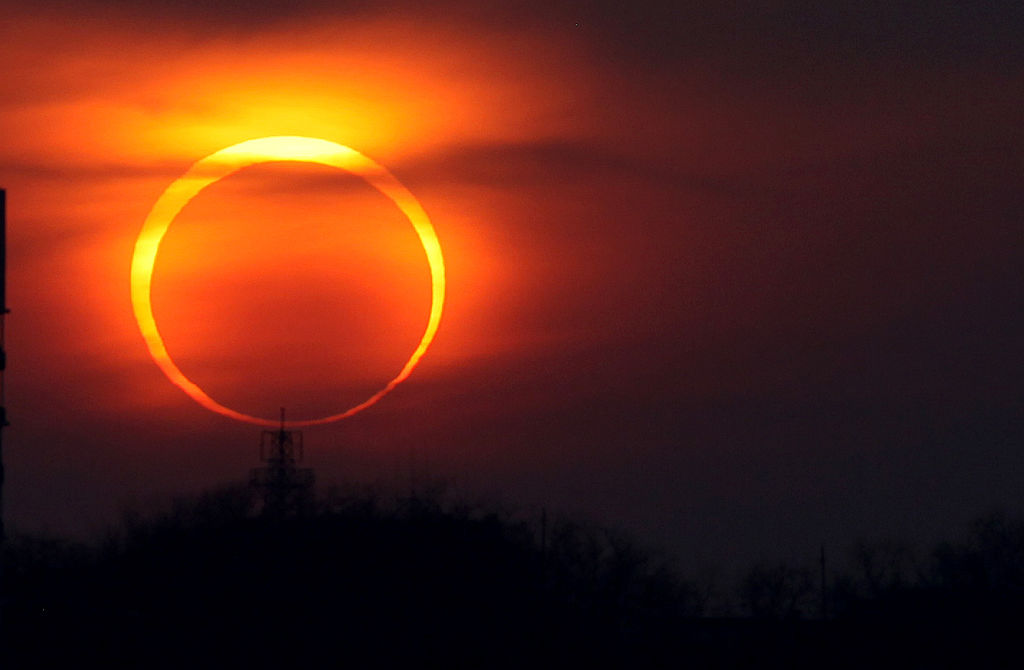
Antarctic observers at Mirny Station, located on the Davis Sea coast, are projected to experience the “ring of fire” annularity for a duration of 1 minute and 52 seconds. However, Concordia Station, jointly operated by France and Italy, is anticipated to offer a more prolonged view, with the annular phase lasting 2 minutes and 9 seconds. Crucially, the latter research outpost also boasts a significantly higher likelihood of clear skies, a key advantage for optimal viewing, according to Time and Date.
The upcoming celestial spectacle is slated to commence at 09:56 UTC (4:46 a.m. EST), initiating with a partial solar eclipse. This initial phase will cast its shadow over Antarctica and segments of southeastern Africa. Specifically, observers in Mozambique, Madagascar, and Mauritius can expect to witness a partial obscuration of the sun ranging from 10% to 35%. The highly anticipated annular phase, often described as a ‘ring of fire’ event, is scheduled to unfold between 11:42 UTC and 12:41 UTC (6:42 to 7:42 a.m. EST). The entire eclipse event, including all concluding partial phases, will fully dissipate by 14:27 UTC (2:27 p.m. EST).
Here are a few paraphrased options, maintaining a journalistic tone and originality:
**Option 1 (Focus on the predictable pattern):**
> Celestial observers can anticipate a cosmic follow-up to an upcoming annular solar eclipse. Due to the precise alignment required for the February 17 solar event, a lunar eclipse is guaranteed to occur during the subsequent new moon phase. This celestial spectacle will manifest as a total lunar eclipse on March 3, offering viewing opportunities across East Asia, Australia, New Zealand, select Pacific regions, and the western reaches of North America.
**Option 2 (More active and engaging):**
> The universe is set to deliver a double dose of eclipses. Following the precise cosmic ballet that will produce an annular solar eclipse on February 17, nature dictates a lunar eclipse will inevitably grace the sky with the next new moon. On March 3, skygazers in East Asia, Australia, New Zealand, portions of the Pacific, and western North America will be treated to the dramatic sight of a total lunar eclipse.
**Option 3 (Concise and direct):**
> Eclipses occur in pairs, and the upcoming annular solar eclipse on February 17 sets the stage for a lunar counterpart. As the sun, new moon, and Earth align with remarkable precision for the solar event, a lunar eclipse is a certainty. On March 3, this celestial pairing will culminate in a total lunar eclipse visible to audiences in East Asia, Australia, New Zealand, parts of the Pacific, and western North America.
Mark your calendars! The skies will put on a spectacular show on **February 6, 2027**, with an annular solar eclipse set to dazzle observers. This celestial event will present a breathtaking “ring of fire” phenomenon, which astronomers estimate could last for an impressive **7 minutes and 51 seconds**.
Residents of **Chile, Argentina, and Uruguay** in South America, as well as those in **Côte d’Ivoire, Ghana, Togo, Benin, and Nigeria** in Africa, will have prime viewing positions to witness this rare spectacle.





