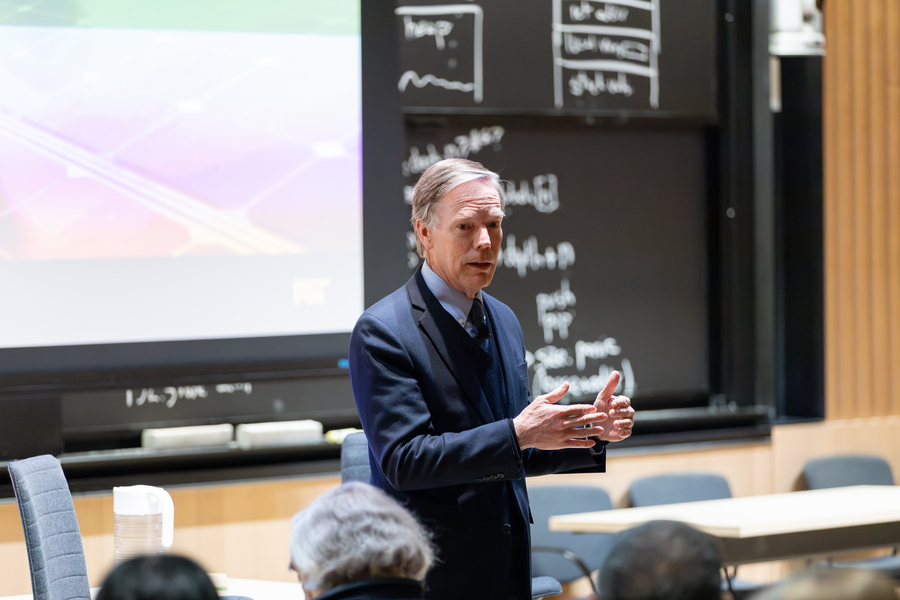
In a recent MIT seminar, Nicholas Burns, former U.S. Ambassador to the People’s Republic of China, highlighted the critical role of collaboration between the United States and China in addressing climate change. He stated that as the world’s two foremost carbon emitters, cooperation between the two nations is essential for the mutual benefit of both countries and for global progress.
During the “MITEI Presents: Advancing the Energy Transition” event, Burns offered a compelling analysis of the evolving U.S.-China relationship. His presentation underscored the profound geopolitical implications of this dynamic on international stability, alongside its critical impact on global progress towards a sustainable energy future and collective efforts to combat climate change.
Burns, now the Goodman Professor of the Practice of Diplomacy and International Relations at Harvard University’s Kennedy School of Government, highlighted the unparalleled global influence of the world’s two largest economies. He asserted that, due to their immense collective economic “weight,” these nations stand alone as the only two powers whose actions profoundly impact every other entity within the international system.
The intricate relationship between the United States and China has been succinctly characterized by Burns in three potent terms: competitive, tough, and adversarial. This frank assessment, he notes, accurately mirrors the sentiment held by both global powers. Burns further identified four crucial domains where this intense rivalry prominently unfolds: military capabilities, technological advancement, global trade and economics, and a fundamental divergence in values.
The complex economic ties between the United States and China are defined by a fierce pursuit of global primacy, according to Burns. He observed that both nations are driven to be “number one,” with neither prepared to accept a secondary position.
This competitive dynamic is particularly significant given China’s standing as the United States’ largest trade partner outside North America. Such high-stakes rivalries frequently generate substantial friction, manifesting in outright trade wars, as exemplified by conflicts in April and October 2025.
Burns specifically highlighted periods of extreme protectionist measures, recalling U.S. tariffs of 145% and Chinese tariffs of 125% on American goods. He stressed that such punitive duties “grind a relationship” to a halt, warning that “those level of tariffs, had they been sustained, would have meant zero trade between the two countries.”
The global energy sector faces significant geopolitical pressures, particularly concerning rare earth elements, a point emphasized by Ambassador Burns. China currently holds a commanding position, dominating the worldwide production and processing of these critical materials—components vital for technologies ranging from lithium batteries and solar panels to electric vehicles.
This near-monopoly has sparked a strong international response. In 2024 and 2025, the United States was not alone in imposing tariffs on these products; a growing coalition of nations, including India, Turkey, South Africa, Mexico, Canada, and the European Union, followed suit. Ambassador Burns voiced approval for this strategic shift, highlighting the bipartisan consensus in the U.S. on the matter: “I think the Trump administration is right, as President Biden was, to try to diversify sources on rare earths,” he affirmed.
Ambassador Burns additionally highlighted a striking paradox within China’s energy landscape: its simultaneous leadership in cutting-edge clean energy technologies and its persistent, large-scale reliance on coal. This, he noted, represents a significant inconsistency in Beijing’s broader environmental endeavors. Looking forward, Burns posited that climate change presents a critical avenue for collaboration between China and the United States, stressing the indispensable role of American engagement, both technologically and diplomatically, in fostering such a partnership.
Burns also detailed the intense technological competition between the United States and China, identifying it as an area of paramount strategic importance. Throughout his remarks, he consistently lauded China’s formidable emphasis on education and academic achievement, particularly its robust investment in Science, Technology, Engineering, and Mathematics (STEM) fields.
To underscore this commitment, Burns referenced a recent article in *The Economist* that highlighted a stark disparity: 36 percent of Chinese first-year university students pursue STEM majors, a figure that dramatically overshadows the mere 5 percent observed among their American counterparts. This imbalance, Burns argued, demands critical attention, prompting a reflection on the sheer volume of graduates each nation produces and, crucially, the proportion of those who ultimately enter science and technology professions.
The forefront of technological innovation is currently defined by rapid advancements in artificial intelligence, quantum computing, and biotechnology. According to analyst Burns, China exhibits significant prowess in industrial processes and a swift doctrine of adaptation. Burns further elaborated that maintaining a competitive edge is not solely about being the first to introduce a technology to the market; rather, it critically hinges on which nation or entity adopts the technology earliest and effectively merges that technological progress with strategic policy.
In a stark assessment of global affairs, U.S. Ambassador to China, Nicholas Burns, has declared the relationship between the United States and China to be the “most important” on Earth. He emphasized that the critical challenge lies in navigating the competitive landscape between the two superpowers. The ultimate success, according to Burns, will be measured by their ability to safeguard their respective interests while simultaneously preventing the catastrophic potential of their vast military might from being unleashed. To avert disaster, Burns stressed the urgent need to “normalize the communication and engagement” between the nations.
In an era of unprecedented global interconnectedness, the world faces a critical juncture. As stated by Burns, the destinies of individuals, nations, and the entire international community are inextricably bound by expansive, cross-border issues. He emphasized the urgent necessity of navigating a path that allows for robust competition while simultaneously fostering peaceful coexistence.
Here are a few options for paraphrasing the provided text, each with a slightly different emphasis:
**Option 1 (Focus on Innovation and Impact):**
> Delve into the future of energy with MITEI’s speaker series, featuring leading minds driving critical advancements in scientific, technological, and policy innovations. These experts are at the vanguard of transforming our global energy landscape. Discover more about this and other upcoming events on MITEI’s Events page.
**Option 2 (Focus on Transformation and Expertise):**
> MITEI’s compelling speaker series showcases prominent energy experts and leaders who are spearheading the scientific, technological, and policy transformations essential for reshaping our energy systems. For details on this and other MITEI events, please consult the MITEI Events page.
**Option 3 (More Direct and Action-Oriented):**
> Gain insights from top energy professionals in MITEI’s speaker series. These experts are pioneers in the scientific, technological, and policy solutions crucial for revolutionizing our energy infrastructure. Find further information about this and other MITEI events by visiting their Events page.
**Option 4 (Concise and Engaging):**
> Explore cutting-edge energy solutions with MITEI’s speaker series, spotlighting the scientists, technologists, and policymakers at the forefront of energy system transformation. Learn more about this and other events on MITEI’s dedicated Events page.
Each of these options aims to:
* **Be Unique:** They use different vocabulary and sentence structures than the original.
* **Be Engaging:** Phrases like “delve into the future,” “compelling speaker series,” and “gain insights” are used to draw the reader in.
* **Be Original:** They rephrase the core ideas without simply rearranging words.
* **Maintain Core Meaning:** The central message about the speaker series, its focus on experts, and the call to action remain intact.
* **Use a Journalistic Tone:** The language is clear, informative, and objective.