
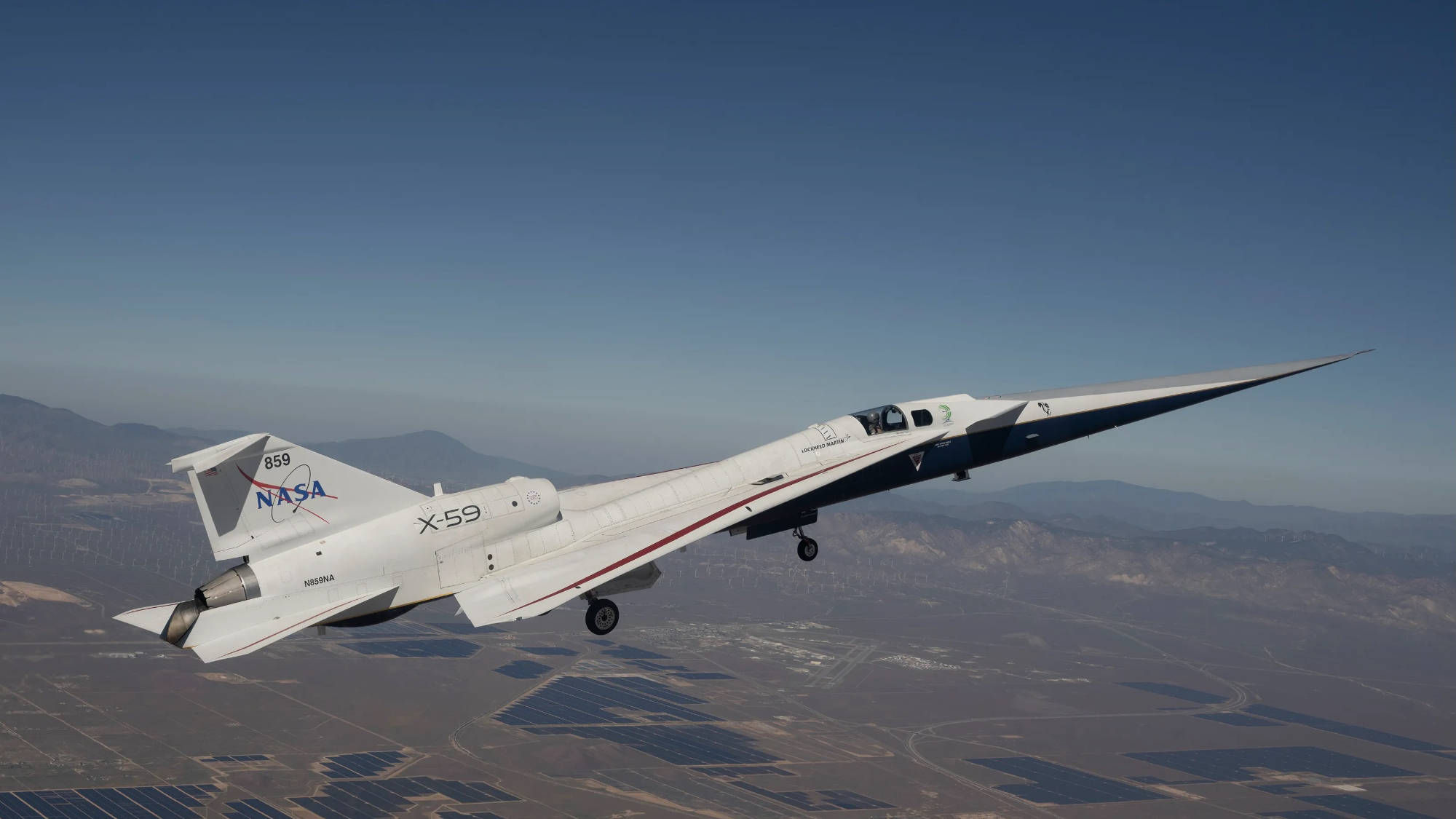
NASA’s groundbreaking X-59 supersonic jet made its second-ever flight on Friday, March 20th, though its time airborne was brief.
The potentially revolutionary X-59 aircraft executed an early landing this past Friday, just nine minutes into its second test flight. The follow-up mission was reportedly curtailed after a warning light illuminated in the cockpit, prompting its swift return.
Despite an earlier-than-anticipated landing, Friday marked a successful outing for NASA’s Low-Boom Flight Demonstrator team, according to project manager Cathy Bahm. From NASA’s Armstrong Flight Research Center in Edwards, California, Bahm affirmed that crucial data was collected and the pilot returned safely. The team, she added, is eager to resume flight operations as quickly as possible.
Since 1973, the United States has maintained a clear prohibition on civilian supersonic flights—those traveling faster than the speed of sound—over its landmass. This long-standing ban was enacted specifically to mitigate the disruptive impact of sonic booms. These intense shockwaves, generated when an aircraft breaks the sound barrier (which at sea level is approximately 761 miles per hour, or 1,225 kilometers per hour), were deemed too problematic for overland travel due to their noise and potential to cause disturbance.
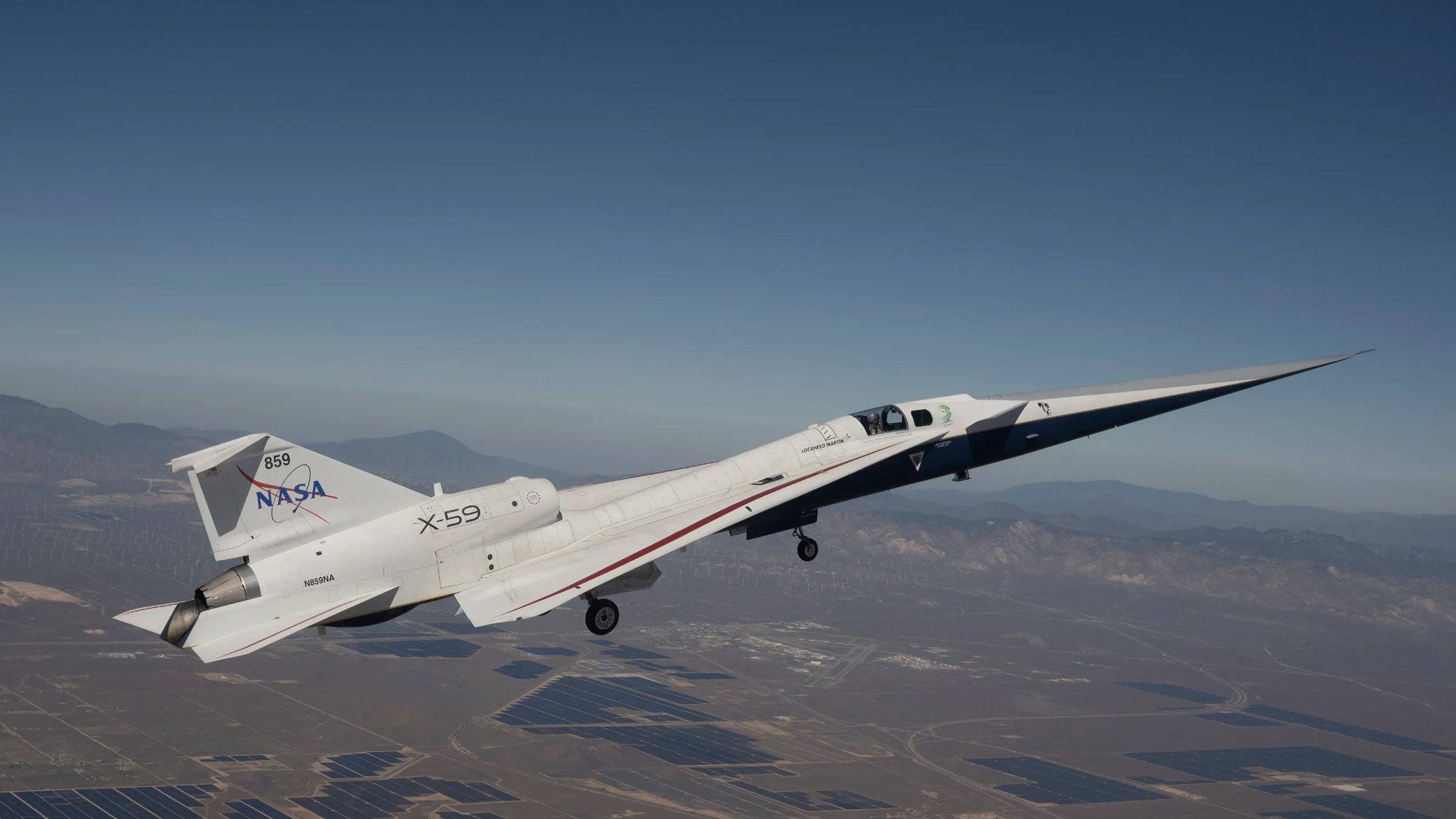
NASA is poised to revolutionize supersonic travel with its X-59 experimental aircraft, the centerpiece of the ambitious Quesst (“Quiet Supersonic Technology”) mission. This innovative plane, distinguished by its elongated nose, is meticulously engineered to dramatically reduce the disruptive sonic boom, aiming instead to produce merely a soft “thump” when it breaks the sound barrier.
NASA officials confirm that data from the Quesst program is poised to establish new, acceptable noise thresholds for supersonic flights over land. This pivotal development, they explain, is expected to unlock burgeoning commercial markets for both cargo and passenger services, ultimately ushering in an era of faster-than-sound air travel.

**Palmdale, California** – The experimental X-59 aircraft, a collaborative endeavor between NASA and Lockheed Martin, successfully completed its inaugural flight on October 29, 2025. The 100-foot-long (30.5-meter) demonstrator took to the skies from Lockheed Martin’s renowned Skunk Works facility in Palmdale, marking a significant milestone for the program.
Under the command of test pilot Nils Larson, the X-59’s 67-minute maiden voyage proceeded without incident. The aircraft ascended to a maximum altitude of 12,000 feet (3,660 meters) and reached a top speed of 230 mph (370 kph). NASA officials confirmed the flight unfolded “precisely as planned,” heralding a smooth and successful debut for the pioneering jet.
NASA had set ambitious goals for the X-59’s second test flight, an hour-long endeavor aimed at “expanding the envelope” of the experimental aircraft’s capabilities. Test pilot Jim “Clue” Less was tasked with replicating the jet’s previous altitude and speed marks before pushing its performance further, targeting 260 mph (418 kph) at an altitude of 20,000 feet (6,100 m). However, the planned objectives for this advanced phase of testing ultimately went unfulfilled.
Here are a few options, maintaining a clear, journalistic tone:
**Option 1 (Concise):**
“The X-59 aircraft successfully completed a brief, nine-minute flight from Edwards Air Force Base in Southern California on Friday. Lifting off at 1:54 p.m. EDT (10:54 a.m. local time), the experimental jet made a safe return to the high-desert facility just moments later.”
**Option 2 (Slightly more detail):**
“On Friday, the X-59 took to the skies from Edwards Air Force Base in Southern California, embarking on a successful nine-minute flight. The aircraft departed at 1:54 p.m. EDT (1754 GMT; 10:54 a.m. local time) and touched down safely at the base just a short time later.”
**Option 3 (Emphasizing the successful outcome):**
“A successful flight for the X-59 aircraft concluded on Friday, with the experimental jet departing and safely landing at Edwards Air Force Base in Southern California. The entire mission, which began at 1:54 p.m. EDT (10:54 a.m. local time), lasted a mere nine minutes.”
Here are a few ways to paraphrase the provided text, maintaining a journalistic tone:
**Option 1 (Focus on the sequence of events):**
> “The flight proceeded smoothly through its takeoff and initial climb, as the crew prepared for the first testing phase. However, a critical warning prompted an immediate diversion back to base,” explained Less during a press briefing on Friday afternoon.
**Option 2 (More direct and action-oriented):**
> “After an uneventful takeoff and climb, just as we were gearing up for the first test point, a warning forced us to abort the mission and return to base,” Less stated at a press conference Friday afternoon.
**Option 3 (Emphasizing the unexpected nature of the warning):**
> According to Less, who spoke at a press briefing Friday afternoon, the flight experienced a normal takeoff and ascent. “We were poised to begin our first test when an unexpected warning necessitated an immediate return to our home base.”
**Option 4 (Concise and informative):**
> Less reported Friday afternoon that the aircraft’s takeoff and initial climb were without incident. “We were preparing for the first test point when a warning required us to return to base immediately.”
**Key changes made:**
* **”Uneventful” variations:** “Proceeded smoothly,” “without incident,” “normal.”
* **”Climbing out, getting ready to set up the first test point” variations:** “Initial climb,” “prepared for the first testing phase,” “gearing up for the first test point,” “poised to begin our first test,” “preparing for the first test point.”
* **”Got the warning, which required an immediate return to base” variations:** “A critical warning prompted an immediate diversion back to base,” “a warning forced us to abort the mission and return to base,” “an unexpected warning necessitated an immediate return to our home base,” “a warning required us to return to base immediately.”
* **”Less said during a press briefing on Friday afternoon” variations:** “Explained Less during a press briefing on Friday afternoon,” “Less stated at a press conference Friday afternoon,” “According to Less, who spoke at a press briefing Friday afternoon,” “Less reported Friday afternoon.”
Each option offers a slightly different emphasis while conveying the same essential information in a clear, professional, and engaging manner.
Here are a few paraphrased options, maintaining a journalistic tone and the core meaning:
**Option 1 (Focus on unexpected urgency):**
“Despite the unplanned urgency of my initial landing, the aircraft performed exceptionally well,” he reported.
**Option 2 (More active voice):**
The pilot stated, “The plane handled beautifully, even though I hadn’t anticipated such a sudden need for my first landing.”
**Option 3 (Slightly more concise):**
“Even though my first landing had to be more abrupt than planned, the aircraft performed flawlessly,” he commented.
**Option 4 (Emphasizing the plane’s capability):**
He added that the aircraft “performed beautifully,” noting that the urgent nature of his first landing was not his original intention.
Mission control acknowledged that the precise reason for the launch alert remains unclear at this early stage, according to members of the Quesst team. They also revealed that a less severe “caution” advisory, concerning a different vehicle subsystem, emerged approximately one hour before the planned liftoff. This earlier advisory, however, did not prevent the flight from proceeding.
According to Less, both matters are currently being examined and there is no cause for undue alarm regarding either situation.
Here are a few paraphrased options, maintaining a professional and journalistic tone:
**Option 1 (Focus on progression and future):**
> “This initial phase marked just the start of an extensive flight-testing program,” he explained. “We’ve successfully collected valuable new data, and numerous additional flights are scheduled to gather even more comprehensive information.”
**Option 2 (More concise and direct):**
> According to him, “This was merely the opening chapter in a prolonged flight-test initiative. We’ve obtained previously unavailable data, and a significant number of flights remain to acquire further insights.”
**Option 3 (Emphasizing the learning aspect):**
> “This represented the initial step in what will be a substantial flight-testing endeavor,” he stated. “The first tests yielded unprecedented data, and we anticipate many more flights to expand our knowledge base considerably.”
**Option 4 (Slightly more active voice):**
> He commented that, “This marked the commencement of a lengthy flight-test campaign. The initial flights provided us with crucial new data, and many more are planned to amass an even greater volume of information.”