
While Saturn is famously adorned with its iconic rings, the gas giant has long captivated scientists for another equally compelling reason: its extraordinarily dynamic atmosphere. This turbulent realm is a theater of extreme weather, shaped by formidable winds, colossal and persistent megastorms, and peculiar weather patterns that can inexplicably linger for years, offering a profound source of study.
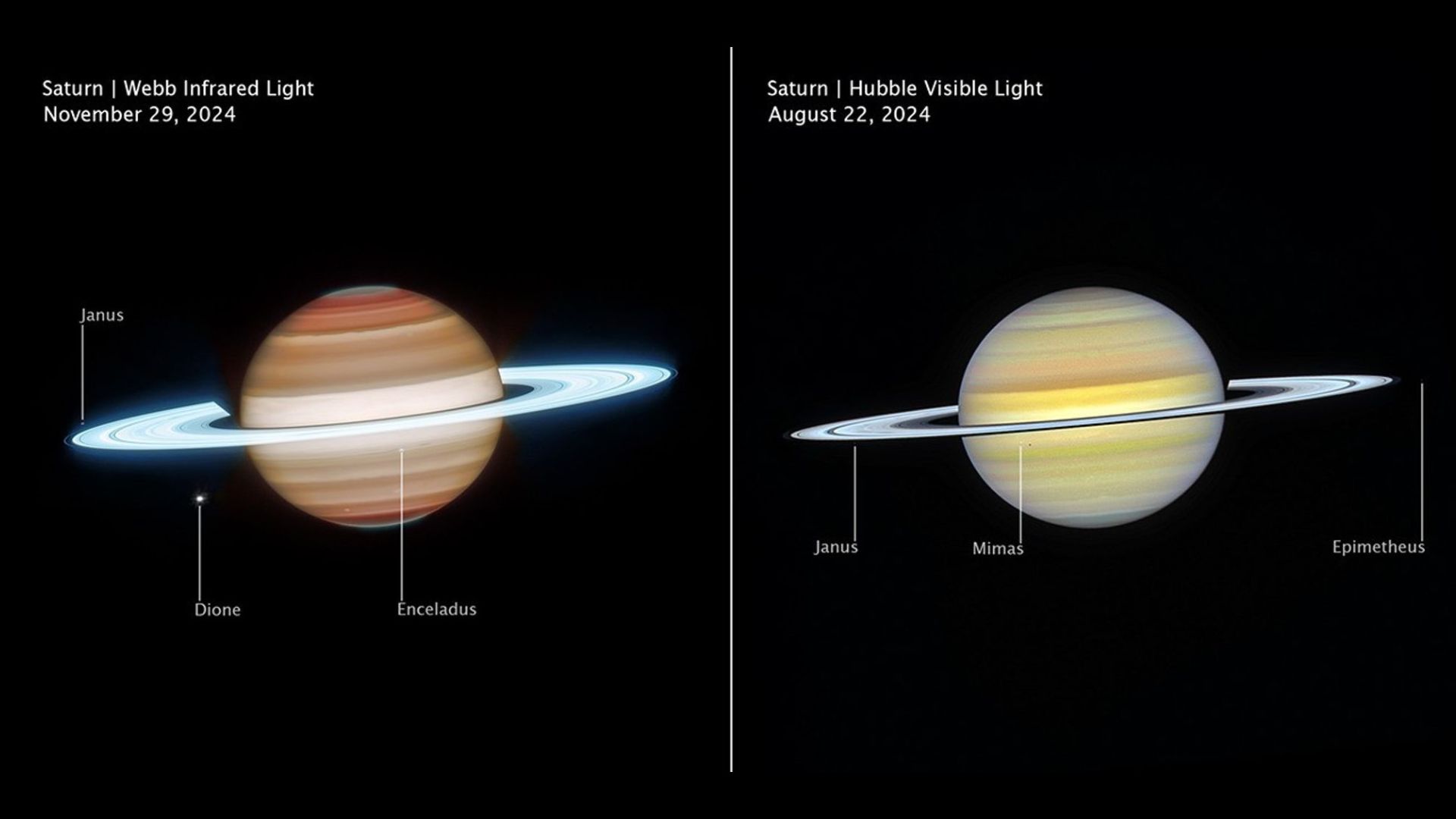
The formidable combined power of the James Webb and Hubble Space Telescopes has delivered unprecedented views of Saturn, effectively piercing through the ringed planet’s enigmatic cloud formations. These stunning new observations collectively offer scientists what NASA has hailed as the “most comprehensive view of Saturn to date.” Crucially, this synchronized imagery empowers researchers to virtually “slice” through the gas giant’s atmosphere, enabling a detailed analysis of its complex layers at various altitudes.
Recent observations have delivered a striking glimpse of one of Saturn’s most peculiar landmarks: the iconic hexagon swirling mysteriously at its north pole. NASA confirms that the faint, yet distinct, edges of this colossal six-sided jet stream are clearly visible in both captured images.
These remarkable photographs, however, carry a bittersweet significance. They may represent some of the last high-resolution views of the enigmatic hexagon that scientists will obtain for decades. Saturn’s north pole is on the cusp of tipping into a prolonged period of winter darkness, a celestial shadow that will obscure the unique atmospheric formation for approximately 15 Earth years, rendering it largely unobservable until the 2040s.
Delving into the intricate dynamics of Saturn’s atmosphere offers scientists a crucial dual perspective. This vital research not only illuminates how colossal, planet-sized storms originate and persist within its turbulent skies, but also provides profound insights into the gas giant’s ancient formation and its multi-billion-year evolutionary journey.
In a collaborative effort showcasing distinct perspectives, two of humanity’s premier space observatories recently captured a crucial period in Saturn’s atmospheric cycle. The Hubble Space Telescope delivered a sharp visible-light image of the ringed giant in August 2024. This observation was integral to the Outer Planet Atmospheres Legacy (OPAL) program, a decade-long scientific endeavor focused on annually tracking the outer planets.
Just 14 weeks later, in November 2024, the James Webb Space Telescope (JWST) provided its own, contrasting infrared view. These closely timed captures collectively illustrate Saturn’s ongoing seasonal transition, marking its progression from northern summer toward its anticipated 2025 equinox.
Here are several ways to paraphrase that text, maintaining a journalistic tone:
**Option 1 (Concise & Direct):**
> The observations from the two telescopes painted starkly different pictures of Saturn.
**Option 2 (Emphasizing Disparity):**
> A notable disparity emerged from the dual observations of Saturn, as the two telescopes captured significantly divergent portrayals of the ringed planet.
**Option 3 (Focus on Perspective):**
> Each of the two telescopes provided a remarkably different perspective on Saturn.
**Option 4 (More Descriptive):**
> Saturn presented a remarkably varied appearance when viewed through the lenses of the two distinct telescopic instruments.
**Option 5 (Highlighting the Revelation):**
> While focused on the gas giant, the two telescopes yielded surprisingly dissimilar views of Saturn, revealing different facets of the planet.
**JWST Unveils Hidden Depths of Saturn with Unprecedented Infrared Clarity**
While the Hubble Space Telescope has long provided us with iconic views of Saturn’s majestic pale-yellow bands and dazzling white rings, the James Webb Space Telescope (JWST) has pushed the boundaries of our understanding, revealing even more astonishing details through its infrared lens.
In a striking departure from previous imagery, JWST’s infrared perspective transforms Saturn’s iconic rings into luminous blue ribbons. NASA scientists explained that this vibrant hue is a direct consequence of the rings’ composition: “they are made of highly reflective water ice.” This suggests that the ice particles within the rings are exceptionally efficient at reflecting the infrared light captured by JWST.
Beyond the rings, Saturn’s polar regions present an equally captivating spectacle. They appear as ethereal gray-green glows, a phenomenon attributed to emissions at wavelengths of approximately 4.3 microns. NASA has put forth two compelling explanations for this unusual radiance: it could be the result of light scattering off of high-altitude aerosols, fine particles suspended in the atmosphere, or it could be evidence of ongoing auroral activity. This latter possibility is particularly intriguing, especially given JWST’s recent success in capturing breathtaking images of giant auroras illuminating Uranus, hinting at a potentially universal atmospheric phenomenon in our outer solar system.
As Saturn embraces its southern hemisphere’s spring, a celestial dance unfolds. Two powerful space telescopes are poised to meticulously observe the gas giant’s ever-shifting atmosphere, promising to unlock deeper insights into its complex weather patterns. For now, however, Saturn remains an enigma, with its most fascinating mysteries veiled within its swirling cloud tops.
**Test Your Cosmic Knowledge: A Solar System Quiz Awaits!**
Think you’re an expert on the celestial bodies that orbit our sun? Prove it with our engaging quiz designed to put your knowledge of the planets to the ultimate test!





