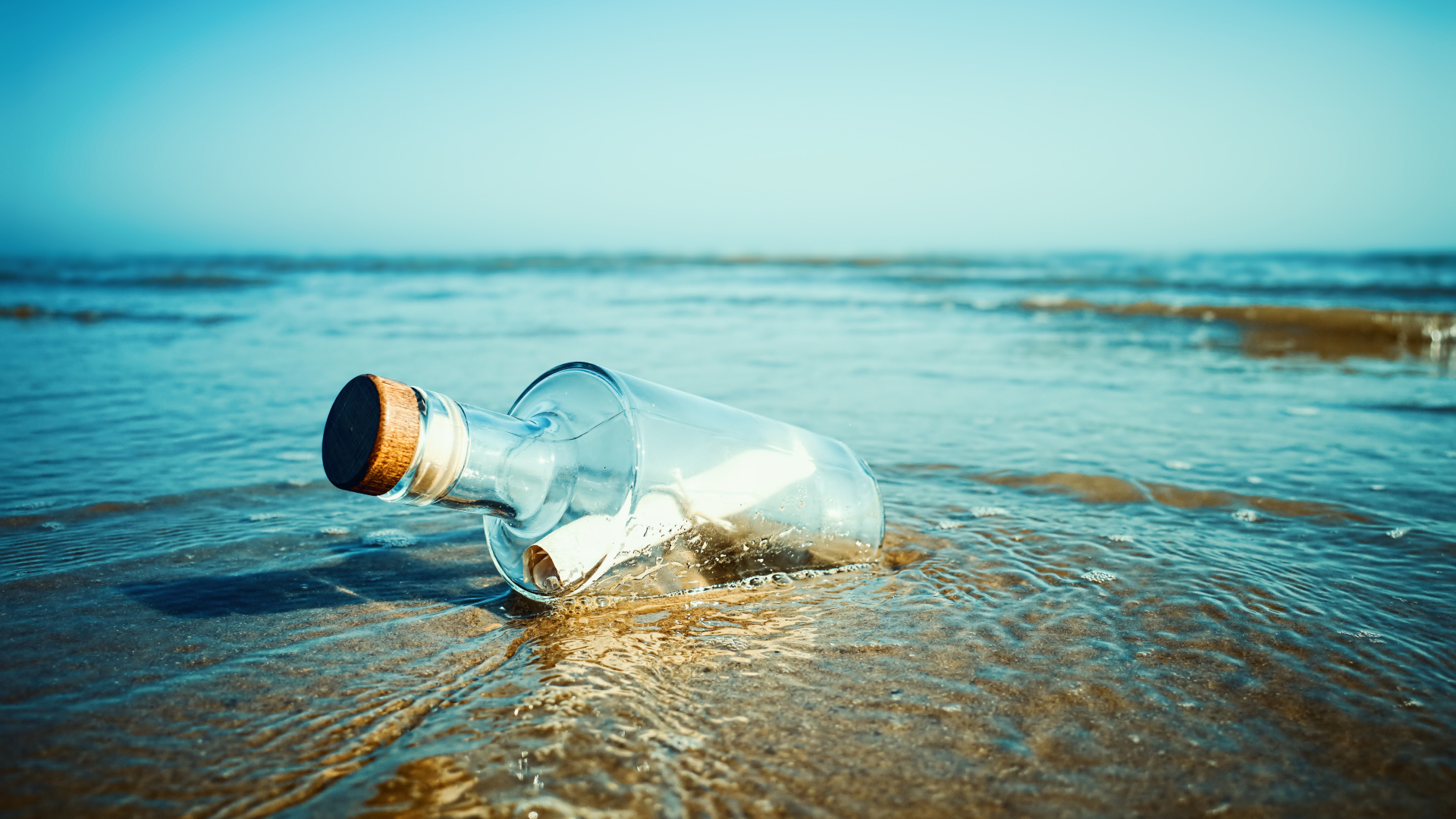
A remarkable century-old message, radiating optimism despite its age, has recently surfaced along Australia’s south-western coast. The intriguing bottled dispatch, penned by a World War One soldier, revealed his remarkably cheerful state of mind, declaring himself to be “as happy as Larry.”
For even the most seasoned wagerer, the probability of a specific outcome for a bottle cast into the ocean would be considered astronomically low. Once surrendered to the vastness of the sea, its journey is dictated by unpredictable currents, meaning its final resting place is truly limitless.
The perilous journey of a message in a bottle faces numerous obstacles, often sealing its fate long before reaching its intended recipient. Should it drift to isolated, uninhabited shores, the chances of discovery become a near impossibility.
However, even if currents guide it to more accessible coastlines frequented by people, a fresh set of challenges emerges. The message itself battles against time and the elements; prolonged exposure to sunlight will inevitably degrade the paper and ink, rendering the communication illegible. Perhaps the most immediate threat is water ingress; should the bottle compromise its seal and fill, it will quickly sink, consigning its contents to the silent depths and virtually guaranteeing it will never be recovered.
The allure of a message in a bottle, particularly one that has defied the elements for over a century, is undeniable. However, the probability of such a discovery, and specifically *your* chances of being the one to find it, are exceptionally slim, bordering on the miraculous.
### The Chances of a 100+ Year Old Bottle Being Found:
The prospect of discovering a message in a bottle that has survived for over 100 years is **extraordinarily rare**. Such finds are newsworthy precisely because of their extreme improbability.
The survival of such a fragile time capsule depends on a confluence of highly improbable factors:
1. **Robust Container:** The bottle itself must be exceptionally sturdy and resilient to withstand decades of ocean currents, collisions with rocks, seabed abrasion, and extreme weather.
2. **Secure Seal:** The stopper (often cork) must remain perfectly intact and watertight, preventing degradation of the message from saltwater, moisture, and marine organisms.
3. **Favorable Currents:** The bottle must navigate complex ocean currents without being beached prematurely in remote, unpopulated areas, or sinking into deep abysses.
4. **Undetected Passage:** It must avoid being crushed by ships, swallowed by marine life, or picked up by other individuals who might not recognize its significance or simply discard it.
Despite these odds, history has recorded a few astonishing instances. One of the most celebrated cases involved a bottle launched in 1906 by a British marine biologist and recovered in 2018 in Western Australia, setting a Guinness World Record for the oldest known message in a bottle at 112 years and 224 days. This discovery captivated the world precisely because it defied such astronomical odds.
### Your Chances of Finding This Bottle:
As for your individual chances of finding such a century-old artifact, they are **astronomically low**. To put it into perspective:
1. **Vastness of the Oceans:** The world’s oceans cover over 70% of the Earth’s surface. Even with currents guiding them, the sheer volume of water and the immensity of coastlines make pinpointing a single, small object incredibly difficult.
2. **Limited Launch Points:** While countless bottles have been cast into the sea over the centuries, only a small fraction of these were properly sealed and documented, let alone destined to survive.
3. **Active Beachcombing Zones:** While many people walk beaches, the number of individuals actively and systematically searching for such specific items on relevant coastlines is comparatively small.
4. **Luck, Pure and Simple:** Ultimately, finding an ancient message in a bottle is a testament to extraordinary luck, placing it in the same league as winning a major lottery. It requires being in the right place at the right time, with the bottle itself having completed an improbable journey to that precise location and moment.
While the statistical odds may be daunting, the enduring romantic appeal of a message from the past remains potent. It’s the ultimate ‘needle in a haystack’ quest, a testament to time and chance, and a compelling reminder of the ocean’s enduring mysteries.
Unraveling the odds of a message-in-a-bottle surviving a century to be discovered might seem like a daunting prospect, yet the actual probability calculation is remarkably straightforward. To determine this specific likelihood, one must first ascertain the total number of messages retrieved after more than 100 years at sea. This figure then serves as the numerator, which is divided by the overall quantity of such messages initially launched, contingent upon the availability of that critical dispatch data.

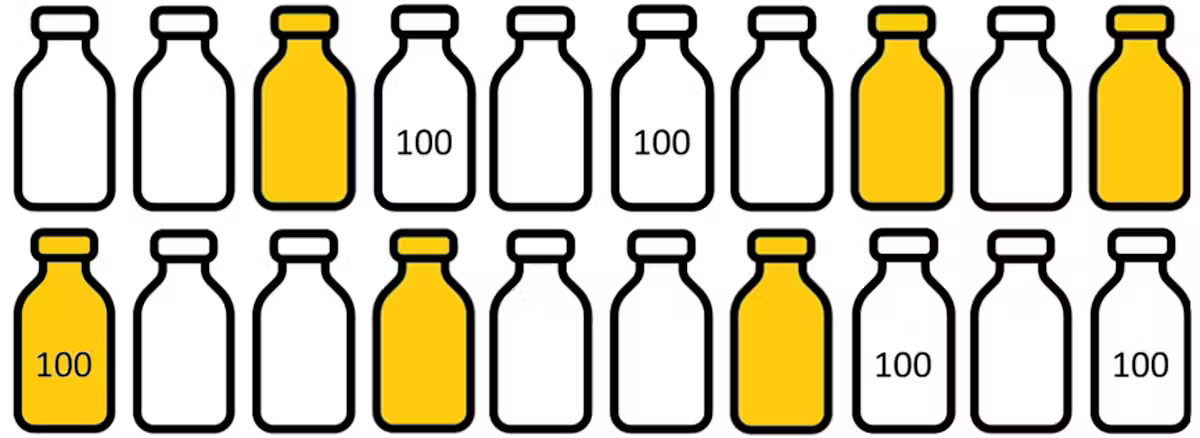
In a hypothetical scenario designed for illustrative purposes, a batch of 20 bottles is dispatched. From this total, six bottles are successfully recovered, with one of these notable for being over a century old, identified by its distinct “100” stamp. This theoretical example thus demonstrates a discovery rate where one in 20 bottles found is over a century old. It is important to emphasize that this calculation serves only as a hypothetical model and does not represent actual data.
Rather than pursuing a direct computation, a distinct analytical strategy offers a more nuanced approach to determining the probability. This method advocates for decomposing the problem into two sequential, calculable components.
First, one must establish the likelihood of discovering a bottle containing a message. Second, the probability that this particular discovered bottle is over 100 years old needs to be assessed. By independently calculating these two probabilities and subsequently multiplying their results, the precise overall probability can be ascertained.

The principle at play here, known as the multiplication rule of probability, is demonstrably true with our example figures: the product of 6/20 and 1/6 yields the same result of 1/20.
Here are a few ways to paraphrase the sentence, maintaining a journalistic tone and its core meaning:
**Option 1 (Focus on practicality):**
> While both methods for determining this probability are straightforward, the direct approach is often impractical, as it hinges on knowing the total number of bottles dispatched – a figure that is exceedingly challenging to ascertain in real-world scenarios.
**Option 2 (More concise):**
> Calculating this probability can be done in two simple ways. However, the direct method’s reliance on knowing the total bottles sent out makes it a difficult, often impossible, task in practice.
**Option 3 (Emphasizing the challenge):**
> Despite the simplicity of two distinct methods for probability calculation, the direct route presents a significant hurdle: it necessitates an accurate count of all distributed bottles, a detail that is notoriously elusive in real-world applications.
**Option 4 (Slightly more active voice):**
> Two uncomplicated approaches exist for calculating this probability. Nevertheless, the direct method demands knowledge of the total bottles issued, a piece of information that proves exceptionally hard to obtain outside of controlled environments.
Here are a few paraphrased options, each with a slightly different emphasis:
**Option 1 (Focus on clarity and efficiency):**
> The multiplication rule offers a distinct advantage by segmenting complex probability calculations into two manageable steps. This allows for independent analysis of each component, with the final results then being combined to yield the desired probability. This approach is particularly beneficial in real-world scenarios where data is often gathered from diverse sources.
**Option 2 (More dynamic and benefit-oriented):**
> By dividing a probability calculation into two distinct phases, the multiplication rule simplifies the process. Each phase can be addressed independently, and their outcomes can be readily synthesized to determine the overall probability. This method proves invaluable in practical applications, enabling the integration of information drawn from multiple, separate sources.
**Option 3 (Concise and journalistic):**
> A key benefit of the multiplication rule lies in its ability to deconstruct a calculation into two distinct parts. This allows for separate analysis before combining the results to arrive at the target probability. This modular approach is highly practical, especially when dealing with real-world situations that require information from varied origins.
**Option 4 (Emphasizing practical application):**
> The multiplication rule streamlines probability assessment by separating the computation into two self-contained elements. This allows for individual examination of each part, after which their outcomes are merged to produce the final probability. This technique is especially valuable in real-world contexts where insights are often derived from disparate information streams.
To begin, let’s explore the likelihood of a message in a bottle being discovered, without considering how long it may have been adrift.
**Finding a message in a bottle is a long shot, but not impossible, according to German maritime experts.**
The Federal Maritime and Hydrographic Agency of Germany estimates there’s a 1 in 10 probability that a castaway’s plea or a simple greeting sent adrift in a bottle will ever reach shore. This figure resonates with the findings of numerous historical “drift bottle” experiments. Oceanographers have long used these floating capsules to chart the mysterious paths of ocean currents, releasing thousands of bottles to track their journeys and glean insights into the sea’s dynamic flow.
Historical data from North Atlantic Ocean studies reveal a diverse range of recovery rates, influenced by both geographical location and the time period of investigation. For example, pioneering research conducted in the 1960s and ’70s reported recovery figures reaching 14% from the Gulf of Mexico, 8% from the Caribbean Sea, and 7% off the northern coast of Brazil. Decades later, a more recent analysis from the 2000s, focusing on the more northerly waters between Canada and Greenland, indicated a significantly lower recovery rate of 5%.
While experimental findings are inherently prone to natural variation when gathered from diverse international settings, for the purpose of straightforward analysis, the probability of recovering a bottled message will be standardized at a consistent one in ten (10%).
Here are a few options, maintaining a clear, journalistic tone:
**Option 1 (Direct & Concise):**
“The next phase of our calculation focuses on the recovered artifacts: What proportion of the found bottles are estimated to be over 100 years old?”
**Option 2 (Analytical & Formal):**
“Moving to the second crucial metric, we seek to determine what percentage of the discovered bottles have surpassed the century mark.”
**Option 3 (Emphasizing the Analytical Step):**
“Our subsequent analysis will address a key question: Among the bottles brought to light, what is the precise proportion that is more than a century old?”
Drawing from a Wikipedia compilation of news articles, the following table presents a unique look at recovered message-in-a-bottle discoveries. Notably, this dataset is restricted to bottles over 25 years old – a likely reflection of the increased newsworthiness and historical intrigue surrounding older, more storied finds.

Here are a few options, maintaining a clear, journalistic tone:
**Option 1 (More formal and direct):**
“To accurately assess the population of message bottles aged 0 to 25 years, our team developed and executed an independent estimation methodology. The process by which these figures were derived is detailed below.”
**Option 2 (Emphasizing the necessity):**
“Lacking an existing official count, it became necessary for us to independently quantify the number of message bottles in circulation, specifically those aged between 0 and 25 years. Our estimation approach is outlined here.”
**Option 3 (Concise and active):**
“The task of determining the prevalence of message bottles — from newly released to 25 years old — required our own calculations. Here’s how that figure was ascertained.”
**Option 4 (Focus on the ‘how’ from the start):**
“We undertook our own assessment to estimate the number of active message bottles, ranging from 0 to 25 years in age. This is how the calculation was performed.”
Data analysis reveals a compelling trend: a marked decrease in the recovery rate of message-bearing bottles directly correlated with their age. This inverse relationship is largely attributed to the harsh marine environment. Over time, messages degrade, and the integrity of the bottles themselves is compromised, making them increasingly susceptible to fracturing, sinking, or becoming obscured by accumulating layers of seabed sediment. Visualizing this data through the accompanying graph provided crucial clarity, distinctly illustrating the declining likelihood of discovery for older specimens.
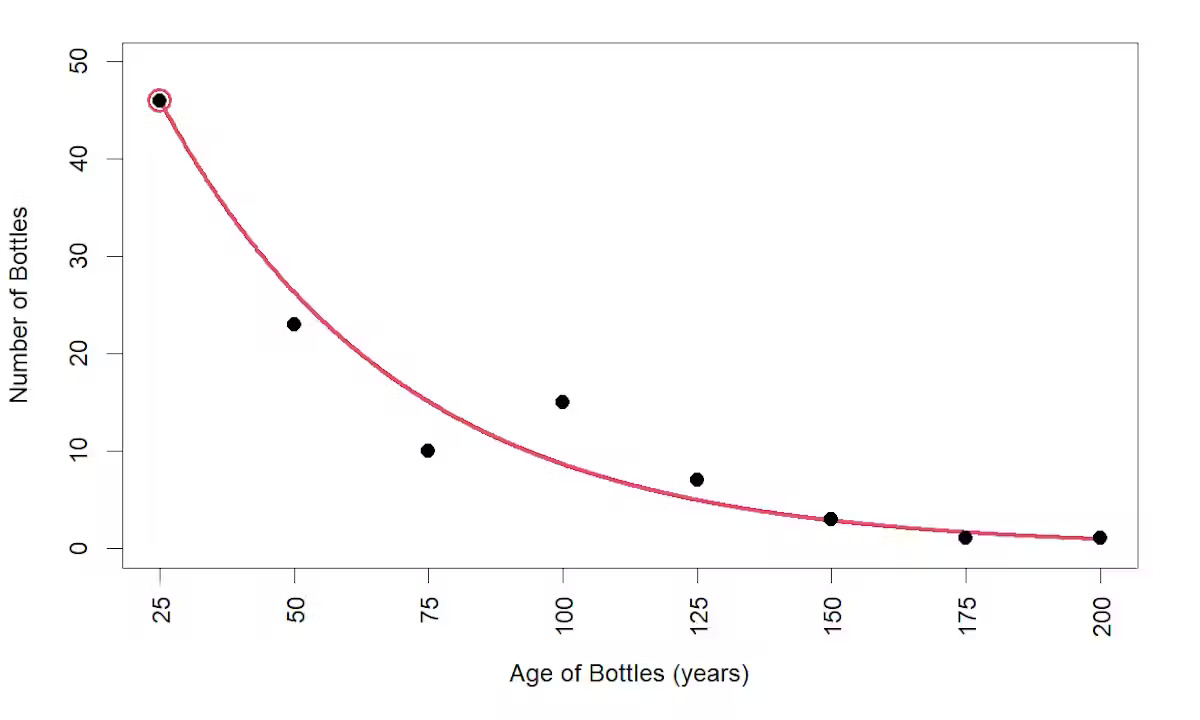
To illustrate the observed trend in the ages of recovered bottles, we’ve plotted a red line on the graph. This line represents the following equation:

Here are a few paraphrased options, maintaining a journalistic tone:
**Option 1 (Focus on the findings):**
> An analytical equation indicates that approximately 46 bottles have been recovered within the 0-to-25-year age bracket. This calculation is designed to estimate the quantity of bottles discovered across various age segments, with each segment representing a 25-year span (e.g., 25 for 0-25 years, 50 for 25-50 years).
**Option 2 (More direct and concise):**
> The analysis estimates that 46 bottles fall within the 0-to-25-year age range, according to a formulated equation. This equation is employed to quantify bottle discoveries across specific age demographics, with intervals defined in 25-year increments.
**Option 3 (Emphasizing the purpose of the equation):**
> To determine the number of bottles found within specific age brackets, an equation was utilized. For the youngest cohort, aged 0 to 25 years, the equation yields an estimate of 46 bottles. The methodology segments age ranges by 25-year increments.
**Option 4 (Slightly more active voice):**
> Researchers have used an equation to estimate the number of bottles found, segmenting them into 25-year age ranges. The findings reveal that an estimated 46 bottles are accounted for within the 0-to-25-year-old category.
A comprehensive count reveals a total of 106 bottles discovered, with a notable 12 of these specimens exceeding a century in age. This means approximately one out of every ten bottles found is over 100 years old.
Here are a few paraphrased options, maintaining a journalistic tone:
**Option 1 (Concise & Direct):**
> Analysis reveals that a mere 10% of message-laden bottles are ever recovered. Of those fortunate enough to be found, only one in ten has a history exceeding a century. Consequently, the probability of unearthing a message in a bottle that is also over 100 years old is estimated to be a slim 1 in 100, derived from multiplying these individual chances.
**Option 2 (Slightly More Evocative):**
> The chances of a message in a bottle reaching shore and being discovered are remarkably low, with only about one in ten making it. Adding another layer of rarity, just 10% of these recovered bottles are found to be over a century old. When these probabilities are combined, the estimated likelihood of finding a message in a bottle that has also endured for over 100 years stands at a slender 1 in 100.
**Option 3 (Emphasizing the Rarity):**
> A significant hurdle for messages in bottles is their recovery rate, with only one in ten ever being found. Further compounding the rarity, a mere 10% of these recovered bottles are more than 100 years old. This means that the combined chance of a message in a bottle being found and having survived for over a century is calculated to be a mere 1 in 100.
Imagine the vastness of our oceans, potentially holding 100,000 bottles, each a vessel for a time capsule message. Among these, scientists estimate that around 1,000 could have been adrift for a century or more. Given the global population of 8 billion, the odds of any single individual unearthing one of these ancient maritime missives stand at a slim 1 in 8 million – a truly remote possibility.
For those dedicated to the intriguing pursuit of message-in-a-bottle discoveries, a strategic approach can significantly enhance their chances. Understanding the intricate dance of ocean currents, specifically the vast circular patterns known as gyres, offers a crucial roadmap to potential landing sites.
For those seeking to intercept drifting messages in bottles, the unique geographical positioning of peninsulas and islands that intersect with oceanic gyres presents promising opportunities. This theory supports the notion that the Caribbean islands, situated within the trajectory of the North Atlantic Gyre, may be particularly advantageous locations for such discoveries. This intriguing possibility adds another compelling reason to explore the allure of the Caribbean.
While we ponder the vastness of unlikely scenarios, spare a moment for the solitary castaway. Their desperate plea for rescue, etched onto the sand or signaled with smoke, faces the same slim chance of being discovered as a whisper lost in a hurricane.
This article, originally published by The Conversation, is being shared here under a Creative Commons license. You can find the original piece for further reading.