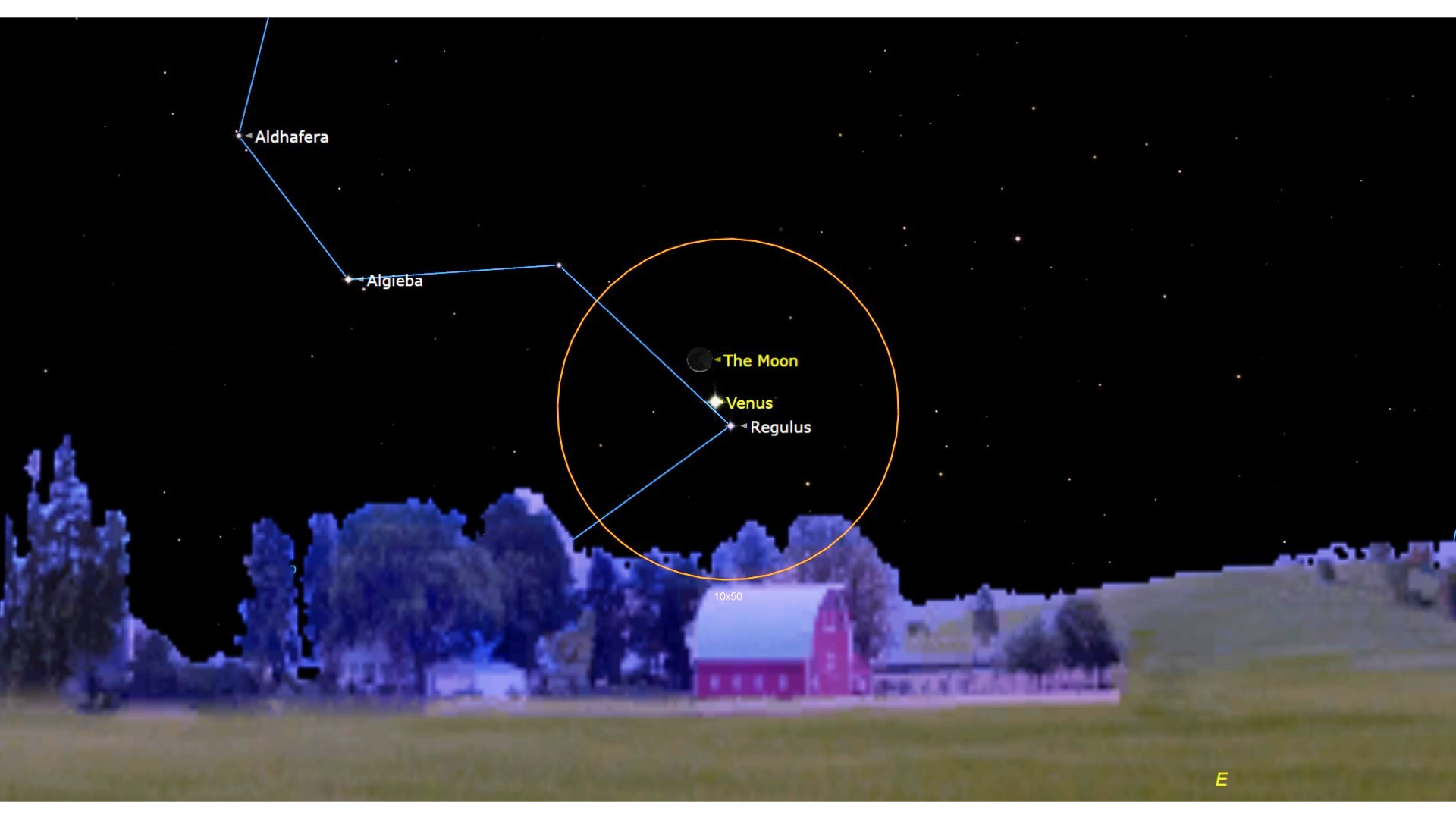
On September 19, predawn sky-watchers in the U.S. will witness a delicate waning crescent moon rise in close proximity to Venus and the bright star Regulus. For observers in other parts of the world, a more dramatic celestial event awaits: the lunar disk will pass directly in front of Venus, briefly occulting, or hiding, the rocky planet’s light.
On September 19, observers should look to the eastern horizon approximately two hours before dawn to witness a striking celestial arrangement. A slim, 2%-illuminated moon will be seen rising low, with the brilliant morning star Venus positioned less than one degree directly below it. Just beyond this pairing, Regulus, the brightest star in the constellation Leo, will also be visible. For a practical measurement, holding your little finger at arm’s length provides a rough approximation of one degree in the night sky.
A subtle illumination, often referred to as Earthshine or the Da Vinci glow, can sometimes be observed on the moon’s unlit face. This faint radiance reveals the expansive lunar maria — the dark, basaltic plains that originated billions of years ago from ancient lava flows. This distinctive phenomenon is exclusively visible during the nights surrounding a new moon, when the lunar disk is perfectly positioned to capture and reflect sunlight bouncing off Earth’s surface.
On the night of September 19, during the late hours, Jupiter will be prominently visible high above the eastern horizon. The gas giant will appear situated just above and to the right of the moon, distinctly positioned within the constellation Gemini. Its striking presence will be further highlighted by the bright twin stars, Castor and Pollux, twinkling noticeably to its left.
Sky-gazers across the United States will have the opportunity to observe the lunar disk in close proximity to Venus and the bright star Regulus during the approaching dawn hours. A more dramatic celestial event awaits viewers in Europe, Canada, Greenland, and portions of Russia, Asia, and Africa, where the moon will directly pass in front of Venus, temporarily obscuring the planet from sight.
This phenomenon, known as an occultation, is predicted to begin globally at 6:34 a.m. ET (1034 GMT) on September 19 and will conclude at 10:26 a.m. ET (1426 GMT) on the same day, according to astronomical data provider in-the-sky.
Stargazers seeking an enhanced view of distant constellations and the planets within our solar system may find value in consulting expert evaluations of top-performing binoculars and telescopes specifically designed for celestial observation.
Space.com invites readers to submit any photographs they capture featuring the moon and Venus. Please include your name, location, and any accompanying comments when emailing your images to spacephotos@space.com.