
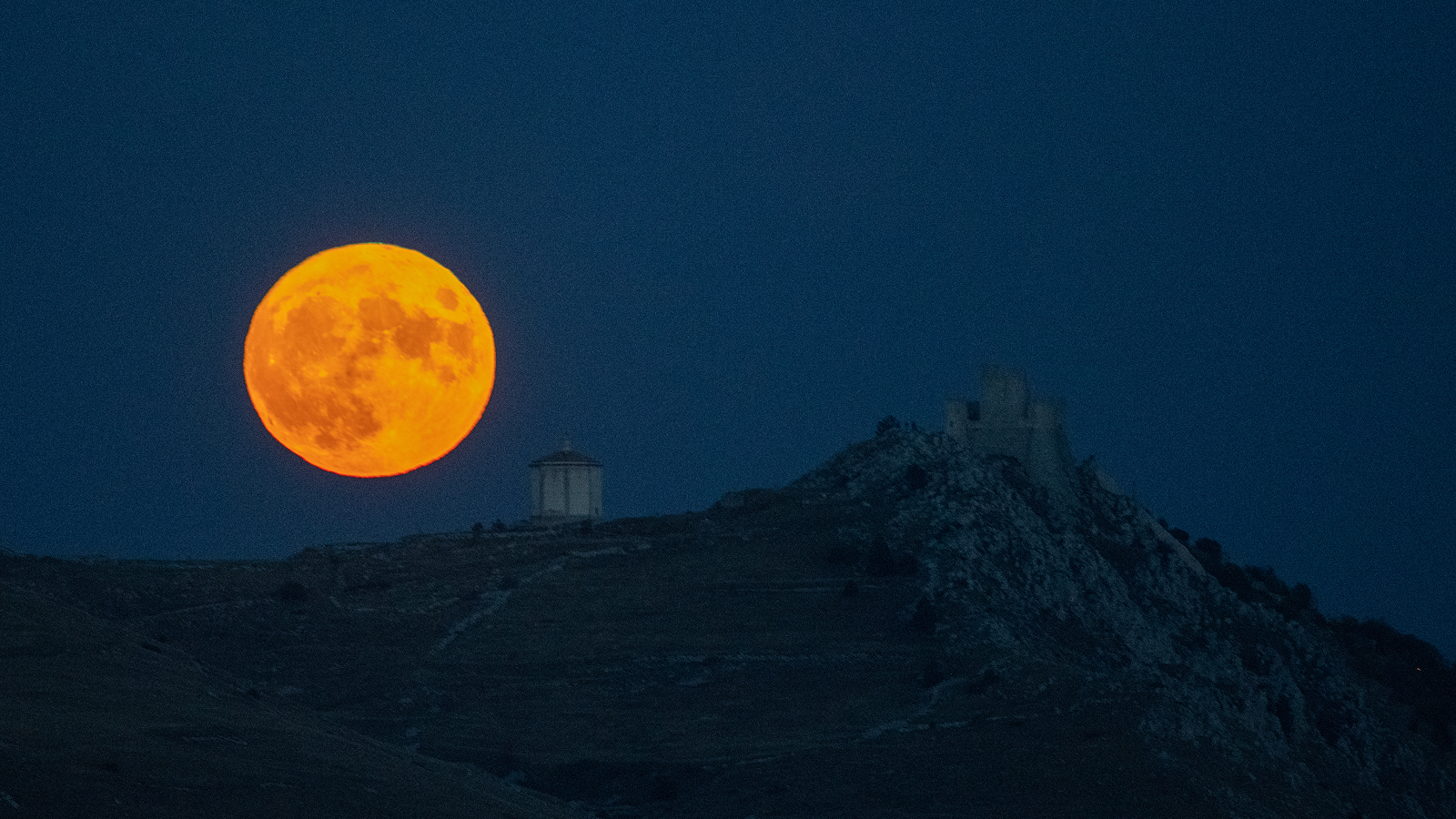
On Monday, October 6, 2025, the autumn sky will feature the year’s inaugural supermoon. Known prominently as the Harvest Moon, this celebrated full moon holds particular significance for the Northern Hemisphere as the first full moon of autumn, traditionally signaling the conclusion of the harvest season.
The moon will officially reach its full phase at 11:47 p.m. EST on Monday, or 3:47 p.m. UTC on Tuesday, October 7. Its illuminated disk will appear bright and complete on the evenings immediately preceding and following this precise moment.
For the best viewing of the full moon ascending on the eastern horizon, observers should look to the sky at dusk on Tuesday. An earlier opportunity presents itself on Sunday, October 5, at dusk, when an almost-full moon will be visible in the east, positioned just above Saturn. This provides a notable spectacle as Saturn is currently near its closest annual approach to Earth.
According to Almanac, the full moon nearest to the autumnal equinox—which occurs on September 22 this year—is traditionally known as the Harvest Moon. This celestial event derives its distinctive name from historical farming folklore, where its bright illumination historically granted farmers additional hours to collect their crops late into the night, extending beyond just the full moon’s peak to the surrounding evenings. While September usually hosts this phenomenon, the lunar calendar indicates that the Harvest Moon will appear in October in 2025.
An essential roundup of the top telescopes anticipated for 2025, designed to facilitate unprecedented exploration of planets, galaxies, and the expansive universe.
For an optimal view of Tuesday’s Harvest Moon, locate an elevated spot with a clear, unobstructed eastern horizon. The moon’s distinctive golden-orange radiance will be most pronounced within the 15 to 20 minutes following its local moonrise. While the unaided eye is sufficient for general appreciation, a quality pair of stargazing binoculars can offer a detailed perspective, revealing lunar craters and the dark lava plains, known as mare, on our natural satellite’s surface.
This year’s harvest moon is set to captivate sky-watchers as it also qualifies as a supermoon, appearing discernibly larger and brighter than usual. During this celestial event, the moon will position itself remarkably close to Earth, reaching a distance of just 224,599 miles (361,457 kilometers). This proximity is approximately 10% nearer than its average orbital span of 238,855 miles (384,400 km), according to NASA. The supermoon phenomenon occurs due to the moon’s slightly elliptical orbit around Earth, which causes it to reach a closest point (perigee) and a farthest point (apogee) each month.
Skygazers can anticipate a striking display late on Wednesday, October 8, when the Harvest Moon will appear at its largest and closest. This occurs as the moon reaches perigee—its nearest point to Earth—just 1.3 days after becoming full, a phenomenon colloquially termed a supermoon.
Coinciding with this lunar event is the peak of the annual Draconid meteor shower, offering the possibility of “shooting stars.” While experts anticipate up to 10 meteors per hour, the moon’s considerable brightness may unfortunately diminish their visibility.
October is shaping up to be a significant month for skywatchers, featuring the close Earth approaches of two comets, Lemmon (C/2025 A6) and SWAN R2 (C/2025 R2). These celestial events are scheduled to align with the peak of the Orionid meteor shower, creating an optimal viewing opportunity on the night of October 21-22 under the dark conditions of a new moon.
Prepare for a spectacular celestial show on November 5, as the Beaver Moon emerges as the biggest supermoon witnessed since 2019.





