While Mars has yet to yield definitive proof of life, the Red Planet has presented scientists with an entirely new and captivating mystery.
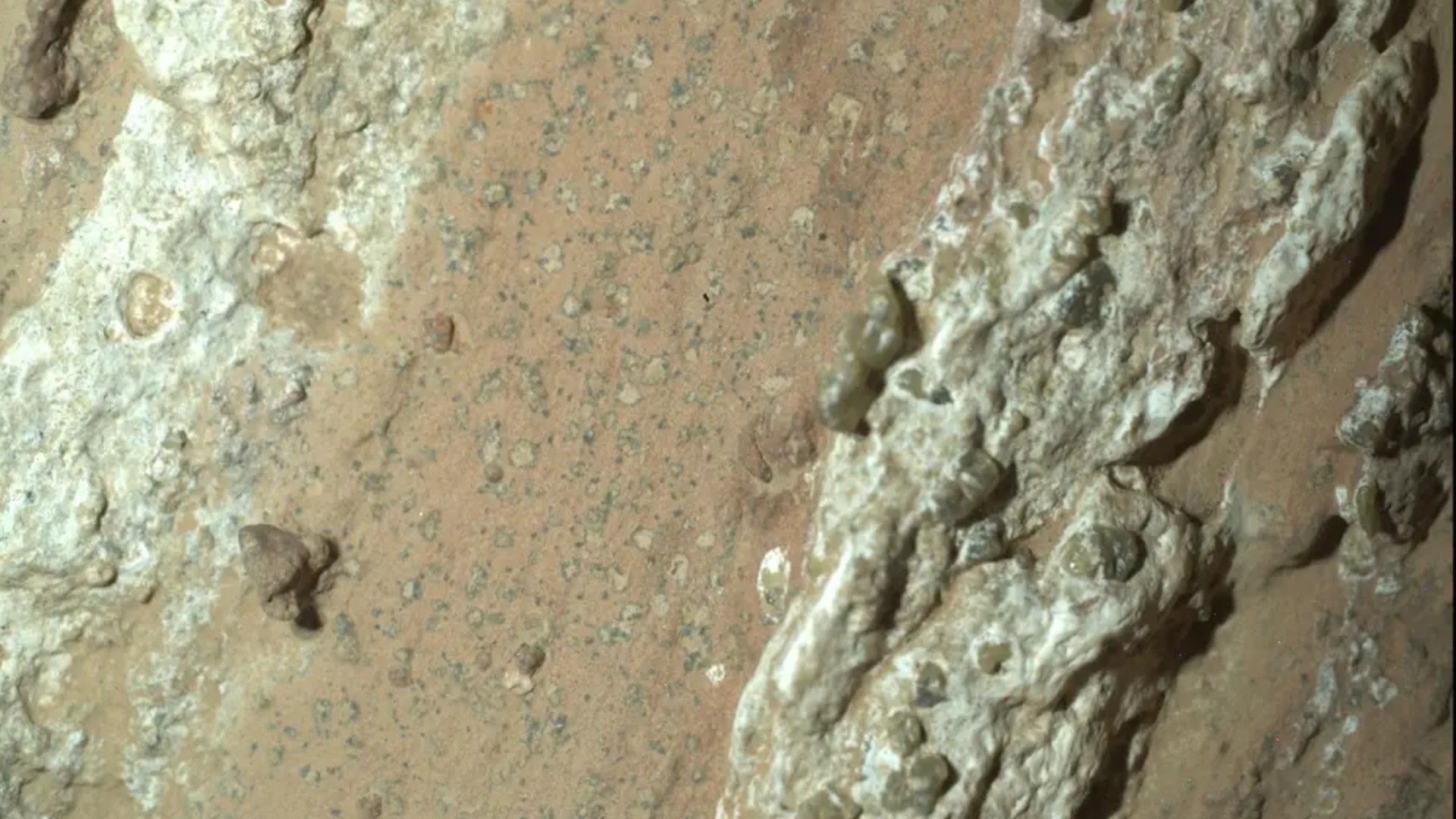
NASA’s Perseverance rover, exploring the western fringe of Jezero Crater, has been investigating Neretva Vallis—an ancient river valley that once fed a vast Martian lake. Within this area, specifically in an outcrop of primordial mudstone known as the Bright Angel formation, the rover identified one of its most intriguing discoveries to date: an arrowhead-shaped rock dubbed Cheyava Falls. This unique specimen is adorned with minute black flecks, likened to “poppy seeds,” and distinct circular markings, reminiscent of “leopard spots.”
In-depth analysis of the peculiar markings has revealed a significant abundance of organic carbon, iron, phosphorus, and sulfur. Notably, scientists recently confirmed the presence of vivianite, an iron phosphate, and greigite, an iron sulfide. On Earth, the formation of both these minerals is typically linked to redox reactions—the electron-swapping processes that are foundational to all life. For instance, plants rely on redox for photosynthesis, humans and other animals utilize it to extract energy from food during respiration, and microbes employ it to metabolize metals in oxygen-deprived environments like deep-sea vents.

On Earth, specific chemical signatures frequently serve as evidence of biological activity. Yet on Mars, these same elusive traces offer a compelling but uncertain prospect—they might indicate the presence of life, or simply be the result of abiotic reactions. Regardless of their origin, these findings mark a distinct departure from the chemical makeup scientists typically expect to encounter on the Red Planet.
The discovered chemical composition is remarkably distinct, unparalleled by anything observed during approximately two to two-and-a-half decades of planetary exploration, according to Joel Hurowitz, a geoscientist at Stony Brook University in New York. Hurowitz, who led the recent study, emphasized this novelty to Space.com, noting that the unique chemistry stands out regardless of its specific origin.
Should these reactions ultimately be identified as non-biological, they could still yield insights into “prebiotically useful chemistry” not previously considered. However, this scenario also serves as a crucial reminder of how abiotic natural processes can closely mimic life’s indicators, generating “false positives” for biosignatures that will require exceptionally rigorous analysis to decipher.
Mars’ characteristic crimson landscape typically reflects a history of oxidation: iron reacting with oxygen billions of years ago, a period when the planet still possessed liquid water and a thicker atmosphere. This process deposited the vast blanket of rust that earned Mars its enduring “Red Planet” nickname. However, at a site named Cheyava Falls, the Perseverance rover has uncovered a contrasting chemical story. It identified minerals formed through reduction, the opposite process, where iron and sulfur gained electrons rather than losing them, revealing a different facet of Martian geological evolution.
Redox reactions exhibit a fascinating characteristic: when left to their natural course, their progression at low temperatures is notably sluggish. This deliberate pace, however, along with the significant energy intrinsically stored within them, renders them an exceptional fuel source for life. Biological systems, particularly microorganisms, leverage specialized enzymes to dramatically accelerate these reactions. This enzymatic intervention enables microbes to efficiently capture and utilize the energy that would otherwise dissipate into the environment.
All living organisms universally depend on acquiring energy from their surroundings. Mike Tice, a geobiologist at Texas A&M University and a co-author of a recent study, told Space.com that early life on Earth developed this essential capability by harnessing redox reactions.
The detection of redox chemistry on Mars unveils a significant possibility: that these very chemical processes could have once offered the energetic support necessary for any life that might have emerged on the planet.
Drawing on insights from Earth’s life and theoretical principles, Tice posits that organisms across the universe will likely depend on redox reactions for energy. He further explained that a key strategy for discovering evidence of past life involves scrutinizing ancient rock formations for the chemical fingerprints of these reactions. The search specifically targets instances where redox reactions appear to have occurred at speeds inexplicable by non-biological chemistry alone.
The minerals recently identified by the Perseverance rover, particularly greigite found within distinct “leopard spots,” have sparked significant scientific interest. According to Tice, this discovery is especially compelling given that the abiotic production of sulfide minerals typically proceeds at an extremely sluggish pace in low-temperature conditions.
According to the scientist, these specific redox reactions are highly improbable under the elevated temperatures the rocks are believed to have encountered. He explained that the very properties making this reaction beneficial for certain living organisms are precisely what elevate its significance as potential evidence for past life.
The ancient rocks at Cheyava Falls, dating back over 3.5 billion years, present a geological paradox. While formations of such immense age often display features that could be mistaken for signs of early life, the rocks at this specific site lack evidence of intense heat or pressure—conditions typically needed to drive rapid, non-biological chemical reactions. Despite this absence, significant quantities of sulfides are notably present. For scientists, this unusual combination keeps the possibility of a biological origin open, though it does not provide definitive confirmation.
Chris Impey, a University of Arizona astronomer not involved in the study, told Space.com that the presented evidence for life is “very indirect.” He further asserted that it is insufficient to persuade anyone of Martian life beyond a reasonable doubt, which he noted has become the prevailing standard in such scientific claims.
Gerard van Belle, director of science at Arizona’s Lowell Observatory and not involved in the research, concurred with the assessment. He cautioned that the evidence did not present a “smoking gun,” emphasizing that the crucial question remains: whether the observed phenomena are exclusively biological in origin, or if non-biological processes could also explain them.
Redox reactions captivate scientists due to the mineral byproducts they generate, which effectively serve as geological archives. The elemental composition and prevalence of these mineral formations provide invaluable insights into the conditions of their origin. Researchers can decipher critical details from these deposits, including whether water once moved through the rock, the specific oxygen levels (from rich to poor) of the ancient environment, and the availability of energy sources that early microbial life might have exploited.
Analysis has revealed that the Bright Angel mudstone possesses a chemical composition distinctly different from other rocks found in Jezero Crater. It exhibits an unusually high level of oxidation and a marked depletion of elements like magnesium and calcium. Researcher Hurowitz notes that this specific profile is strikingly similar to Earth soils that have experienced severe weathering from long-term rainfall. Hurowitz suggests this chemical anomaly likely reflects significant changes in Mars’ climate and atmosphere during the period when Jezero Crater was accumulating sediment.
The Bright Angel formation is fundamentally reshaping scientists’ understanding of Mars’ ancient environments, according to researcher Hurowitz. This geological feature reveals that the planet’s climate and atmosphere likely experienced significant variations across its history. Crucially, Hurowitz pointed out that even during these periods of environmental flux, Mars possessed the capacity to sustain habitable conditions.
NASA’s Perseverance rover has successfully extracted a rock core from Cheyava Falls, a critical step towards its eventual return to Earth. This cached sample is central to the ambitious Mars Sample Return (MSR) mission, designed to provide scientists with unprecedented analytical capabilities impossible to achieve with the rover’s onboard instruments. However, the MSR campaign faces significant headwinds. The initiative has been plagued by a series of delays and substantial cost overruns, casting doubt on its progression. Further jeopardizing the project, President Donald Trump’s proposed federal budget for 2026 includes provisions that would cancel the mission outright.
Hurotwiz expressed his immediate intention to begin isotopic measurements on the Cheyava Falls sample. The analysis will focus on comparing the ratios of lighter and heavier isotopes of iron, sulfur, and carbon present in the rock. Specifically, he plans to examine the distinctions between the original mudstone and the newer vivianite and greigite minerals that crystallized within it. Hurotwiz noted that differences in isotopic compositions between these reactants and products can serve as a diagnostic indicator for determining whether biological processes played a role in the redox reactions that led to their formation.
Van Belle emphasized that the return of pristine samples to Earth would dramatically reshape the search for fossil-like structures. Such uncontaminated evidence would offer critical clarity, circumventing the persistent contamination uncertainties that have historically complicated scientific debates, particularly those surrounding the famous Mars meteorite Allan Hills 84001.
Just two years ago, Tice would have characterized any discussion about the past existence of life on Mars as premature, citing an insufficient scientific basis for meaningful debate. While earlier NASA missions had established that the Red Planet’s surface possessed conditions capable of supporting life billions of years in the past, these expeditions did not, however, yield definitive evidence to either confirm or deny actual habitation during that ancient epoch.
However, the Perseverance rover is now poised to fundamentally alter that established understanding.
The initial availability of tangible evidence, he noted with excitement, now provides a concrete basis for robust scientific discussions and the strategic planning of future observations. This crucial advancement, he emphasized, is firmly anchored in the empirical reality of actual rocks and minerals.
The speaker drew a vivid parallel, comparing the moment to a treasure hunt’s pivotal first step. “It’s precisely when the metal detector signals a hit and you’ve just unearthed something radiant,” he explained. “While the exact nature of the discovery still requires full identification, it undeniably represents a concrete foundation to build upon.”