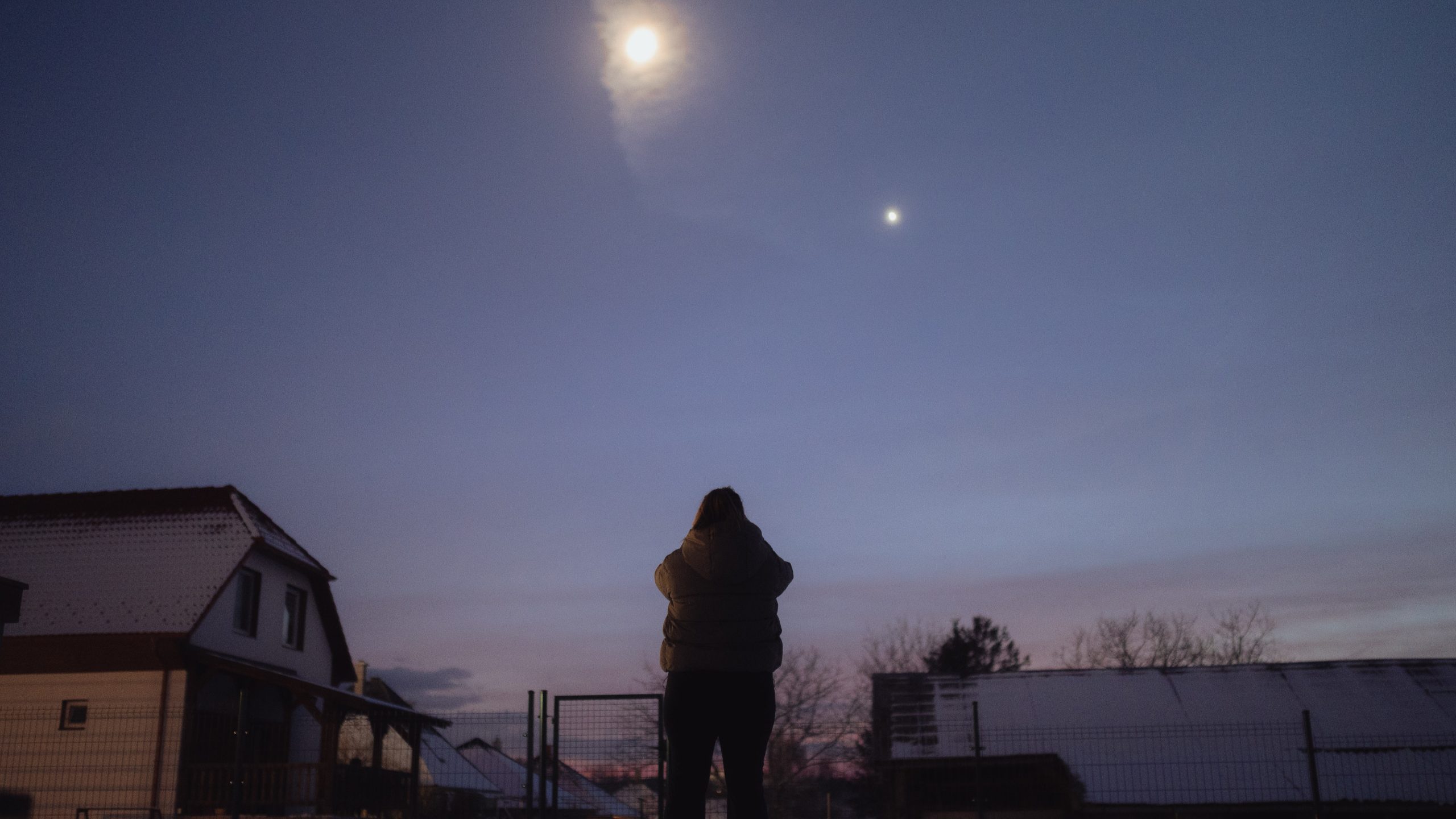
Sunday evening, October 5, offers sky-watchers a prime opportunity to spot the ringed planet Saturn, widely regarded as the most beautiful object visible through a telescope. Guiding the way will be the moon, appearing just 24 hours shy of its full illumination and designated this year’s Harvest Full Moon.
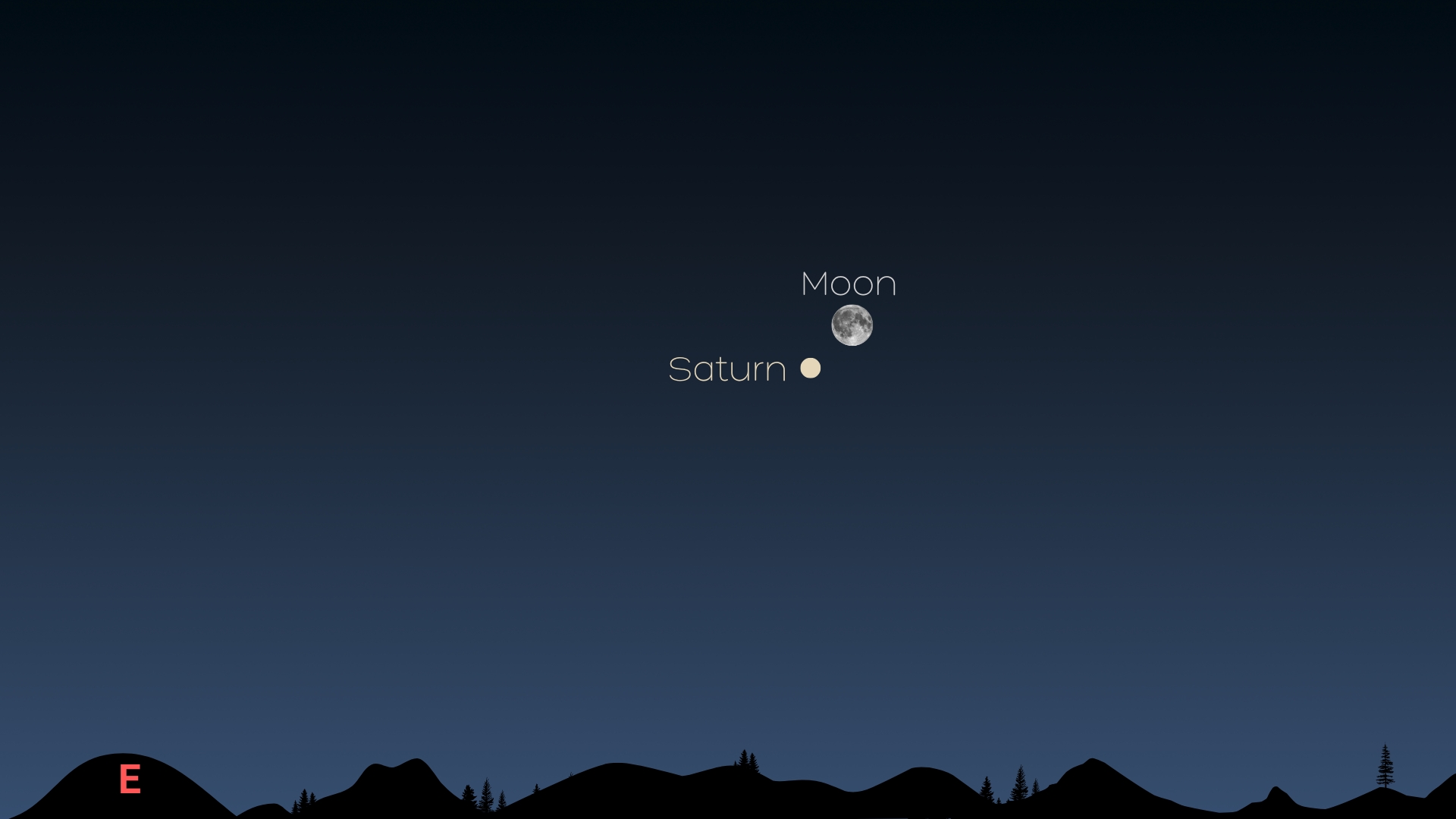
To the unaided eye, Saturn presents a modest appearance, lacking the distinctive features that characterize other planets. Unlike the brilliant luminosity of Venus or Jupiter, or the fiery hue of Mars, Saturn appears simply as a bright, yellowish-white “star.” For those hoping to glimpse the ringed planet, look towards the east-southeast horizon around 8 p.m. local daylight time; it will be visible approximately a quarter of the way up, though its true identity as the solar system’s iconic gas giant may not be immediately apparent.
This Sunday, Saturn will offer a prime viewing opportunity, appearing just below the moon and making it easily traceable. Should skies remain clear, it presents an ideal occasion to gather friends and neighbors for a shared observation of two of the night sky’s most captivating celestial bodies.
The moon presents a captivating spectacle for observers. While a fully illuminated moon often appears flat and one-dimensional, with brilliance that can momentarily overwhelm the eye, Sunday’s moon, though not entirely full at 98.5% sunlit, will still project a dazzling luminosity. Perhaps its most distinctive feature is Tycho, a prominent impact crater situated in the southern lunar highlands. Named in honor of Danish astronomer Tycho Brahe, this crater manifests as a brilliant spot, sending out radiant streaks of material that stretch across a significant portion of the moon’s lower expanse.
Copernicus emerges as a prominent lunar impact crater, positioned slightly northwest of the moon’s central Earth-facing hemisphere. It becomes unmistakably identifiable whenever illuminated by sunlight. Alongside the equally renowned Tycho crater, Copernicus is uniquely characterized by the brilliant network of rays that conspicuously emanate from its core. Under optimal lighting conditions, the intense luminosity of these combined ray systems from both Tycho and Copernicus can be so overwhelming that they often eclipse other surface features, making their location a considerable challenge.
Once your observation of the moon is complete, direct your attention to Saturn. For reference, a clenched fist held at arm’s length spans approximately 10 degrees of the night sky. Saturn will be visibly situated a mere 2.2 degrees directly below the moon, an angular distance notably less than a quarter of that visual guide.
Saturn’s renowned ring system, a distinctive feature from our earthly vantage point, underwent a notable visual transformation this year. After progressively narrowing since 2017, the rings reached an “edge-on” alignment relative to Earth on March 23, appearing to vanish entirely.
In the days following this alignment, the rings’ angle of inclination toward Earth slowly increased, reaching 2.2 degrees by May 5. Despite this growing angle, the rings remained virtually invisible. This paradox was due to the sun illuminating their northern face, even as their southern side was tipped toward our planet.
A pivotal shift occurred on May 6 when the sun’s illumination began to fall on the south side of the rings. This change led to their reappearance, observed as a thin, bright line bisecting Saturn’s disk.
This Sunday, those equipped with a telescope offering at least 30x magnification will find Saturn’s iconic rings visible. However, due to their inclination angle once again narrowing to a mere 1.4 degrees, they will appear as a brilliant, slender line across the planet.
A gradual yet consistent improvement is projected to materialize over the next several years.

Saturn recently completed a significant phase in its 29.46-year orbital journey, reaching what astronomers liken to an autumnal equinox. During this period, the gas giant’s north pole was angled forward, resulting in its impressive ring system appearing directly edge-on to the sun.
Looking ahead, precisely a quarter of its orbit from that point, in April 2032, Saturn will experience its winter solstice. This event will mark the maximum exposure of the planet’s southern hemisphere and the southern face of its rings to both the sun and observers on Earth. At that time, the rings will be dramatically tilted towards our planet, reaching a maximum “Saturnicentric latitude” of 26.75 degrees.
Over the next one to two years, Saturn’s rings are poised to offer a significantly clearer view. This enhanced visibility, particularly when observed through a moderate or large telescope, is expected to elicit profound surprise and astonishment, even from the most seasoned astronomical observers.
That captivating alignment of the Moon and Saturn in Sunday’s sky is, in fact, an illusion of perspective. The celestial bodies are far from each other in the vastness of space. While the Moon will be approximately 227,000 miles (365,000 km) from Earth, Saturn is a staggering 797 million miles (1.283 billion km) distant, making it more than 3,500 times farther away.
Joe Rao is an esteemed astronomy expert, serving as an instructor and guest lecturer at New York’s Hayden Planetarium. His insights into the cosmos are also widely published, appearing in prominent journals such as Natural History magazine, Sky and Telescope, and numerous other publications.
Space.com invites readers to submit compelling photographs of the moon and Saturn. Those wishing to share their images are requested to send them, along with any accompanying comments, their name, and location, to spacephotos@space.com.