
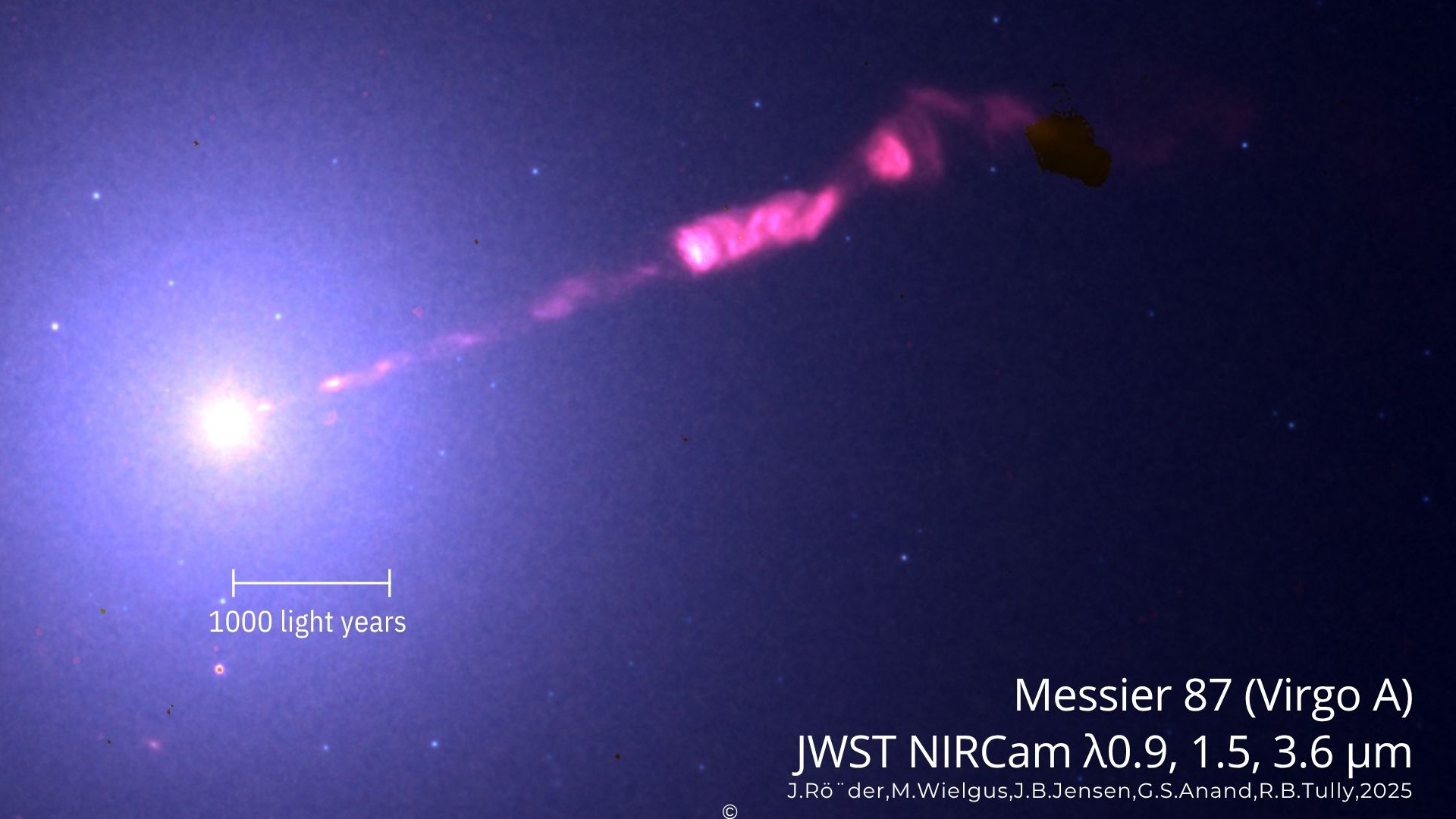
For more than a century, astronomers have been captivated by the extraordinary phenomenon of a brilliant jet of matter powerfully emanating from the core of the giant elliptical galaxy M87.
The James Webb Space Telescope (JWST) has delivered the clearest infrared view ever of a powerful cosmic engine, unveiling unprecedented details about its black hole-driven jet. Significantly, the telescope also pinpointed the jet’s elusive twin, streaming in the opposite direction.
The latest image from the James Webb Space Telescope (JWST) unveils a captivating jet, manifesting as a luminous pink ribbon gracefully unfurling across a hazy violet expanse. This powerful stream of charged particles, originating from the central black hole of galaxy M87, extends several thousand light-years into space. Along its impressive length, brilliant knots are distinctly visible, pinpointing the precise locations where particles are propelled to velocities approaching the speed of light.

The Webb Telescope has achieved a significant milestone, capturing for the first time in infrared light a faint counter-jet located approximately 6,000 light-years from the black hole. This elusive feature is notably challenging to observe because its rapid recession from Earth at near-light speed causes its light to appear significantly dimmer.
M87, a galaxy located approximately 55 million light-years from Earth, stands as one of the most thoroughly investigated celestial objects since its initial documentation by Charles Messier in the 18th century. At its nucleus resides the supermassive black hole, M87*, which garnered significant attention in 2019 as the first black hole ever directly imaged by humanity. This formidable black hole is also the driving force behind a colossal jet, an extraordinary phenomenon that serves as a unique natural laboratory for studying some of the universe’s most extreme physical processes.
A team led by Jan Röder of the Institute of Astrophysics of Andalusia in Spain utilized the James Webb Space Telescope’s Near Infrared Camera (NIRCam) to image the jet of M87 across four distinct infrared bands. To achieve this clarity, the researchers meticulously processed their observations, carefully subtracting starlight, interstellar dust, and distant background galaxies to isolate the jet’s structure. This precise method yielded what is now considered the most detailed infrared portrait of M87’s powerful outflow ever assembled, as detailed in a paper the team published last week in the journal Astronomy and Astrophysics.
Near the galactic core, a powerful jet exhibits a distinct helical structure. The James Webb Space Telescope (JWST) captured a snapshot revealing a slowly progressing feature, dubbed “knot L,” alongside the brighter region known as HST-1. This HST-1 region is notable for its rapid, seemingly superluminal motion.
Webb’s remarkably clear imagery further shows HST-1 fragmenting into two separate substructures, each displaying unique emission properties. This observation provides compelling evidence, as noted by the study, of intense shockwaves and intricate particle dynamics occurring in the immediate vicinity of the central black hole.
Approximately 6,000 light-years from the black hole, a counter-jet has been identified. Researchers note that this feature appears as a faint C-shape, comprising two filaments joined by a hotspot, an observation that aligns with previous radio data.
New data unequivocally establishes that the jet’s luminosity originates from synchrotron radiation, a process where light is generated by charged particles as they spiral through magnetic fields. Through meticulous measurement of subtle color variations across the infrared spectrum, the research team was able to precisely trace the complex dynamics of these particles—observing their acceleration, subsequent cooling, and twisting motions as they traverse the jet, the study indicates.
M87’s astrophysical jets serve as unparalleled natural laboratories for extreme physics, energized by supermassive black holes that accelerate particles to levels of energy far beyond any achieved on Earth. Investigating these powerful phenomena is vital for astronomers to comprehend how black holes shape their host galaxies, influencing processes like star formation and disseminating essential matter and energy across intergalactic voids.





