
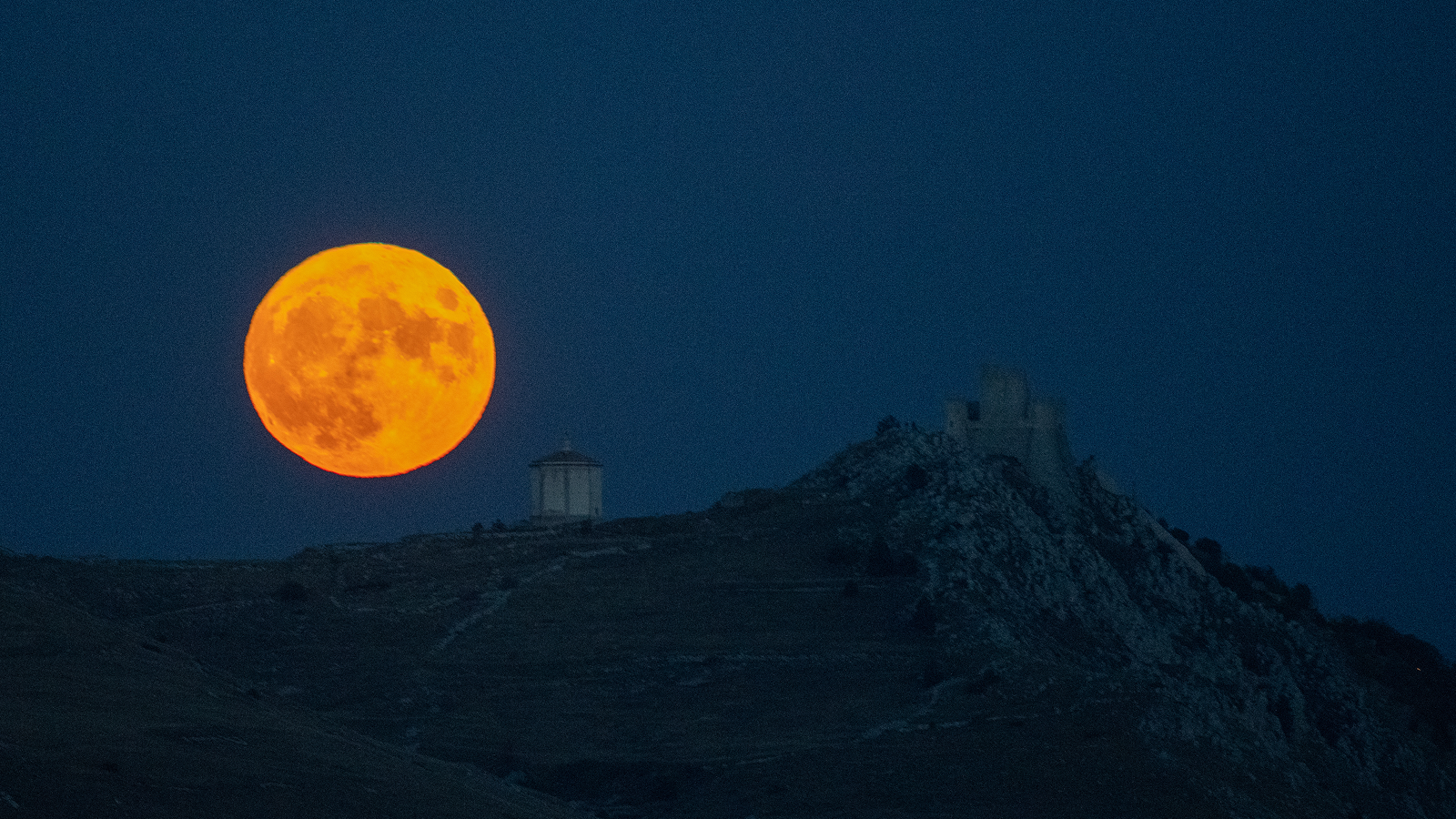
The night sky on October 6 is poised to host 2025’s inaugural supermoon, which promises to appear exceptionally large and luminous. This significant celestial event, widely recognized as the Harvest Moon, stands as one of the year’s most famous full moons. For the Northern Hemisphere, it marks the arrival of autumn’s first full moon, traditionally signaling the conclusion of the harvest season.
The moon is set to officially achieve its full phase at 11:47 p.m. EST on Monday, corresponding to 3:47 p.m. UTC on Tuesday, October 7. Its brilliant, complete disk will be visible on the nights immediately preceding and following this peak illumination.
For the most striking view, Tuesday’s dusk offers the prime opportunity to witness the full moon ascend over the eastern horizon. Additionally, observers are encouraged to look eastward at dusk on Sunday, October 5, to spot the almost-full moon shining just above Saturn, which is currently nearing one of its closest points to Earth.
The Harvest Moon, defined by Almanac as the full moon occurring nearest the autumnal equinox, arrives this year on September 22. This celestial event derives its distinctive name from agricultural folklore, which recounts how the moon’s pervasive light historically enabled farmers to extend their harvest well into the night, not only on the night of its peak illumination but also for several nights surrounding it. While typically observed in September, the lunar calendar indicates the Harvest Moon will shift to October in 2025.
A comprehensive guide to 2025’s premier telescopes identifies the top instruments for observing planets, distant galaxies, and the broader cosmos.
For an optimal viewing experience of Tuesday’s Harvest Moon, observers should seek an elevated location providing an unobstructed vista of the eastern horizon. The moon’s signature golden-orange brilliance will be most pronounced in the 15 to 20 minutes immediately following its local moonrise. While the event is fully appreciable with the naked eye, a quality pair of stargazing binoculars can enhance the experience, offering a detailed glimpse of lunar craters and the vast, dark lava plains known as mare.
This year’s Harvest Moon will also present as a supermoon, offering sky-gazers a slightly larger and notably brighter celestial display. This phenomenon occurs as the Moon’s elliptical orbit brings it closer to Earth, reaching its perigee. On this occasion, the Moon will be positioned approximately 224,599 miles (361,457 kilometers) from our planet. This distance is roughly 10% nearer than its average separation of 238,855 miles (384,400 km), as confirmed by NASA data. The monthly variation in lunar distance, with a closest point (perigee) and farthest point (apogee), is a natural consequence of its orbital path.
The celestial event colloquially known as a “supermoon” refers to a full moon that occurs when our satellite is near its perigee, the closest point in its orbit to Earth. This month, the Harvest Moon’s perigee will arrive approximately 1.3 days after its full phase. Consequently, the moon is expected to appear at its largest and closest late on the night of Wednesday, October 8.
This date also marks the peak of the annual Draconid meteor shower, offering the possibility of viewing “shooting stars.” While up to 10 meteors per hour are anticipated, the exceptional brightness of the full moon may, however, make spotting these celestial streaks challenging.
October promises a captivating celestial display, highlighted by a unique astronomical alignment later in the month. Overnight on October 21-22, sky-watchers will have the rare opportunity to witness two comets, Lemmon (C/2025 A6) and SWAN R2 (C/2025 R2), making their closest approaches to Earth. This double comet event is set to coincide with the peak of the Orionid meteor shower, all occurring under the optimal dark skies provided by a new moon.
The upcoming full moon, designated the Beaver Moon and anticipated as the largest supermoon since 2019, was originally projected to emerge on November 5. However, an update on October 6 revised this, indicating the full moon’s appearance that same evening.





