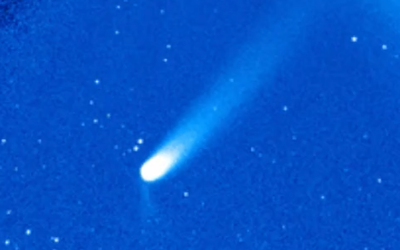
A new study has revealed that an interstellar rocky object is rapidly ejecting water, a phenomenon so intense it’s been compared to a “fire hose running at full blast.”
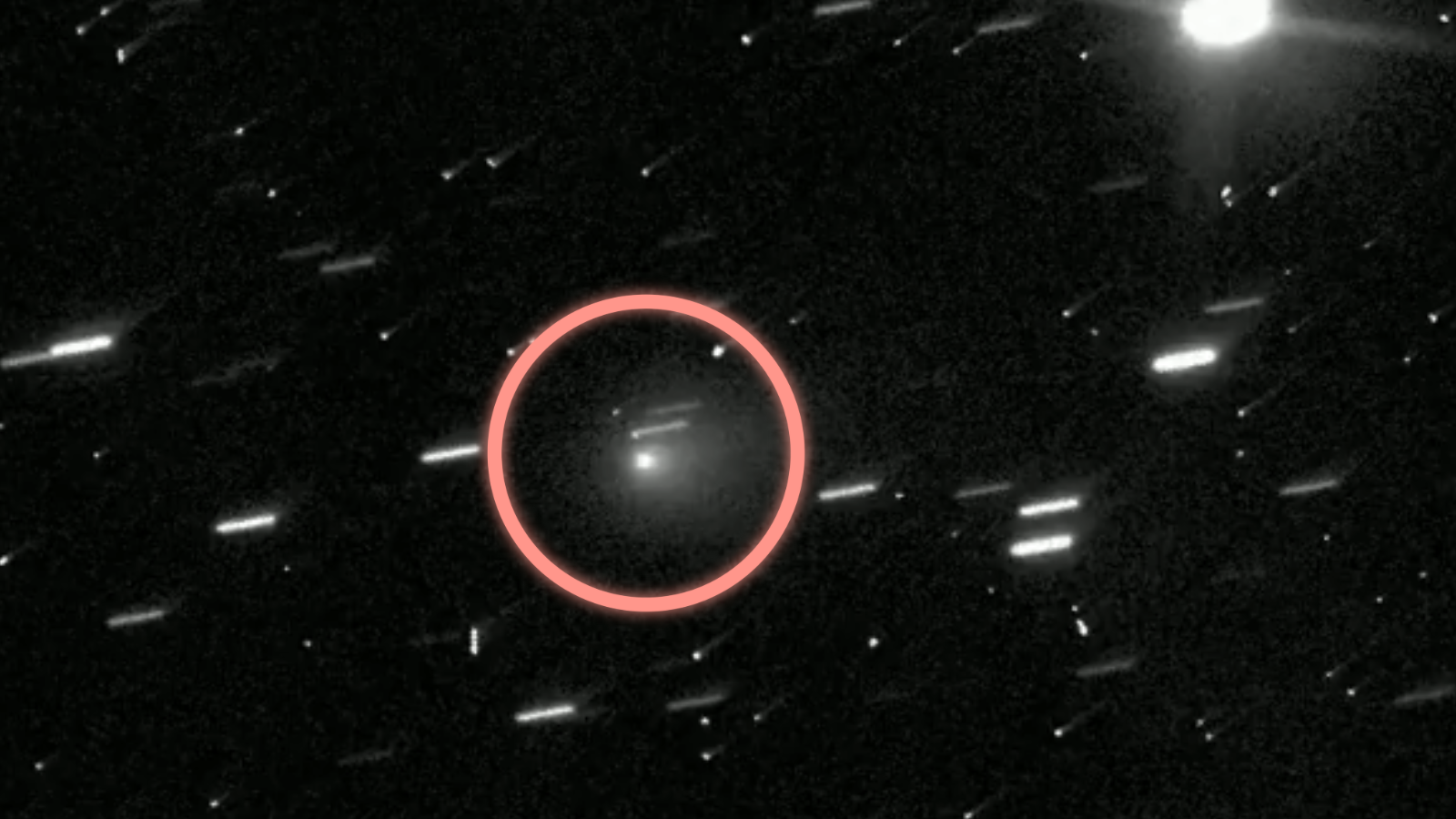
For the first time, scientists have detected the chemical signature of water emanating from an interstellar object, thanks to observations made with NASA’s Neil Gehrels Swift Observatory. This landmark discovery was made on comet 3I/ATLAS, marking only the third known celestial visitor from another star system ever observed traversing our cosmic neighborhood.
Water serves as the critical benchmark in comet science, forming the basis for understanding how solar energy drives a comet’s activity and releases its constituent gases. The discovery of water in an interstellar visitor like 3I/ATLAS provides astronomers with a unique opportunity to directly compare it with comets native to our own solar system, thereby offering a rare window into the chemical makeup of distant planetary systems.
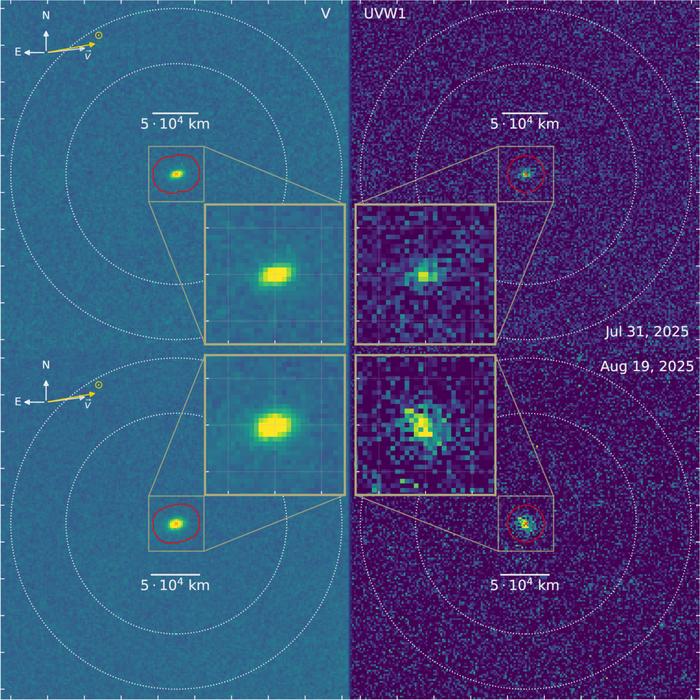
The discovery of water—or its distinct ultraviolet signature, hydroxyl (OH)—on an interstellar comet provides a profound glimpse into other planetary systems, explained Dennis Bodewits, a physics professor at Auburn University and co-author of a recent study. Such a finding, Bodewits emphasized in a statement, suggests that the essential chemical ingredients for life are not exclusive to our own planetary system.
During July and August 2025, astronomers Bodewits and his team conducted observations of 3I/ATLAS using the Swift telescope. At the time of their study, the object was positioned roughly 2.9 times farther from the sun than Earth, a distance notably exceeding the zone where water ice typically undergoes vaporization.
The Swift observatory has reportedly identified a subtle ultraviolet emission emanating from hydroxyl (OH), a chemical byproduct generated when sunlight fragments water molecules. To meticulously isolate this delicate spectral signature, astronomers employed a specialized technique: stacking dozens of brief, three-minute exposures. This comprehensive data collection method combined more than two hours of ultraviolet observations with an additional 40 minutes of visible light data.

A study published September 30 in the Astrophysical Journal Letters has revealed that comet 3I/ATLAS is shedding water at an estimated rate of 40 kilograms per second. This substantial outflow has been likened by researchers to the full-throttle discharge of a fire hose.
Analyzing the outflow rate, the research team estimates that at least 8% of the comet’s surface exhibits activity. This represents a remarkably substantial proportion, significantly surpassing the 3% to 5% typically observed in comets originating from our own solar system, according to the study.
Scientists propose that a comet’s significant activity stems not from its solid surface, but from icy fragments orbiting it. Near-infrared observations, gathered by Gemini South and NASA’s Infrared Telescope Facility, reveal these ice chunks suspended within the coma – the envelope of gas and dust surrounding the nucleus. When exposed to solar radiation, these clumps warm, effectively becoming miniature steam vents that release water vapor. This process unfolds even as the comet’s main surface ice remains too frigid for direct sublimation, researchers explain.
Interstellar comets consistently present astronomers with unexpected characteristics, fundamentally challenging existing theories on how planets and comets form around stars. According to Zexi Xing, a postdoctoral researcher at Auburn University who led a new study, each such discovery forces a reevaluation of established knowledge. Previous observations revealed ‘Oumuamua as remarkably dry and Borisov rich in carbon monoxide. The latest surprise comes from comet ATLAS, detected releasing water at a distance where such emissions were not anticipated.
Though it has since moved beyond the Swift telescope’s observation capabilities, the interstellar object 3I/ATLAS was successfully reacquired in early October by the European Space Agency’s Mars orbiters. At the time of this sighting, the visitor was approximately 30 million kilometers from Mars. The agency has stated its intention to continue tracking 3I/ATLAS and plans to redirect its Jupiter Icy Moons Explorer (JUICE) mission to observe the object starting in November.
The JUICE spacecraft is scheduled to observe the comet shortly after its closest approach to the sun, a phase when the celestial body is predicted to reach its peak activity. This timing is expected to provide JUICE with an optimal vantage point to capture these dynamic events, the agency reported.
Scientists anticipate a significant delay in receiving data from the JUICE mission. With the spacecraft currently positioned on the far side of the sun and transmitting via a slower backup antenna, its observations of comets are not expected to reach Earth until February 2026.